


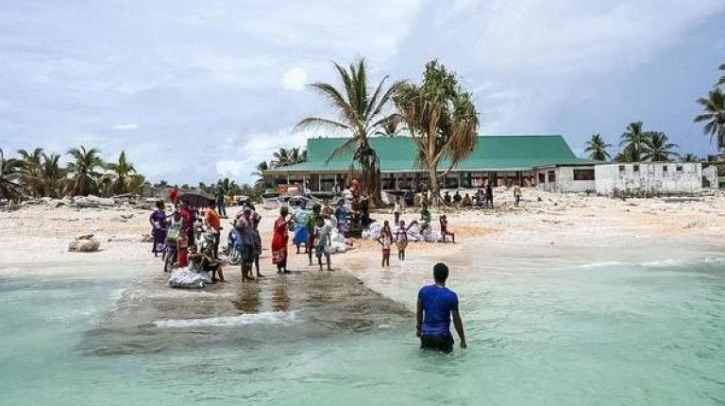
A WMO delegation is participating in the Fourth International Conference on Small Island Developing States (SIDS4) this week to promote the need to accelerate progress in the Early Warnings for All initiative to ensure that every person on Earth is covered by early warning systems, including vulnerable communities worldwide on Small Island Developing States.
The international conference is being held in Antigua and Barbuda on May 27-30 to agree on a new plan of action to build the resilience of small islands in tackling the Early Warnings for All challenges and achieving the Sustainable Development Goals.
“The United Nations stands with you in reaffirming SIDS’s aspirations: to halt and mitigate the terrible impacts of the climate crisis; to build resilient economies; to foster safe, healthy and prosperous societies; to achieve water, food and energy security; to conserve biodiversity; and to protect and sustainably use the ocean and its resources,” said UN secretary-general António Guterres in an opening address on May 27.
The conference in St. Johns takes place ahead of what is forecast to be a very active hurricane season. Just one landfalling hurricane can undermine years of socio-economic development in SIDS.
Ko Barrett, deputy secretary-general of the WMO, said, “SIDS face many challenges exacerbated by climate change. Their limited landmass, fragile ecosystems and often narrow resource bases make them disproportionately vulnerable to the impacts of extreme weather events, rising sea levels and shifting precipitation patterns. These threats not only endanger lives but also jeopardize the very existence of these nations, disrupting economies and displacing communities.
“Early warning systems serve as a lifeline for SIDS, providing timely and accurate information to governments, communities and other stakeholders. These systems play a crucial role in saving lives and mitigating the socio-economic impacts of disasters by facilitating proactive measures such as evacuation plans, resource allocation and infrastructure reinforcement,” added Barrett, who coordinates WMO Early Warnings for All action.
According to the organization, only one-third of SIDS report the existence of early warning systems in their countries.
Scaling up climate finance
The SIDS4 conference brings together world leaders, development agencies, the private sector and civil society to address critical SIDS-specific challenges including the climate crisis, biodiversity loss and spiraling debt.
WMO will host a side event on May 30: ‘Scaling up climate finance support for Early Warnings for All in SIDS’. The UN Office for Disaster Risk Reduction, International Red Cross and Red Crescent Society, and the Caribbean Meteorological Organization are among the panelists.
“Sustained investments in infrastructure, technology, capacity building, and institutional frameworks are required. Moreover, tailored approaches are needed to account for the geographical and climatic diversity within SIDS, ensuring that early warning systems effectively address region-specific hazards,” stated Daniel Kull, WMO director of resource mobilization.
The organization also highlighted that early warning solutions must be localized and integrate traditional and indigenous knowledge, and stated that they need to be accessible, understandable and actionable for the communities they aim to serve – particularly in SIDS where community knowledge and engagement are essential to translate early warning into early action.
As part of the Early Warnings for All initiative, there is a need to enhance the ocean observation network, which is currently in decline in SIDS, according to Rodney Martinez, representative for North America, Central America and the Caribbean, WMO. This impacts on SIDS’s ability to predict extreme weather and climate events and take preventative actions.
Flash Flood Guidance System
‘Empowering SIDS for Resilience: Harnessing data and digital technologies to mitigate flash flood risks – Flash Flood Guidance System’ is the theme of a second side-event on May 30 by WMO in conjunction with USAID.
Flash floods represent significant hazards, resulting in the loss of over 5,000 lives annually and imposing significant social, economic and environmental consequences. Accounting for about 85% of flooding incidents, flash floods have the highest mortality rate among various flooding types, including coastal flooding.
WMO’s Flash Flood Guidance System with global coverage provides operational forecasters and disaster management agencies with real-time informational guidance products on the threat of small-scale flash flooding.
Hwirin Kim, head of the hydrological and water resources division at the WMO, commented, “Since its inception in 2007, the FFGS has been implemented in 73 countries, including 15 SIDS nations, encompassing a population of three billion people. By harnessing diverse data sources such as satellite, radar data, automatic weather stations, numerical weather prediction models, and geographic information systems (GIS), the FFGS equips SIDS countries to provide timely and precise flash flood warnings to vulnerable populations.”
In related news, the WMO’s Regional Association for Africa recently met to address Africa’s challenges in weather-, water- and climate-related issues. Click here to read the full story.