

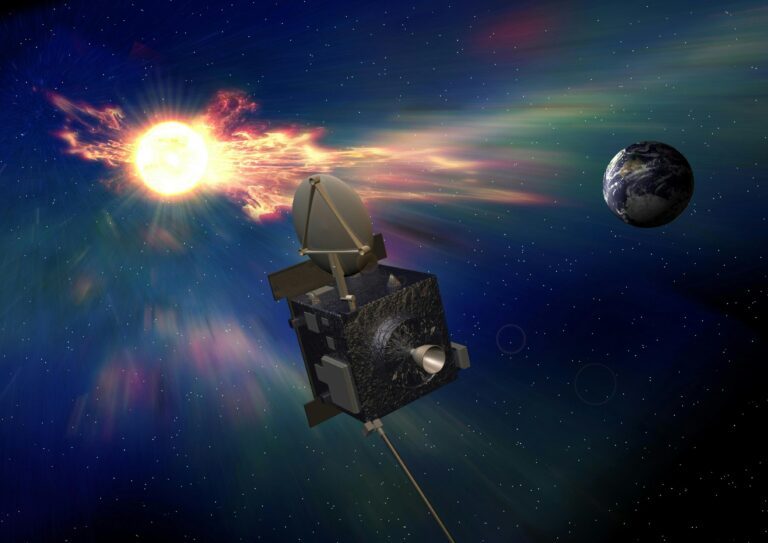
Airbus has been selected by the European Space Agency (ESA) to design and build the space weather forecasting satellite Vigil, the first operational mission in ESA’s Space Situational Awareness (SSA) Space Safety Programme (S2P).
Space weather forecasting satellite Vigil
Vigil will be positioned at Lagrange point L5 on the same orbit as the Earth, 150,000,000km behind it as the Earth orbits the Sun. This will enable Vigil to see the Sun as it rotates, and see the size and speed of solar weather heading toward the Earth. Data from Vigil could provide notice of four to five days of solar winds streaming toward Earth. Vigil, due to be launched in 2031, will be the first ESA spacecraft to be positioned at L5 and is designed to operate in orbit for more than 7.5 years.
Meteorological technology on board
Vigil, which will be built in the UK, will include a compact coronagraph developed by the US Naval Research Laboratory, a heliographic imager from Florence-based Leonardo and a photo-magnetospheric field imager from Germany’s Max Planck Institute. In addition, Vigil will carry a plasma analyzer from the Mullard Space Science Laboratory in London and a magnetometer from Imperial College London. NASA is providing Vigil’s sixth instrument, an extreme ultraviolet (UV) imager.
The spacecraft platform will provide the environment for scientific measurements, including tight magnetic cleanliness and contamination control measures. Being an operational mission, the design of the satellite has to be extremely resilient to ensure the continuous operation of its instruments and high reliability in data transmission for users, especially in case of a major solar event.
Protecting Earth systems against solar storms
The spacecraft will give extra warning to Earth about incoming solar storms and coronal mass ejections, which can potentially disrupt satellites in orbit and electronic and power distribution systems on Earth.
From its particular vantage point, Vigil will complement other satellites monitoring the Sun from closer to the Earth. According to the partners, coronal mass ejections (CMEs) are among the most potentially damaging events from the Sun. These consist of a magnetized plasma containing protons, electrons and other charged particles. For example, in 1989 a major geomagnetic storm struck Earth and caused a nine-hour outage of electricity transmission across Quebec, Canada.
Advance warning of incoming CME will enable power companies and authorities to shut down systems temporarily to protect them from power surges and ensure they can be powered up quickly after the danger has passed. This will avoid longer power outages and major damage to electronic systems used for global positioning and communication services.
Strategic partners
Vigil was selected by ESA in 2022 and is supported by the UK Space Agency and other ESA member states. The UK’s Met Office has a dedicated space weather forecasting department which will use the data from Vigil to offer the world more accurate forecasts.
Patrick Wood, head of space systems UK at Airbus Defence and Space, said, “Vigil is one of the most exciting and important space missions that will not only improve our understanding of the Sun’s behaviour but crucially provide us with earlier warning and greater precision about potentially damaging solar weather. Space weather forecasters will be able to see what is coming from the Sun and provide more accurate alerts.”
Andrew Griffith MP, Minister for Space at the Department for Science, Innovation and Technology, added, “Space weather generates stunning phenomena like the recent displays of the Northern lights over our skies – but it also presents a real risk to our way of life which is increasingly dependent on space and satellite services. The Vigil mission will transform our understanding of the impact of potentially dangerous solar events and I congratulate Airbus here in the UK on taking the lead in this important mission.”
“Vigil will be Europe’s first 24/7 operational space weather satellite, providing valuable time to protect critical infrastructure such as power grids or mobile communication networks on Earth as well as valuable satellites in Earth orbit, including the International Space Station ISS,” commented Josef Aschbacher, director general of ESA. “Vigil will drastically improve both the lead time of space weather warnings as well as their level of detail from its unique vantage point in deep space.”
For more of the top insights into the future of returns, read Meteorological Technology International‘s exclusive feature, “How are experts developing space weather forecasts for geomagnetic storms?” here.