


Close Menu
Meteorological Technology International
  • News
    • A-E
      • Agriculture
      • Automated Weather Stations
      • Aviation
      • Climate Measurement
      • Data
      • Developing Countries
      • Digital Applications
      • Early Warning Systems
      • Extreme Weather
    • G-P
      • Hydrology
      • Lidar
      • Lightning Detection
      • New Appointments
      • Nowcasting
      • Numerical Weather Prediction
      • Polar Weather
    • R-S
      • Radar
      • Rainfall
      • Remote Sensing
      • Renewable Energy
      • Satellites
      • Solar
      • Space Weather
      • Supercomputers
    • T-Z
      • Training
      • Transport
      • Weather Instruments
      • Wind
      • World Meteorological Organization
      • Meteorological Technology World Expo
  • Features
  • Online Magazines
    • January 2026
    • April 2025
    • January 2025
    • September 2024
    • April 2024
    • Archive Issues
    • Subscribe Free!
  • Opinion
  • Videos
  • Supplier Spotlight
  • Expo
LinkedIn X (Twitter) Facebook
  • Sign-up for Free Weekly E-Newsletter
  • Meet the Editors
  • Contact Us
  • Media Pack
LinkedIn Facebook
Subscribe
Meteorological Technology International
  • News
      • Agriculture
      • Automated Weather Stations
      • Aviation
      • Climate Measurement
      • Data
      • Developing Countries
      • Digital Applications
      • Early Warning Systems
      • Extreme Weather
      • Hydrology
      • Lidar
      • Lightning Detection
      • New Appointments
      • Nowcasting
      • Numerical Weather Prediction
      • Polar Weather
      • Radar
      • Rainfall
      • Remote Sensing
      • Renewable Energy
      • Satellites
      • Solar
      • Space Weather
      • Supercomputers
      • Training
      • Transport
      • Weather Instruments
      • Wind
      • World Meteorological Organization
      • Meteorological Technology World Expo
  • Features
  • Online Magazines
    1. January 2026
    2. September 2025
    3. April 2025
    4. January 2025
    5. September 2024
    6. April 2024
    7. January 2024
    8. September 2023
    9. April 2023
    10. Archive Issues
    11. Subscribe Free!
    Featured
    November 27, 2025

    In this Issue – January 2026

    By Hazel KingNovember 27, 2025
    Recent

    In this Issue – January 2026

    November 27, 2025

    In this Issue – September 2025

    August 11, 2025

    In this Issue – April 2025

    April 15, 2025
  • Opinion
  • Videos
  • Supplier Spotlight
  • Expo
Facebook LinkedIn
Subscribe
Meteorological Technology International
Rainfall

KIT develops AI model to improve resolution of precipitation maps

Elizabeth BakerBy Elizabeth BakerJuly 14, 20253 Mins Read
Share LinkedIn Facebook Twitter Email
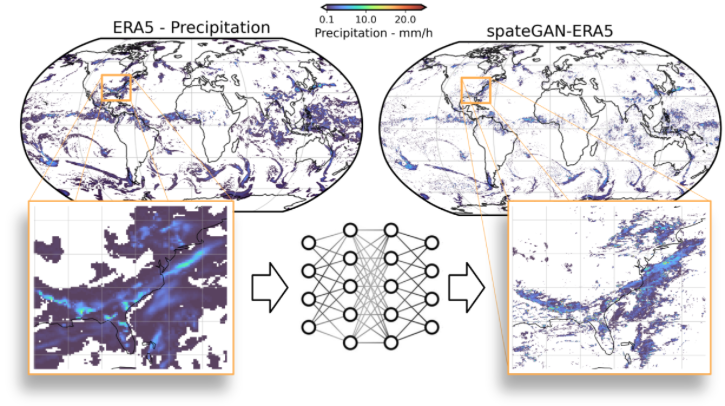
Working from low-resolution global precipitation data, the spateGAN-ERA5 AI model generates high-resolution fields for the analysis of heavy rainfall events.
Credit: Christian Chwala, KIT
Share
LinkedIn Facebook Twitter Email

Researchers at the Karlsruhe Institute of Technology (KIT) have developed a model that uses artificial intelligence (AI) to convert low-resolution global weather data into high-resolution precipitation maps. Their findings have been published in npj Climate and Atmospheric Science.

Combining historical data and AI

“Heavy rainfall and flooding are much more common in many regions of the world than they were just a few decades ago,” said Dr Christian Chwala, an expert on hydrometeorology and machine learning at the Institute of Meteorology and Climate Research (IMK-IFU) on KIT’s Campus Alpin in the German town of Garmisch-Partenkirchen. “But until now, the data needed for reliable regional assessments of such extreme events was missing for many locations.” His research team addressed this problem with a new AI that can generate precise global precipitation maps from low-resolution information. The result is a unique tool for the analysis and assessment of extreme weather, even for regions with poor data coverage, such as the Global South.

For the method, the researchers use historical data from weather models that describe global precipitation at hourly intervals with a spatial resolution of about 24km. Not only was their generative AI model (spateGEN-ERA5) trained with this data, but it also learned (from high-resolution weather radar measurements made in Germany) how precipitation patterns and extreme events correlate at different scales, from coarse to fine.

“Our AI model doesn’t merely create a more sharply focused version of the input data, it generates multiple physically plausible, high-resolution precipitation maps,” said Luca Glawion, one of the researchers at IMK-IFU, who developed the model while working on his doctoral thesis in the SCENIC research project. “Details at a resolution of 2km and 10 minutes become visible. The model also provides information about the statistical uncertainty of the results, which is especially relevant when modeling regionalized heavy rainfall events.” He also noted that validation with weather radar data from the US and Australia showed that the method can be applied to entirely different climatic conditions.

Assessing flood risks worldwide

Due to the method’s global applicability, the researchers hope to offer new possibilities for better assessment of regional climate risks. “It’s the especially vulnerable regions that often lack the resources for detailed weather observations,” said Dr Julius Polz of IMK-IFU, who was also involved in the model’s development. “Our approach will enable us to make much more reliable assessments of where heavy rainfall and floods are likely to occur, even in such regions with poor data coverage.” Not only can the new AI method contribute to disaster control in emergencies, but it can also help with the implementation of more effective long-term preventive measures, such as flood control.

In related news, Will Downs, a PhD student at the University of Miami Rosenstiel School of Marine, Atmospheric and Earth Science, recently created an AI model that identifies and tracks tropical easterly waves that can develop into powerful hurricanes as they travel across the Atlantic Ocean. Click here to read the full story.

Previous ArticleUniversity of Miami researcher develops AI model to track early signs of hurricane formation
Next Article Typhoon disaster knowledge service leverages large language model

Read Similar Stories

Climate Measurement

Study identifies atmospheric trigger behind flash droughts in Puerto Rico

April 15, 20263 Mins Read
Rainfall

New research to improve flash flood warnings in rural Virginia

March 17, 20263 Mins Read
Rainfall

Study identifies atmospheric warning signs for extreme flash flooding

February 5, 20263 Mins Read
Latest News

Northumbria University secures £4m to study Earth’s radiation belts

April 16, 2026

AI model improves real-time prediction of wildfire spread

April 16, 2026

Study identifies atmospheric trigger behind flash droughts in Puerto Rico

April 15, 2026

Receive breaking stories and features in your inbox each week, for free


Enter your email address:


Supplier Spotlights
  • EUMETSAT
Getting in Touch
  • Contact Us / Advertise
  • Meet the Editors
  • Media Pack
  • Free Weekly E-Newsletter
Our Social Channels
  • Facebook
  • LinkedIn
© 2026 UKi Media & Events a division of UKIP Media & Events Ltd
  • Cookie Policy
  • Privacy Policy
  • Terms and Conditions
  • Notice and Takedown Policy

Type above and press Enter to search. Press Esc to cancel.