



Close Menu
Meteorological Technology International
  • News
    • A-E
      • Agriculture
      • Automated Weather Stations
      • Aviation
      • Climate Measurement
      • Data
      • Developing Countries
      • Digital Applications
      • Early Warning Systems
      • Extreme Weather
    • G-P
      • Hydrology
      • Lidar
      • Lightning Detection
      • New Appointments
      • Nowcasting
      • Numerical Weather Prediction
      • Polar Weather
    • R-S
      • Radar
      • Rainfall
      • Remote Sensing
      • Renewable Energy
      • Satellites
      • Solar
      • Space Weather
      • Supercomputers
    • T-Z
      • Training
      • Transport
      • Weather Instruments
      • Wind
      • World Meteorological Organization
      • Meteorological Technology World Expo
  • Features
  • Online Magazines
    • January 2026
    • April 2025
    • January 2025
    • September 2024
    • April 2024
    • Archive Issues
    • Subscribe Free!
  • Opinion
  • Videos
  • Supplier Spotlight
  • Expo
LinkedIn X (Twitter) Facebook
  • Sign-up for Free Weekly E-Newsletter
  • Meet the Editors
  • Contact Us
  • Media Pack
LinkedIn Facebook
Subscribe
Meteorological Technology International
  • News
      • Agriculture
      • Automated Weather Stations
      • Aviation
      • Climate Measurement
      • Data
      • Developing Countries
      • Digital Applications
      • Early Warning Systems
      • Extreme Weather
      • Hydrology
      • Lidar
      • Lightning Detection
      • New Appointments
      • Nowcasting
      • Numerical Weather Prediction
      • Polar Weather
      • Radar
      • Rainfall
      • Remote Sensing
      • Renewable Energy
      • Satellites
      • Solar
      • Space Weather
      • Supercomputers
      • Training
      • Transport
      • Weather Instruments
      • Wind
      • World Meteorological Organization
      • Meteorological Technology World Expo
  • Features
  • Online Magazines
    1. January 2026
    2. September 2025
    3. April 2025
    4. January 2025
    5. September 2024
    6. April 2024
    7. January 2024
    8. September 2023
    9. April 2023
    10. Archive Issues
    11. Subscribe Free!
    Featured
    November 27, 2025

    In this Issue – January 2026

    By Hazel KingNovember 27, 2025
    Recent

    In this Issue – January 2026

    November 27, 2025

    In this Issue – September 2025

    August 11, 2025

    In this Issue – April 2025

    April 15, 2025
  • Opinion
  • Videos
  • Supplier Spotlight
  • Expo
Facebook LinkedIn
Subscribe
Meteorological Technology International
Extreme Weather

Typhoon disaster knowledge service leverages large language model

Elizabeth BakerBy Elizabeth BakerJuly 15, 20253 Mins Read
Share LinkedIn Facebook Twitter Email
A tornado from space swirls over the sea.
Elements of this image furnished by NASA
Share
LinkedIn Facebook Twitter Email

A team of researchers has published a study, named Typhoon Disaster Knowledge Service Driven by Large Language Models: Key Technologies and Applications, which introduces a framework for typhoon disaster knowledge services, comprising three interconnected layers: data, knowledge and service. According to the researchers, this study highlights the transformative potential of large language models (LLMs) in typhoon disaster management, and lays a foundation for integrating LLMs with geospatial technologies.
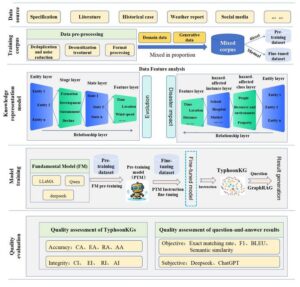
Typhoon disaster knowledge service leverages large language model.
Technical route for constructing a typhoon disaster knowledge graph by LLMs. Credit: CC BY Beijing Zhongke Journal Publishing Co. Ltd

This study was led by researchers Yi Huang and Yongqi Xia, who are both from the School of Internet of Things at Nanjing University of Posts and Telecommunications. Researchers Xueying Zhang and Yehua Sheng, both from the Key Laboratory of Virtual Geographic Environment at Nanjing Normal University, Ministry of Education, and researcher Peng Ye from the Urban Planning and Development Institute of Yangzhou University, also supported the study.

Creating the technology

At the data-to-knowledge layer, this study proposes an LLM-driven automated method for constructing typhoon disaster knowledge graphs (KGs). This method employed a ‘pre-training + fine-tuning’ paradigm to transform unstructured textual data into a structured knowledge representation. A specialized training dataset was then curated, incorporating typhoon-related texts with explicit temporal and spatial attributes. The resulting KG integrated 7,221 nodes, 52 edges and 5,776 triplets, which captured spatiotemporal dynamics and disaster impact mechanisms.

The aforementioned structured knowledge formed a foundation for the subsequent service layer, where an LLM-based intelligent question-answering system was developed. Using graph retrieval-augmented generation (GraphRAG), the system has been designed to retrieve contextually relevant knowledge from the KG and generate user-specific guidance, such as evacuation plans and resource allocation strategies.

Informing early warnings

The authors aimed to demonstrate the effectiveness of this system through experiments, which reportedly achieved high accuracy in concept, entity, attribute and relation extraction. Such a knowledge-to-service layer is intended to ensure seamless conversion of structured knowledge into practical services, such as personalized evacuation plans and resource allocation strategies.

In related news, Dr Xiaowei Tan from the China Meteorological Administration (CMA) Earth System Modeling and Prediction Centre and her colleagues recently published a paper titled Typhoon Kompasu (2118) simulation with planetary boundary layer and cloud physics parameterization improvements in Atmospheric and Oceanic Science Letters. Their study introduces a new parameterization scheme for friction velocity at the ocean surface and a two-moment cloud microphysics parameterization scheme into the CMA-TYM operational model, replacing the original schemes. Read the full story here

Previous ArticleKIT develops AI model to improve resolution of precipitation maps
Next Article Trump cuts US$3m in funding from New York’s weather tracking system

Read Similar Stories

Extreme Weather

AI model improves real-time prediction of wildfire spread

April 16, 20263 Mins Read
Climate Measurement

Study identifies atmospheric trigger behind flash droughts in Puerto Rico

April 15, 20263 Mins Read
Climate Measurement

Regional training aims to improve flood forecasting in Central Africa

April 1, 20263 Mins Read
Latest News

Northumbria University secures £4m to study Earth’s radiation belts

April 16, 2026

AI model improves real-time prediction of wildfire spread

April 16, 2026

Study identifies atmospheric trigger behind flash droughts in Puerto Rico

April 15, 2026

Receive breaking stories and features in your inbox each week, for free


Enter your email address:


Supplier Spotlights
  • Reuniwatt
Getting in Touch
  • Contact Us / Advertise
  • Meet the Editors
  • Media Pack
  • Free Weekly E-Newsletter
Our Social Channels
  • Facebook
  • LinkedIn
© 2026 UKi Media & Events a division of UKIP Media & Events Ltd
  • Cookie Policy
  • Privacy Policy
  • Terms and Conditions
  • Notice and Takedown Policy

Type above and press Enter to search. Press Esc to cancel.