



Close Menu
Meteorological Technology International
  • News
    • A-E
      • Agriculture
      • Automated Weather Stations
      • Aviation
      • Climate Measurement
      • Data
      • Developing Countries
      • Digital Applications
      • Early Warning Systems
      • Extreme Weather
    • G-P
      • Hydrology
      • Lidar
      • Lightning Detection
      • New Appointments
      • Nowcasting
      • Numerical Weather Prediction
      • Polar Weather
    • R-S
      • Radar
      • Rainfall
      • Remote Sensing
      • Renewable Energy
      • Satellites
      • Solar
      • Space Weather
      • Supercomputers
    • T-Z
      • Training
      • Transport
      • Weather Instruments
      • Wind
      • World Meteorological Organization
      • Meteorological Technology World Expo
  • Features
  • Online Magazines
    • January 2026
    • April 2025
    • January 2025
    • September 2024
    • April 2024
    • Archive Issues
    • Subscribe Free!
  • Opinion
  • Videos
  • Supplier Spotlight
  • Expo
LinkedIn X (Twitter) Facebook
  • Sign-up for Free Weekly E-Newsletter
  • Meet the Editors
  • Contact Us
  • Media Pack
LinkedIn Facebook
Subscribe
Meteorological Technology International
  • News
      • Agriculture
      • Automated Weather Stations
      • Aviation
      • Climate Measurement
      • Data
      • Developing Countries
      • Digital Applications
      • Early Warning Systems
      • Extreme Weather
      • Hydrology
      • Lidar
      • Lightning Detection
      • New Appointments
      • Nowcasting
      • Numerical Weather Prediction
      • Polar Weather
      • Radar
      • Rainfall
      • Remote Sensing
      • Renewable Energy
      • Satellites
      • Solar
      • Space Weather
      • Supercomputers
      • Training
      • Transport
      • Weather Instruments
      • Wind
      • World Meteorological Organization
      • Meteorological Technology World Expo
  • Features
  • Online Magazines
    1. January 2026
    2. September 2025
    3. April 2025
    4. January 2025
    5. September 2024
    6. April 2024
    7. January 2024
    8. September 2023
    9. April 2023
    10. Archive Issues
    11. Subscribe Free!
    Featured
    November 27, 2025

    In this Issue – January 2026

    By Hazel KingNovember 27, 2025
    Recent

    In this Issue – January 2026

    November 27, 2025

    In this Issue – September 2025

    August 11, 2025

    In this Issue – April 2025

    April 15, 2025
  • Opinion
  • Videos
  • Supplier Spotlight
  • Expo
Facebook LinkedIn
Subscribe
Meteorological Technology International
Extreme Weather

China Meteorological Administration improves typhoon intensity predictions

Elizabeth BakerBy Elizabeth BakerMarch 5, 20252 Mins Read
Share LinkedIn Facebook Twitter Email
Dr Xiaowei Tan from the China Meteorological Administration (CMA) Earth System Modeling and Prediction Centre, China, and her colleagues, have recently published a paper entitled "Typhoon Kompasu (2118) simulation with planetary boundary layer and cloud physics parameterization improvements" in Atmospheric and Oceanic Science Letters.
Share
LinkedIn Facebook Twitter Email

Dr Xiaowei Tan from the China Meteorological Administration (CMA) Earth System Modeling and Prediction Centre and her colleagues have recently published a paper titled Typhoon Kompasu (2118) simulation with planetary boundary layer and cloud physics parameterization improvements in Atmospheric and Oceanic Science Letters. Their study introduces a new parameterization scheme for friction velocity at the ocean surface and a two-moment cloud microphysics parameterization scheme into the CMA-TYM operational model, replacing the original schemes.

Analyzing current extreme tropical cyclone methodology

When publishing the report, the researchers highlighted the importance of continuously improving numerical models and their capacity to forecast typhoon tracks and intensities.

They also assert that while the accuracy of typhoon track forecasts using numerical models has gradually improved since 1990, the improvement in intensity forecasts has been slow.

Advantages of new parameterization schemes
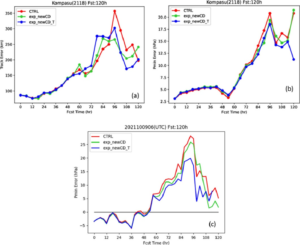
Both parameterization schemes have a significant positive impact on the track and intensity predictions of Typhoon Kompasu (2118) after 60 hours of model integration. Credit: Xiaowei Tan

According to the research team, the statistical results show that both parameterization schemes improve the predictions of Typhoon Kompasu’s track and intensity. Additional analysis revealed that these two schemes affect the timing and magnitude of extreme tropical cyclone intensity values by influencing the evolution of the tropical cyclone’s warm-core structure.

Moreover, this study also suggests a novel approach for evaluating tropical cyclone forecasting capabilities by incorporating the error in the timing of peak intensity into model verification.  This comprehensive evaluation method could provide valuable insights, the researchers says, aiding in the further refinement of numerical models and ultimately enhancing the ability to predict and respond to typhoons more effectively.

In related news, the School of Atmospheric Sciences at Nanjing University, China, and the Earth System Numerical Prediction Center of the CMA have recently published a paper that posits that AI could replace numerical weather models. Click here to read the full story.

Previous ArticleAustralian Bureau of Meteorology CEO to step down in September 2025
Next Article AI has ‘great potential’ for detecting wildfires, Universidade Federal do Amazonas finds

Read Similar Stories

Extreme Weather

AI model improves real-time prediction of wildfire spread

April 16, 20263 Mins Read
Climate Measurement

Study identifies atmospheric trigger behind flash droughts in Puerto Rico

April 15, 20263 Mins Read
Climate Measurement

China inaugurates 27th national climate observatory in Hebei

April 9, 20262 Mins Read
Latest News

Northumbria University secures £4m to study Earth’s radiation belts

April 16, 2026

AI model improves real-time prediction of wildfire spread

April 16, 2026

Study identifies atmospheric trigger behind flash droughts in Puerto Rico

April 15, 2026

Receive breaking stories and features in your inbox each week, for free


Enter your email address:


Supplier Spotlights
  • ZOGLAB Microsystem Co., Ltd
Getting in Touch
  • Contact Us / Advertise
  • Meet the Editors
  • Media Pack
  • Free Weekly E-Newsletter
Our Social Channels
  • Facebook
  • LinkedIn
© 2026 UKi Media & Events a division of UKIP Media & Events Ltd
  • Cookie Policy
  • Privacy Policy
  • Terms and Conditions
  • Notice and Takedown Policy

Type above and press Enter to search. Press Esc to cancel.