


Close Menu
Meteorological Technology International
  • News
    • A-E
      • Agriculture
      • Automated Weather Stations
      • Aviation
      • Climate Measurement
      • Data
      • Developing Countries
      • Digital Applications
      • Early Warning Systems
      • Extreme Weather
    • G-P
      • Hydrology
      • Lidar
      • Lightning Detection
      • New Appointments
      • Nowcasting
      • Numerical Weather Prediction
      • Polar Weather
    • R-S
      • Radar
      • Rainfall
      • Remote Sensing
      • Renewable Energy
      • Satellites
      • Solar
      • Space Weather
      • Supercomputers
    • T-Z
      • Training
      • Transport
      • Weather Instruments
      • Wind
      • World Meteorological Organization
      • Meteorological Technology World Expo
  • Features
  • Online Magazines
    • January 2026
    • April 2025
    • January 2025
    • September 2024
    • April 2024
    • Archive Issues
    • Subscribe Free!
  • Opinion
  • Videos
  • Supplier Spotlight
  • Expo
LinkedIn X (Twitter) Facebook
  • Sign-up for Free Weekly E-Newsletter
  • Meet the Editors
  • Contact Us
  • Media Pack
LinkedIn Facebook
Subscribe
Meteorological Technology International
  • News
      • Agriculture
      • Automated Weather Stations
      • Aviation
      • Climate Measurement
      • Data
      • Developing Countries
      • Digital Applications
      • Early Warning Systems
      • Extreme Weather
      • Hydrology
      • Lidar
      • Lightning Detection
      • New Appointments
      • Nowcasting
      • Numerical Weather Prediction
      • Polar Weather
      • Radar
      • Rainfall
      • Remote Sensing
      • Renewable Energy
      • Satellites
      • Solar
      • Space Weather
      • Supercomputers
      • Training
      • Transport
      • Weather Instruments
      • Wind
      • World Meteorological Organization
      • Meteorological Technology World Expo
  • Features
  • Online Magazines
    1. January 2026
    2. September 2025
    3. April 2025
    4. January 2025
    5. September 2024
    6. April 2024
    7. January 2024
    8. September 2023
    9. April 2023
    10. Archive Issues
    11. Subscribe Free!
    Featured
    November 27, 2025

    In this Issue – January 2026

    By Hazel KingNovember 27, 2025
    Recent

    In this Issue – January 2026

    November 27, 2025

    In this Issue – September 2025

    August 11, 2025

    In this Issue – April 2025

    April 15, 2025
  • Opinion
  • Videos
  • Supplier Spotlight
  • Expo
Facebook LinkedIn
Subscribe
Meteorological Technology International
Rainfall

New research to improve flash flood warnings in rural Virginia

Hazel KingBy Hazel KingMarch 17, 20263 Mins Read
Share LinkedIn Facebook Twitter Email
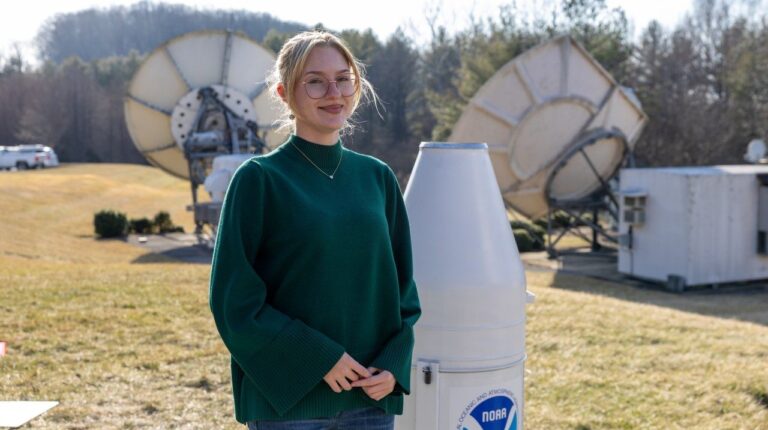
McKenzie Tate, student at Virginia Tech, with a NOAA rain gauge.
Share
LinkedIn Facebook Twitter Email

A student on Virginia Tech’s meteorology program is working on a project to improve high-impact flash flood warnings in rural Virginia by studying the density of current National Oceanic and Atmospheric Administration (NOAA) rain gauges.

Over the past four years, the region has experienced multiple high-impact flooding events that caused widespread damage and loss of life. However, the defining steep terrain in Appalachia complicates how rainfall is measured and monitored as the NOAA rain gauges have strict placement requirements. They need open, flat land with no nearby trees, which is difficult in a region where there are mountains, valleys and forests.

“There are very few NOAA rain gauges in the region,” said student McKenzie Tate. “For example, we estimated that Grundy, Virginia, is about 60km [37 miles] from the nearest NOAA rain gauge. What’s happening 60km away could be very different from what’s happening in a specific town surrounded by complex terrain.”

The Virginia Tech team evaluated how well radar-based precipitation estimates perform in this complex landscape. During major storms, the National Weather Service relies heavily on radar-driven rainfall estimates. But in mountainous areas, radar beams can be partially blocked or distorted by terrain, increasing the likelihood of error, particularly in communities located far from radar sites.

By comparing national rain gauge records with NEXRAD radar data and multi-radar multi-sensor (MRMS) estimates, the researchers found that results are highly sensitive to the availability of ground-based observations. With fewer gauges available to correct radar-only estimates, errors can become more pronounced during short-duration, high-intensity storms, the type most likely to trigger flash flooding.

“In one case, we noticed a ‘blue bubble’ of lower precipitation around a station, surrounded by higher precipitation estimates,” said Tate. “That suggested the density of stations affects how MRMS integrates observational data. MRMS uses radar and assimilates ground observations together. With fewer stations, the system has less ground data to refine its estimates, leading to generalization in areas farther from gauges.”

The findings highlight a broader challenge: areas that are already vulnerable to flooding often have limited monitoring infrastructure. Expanding ground-based observation networks across Appalachia could improve rainfall estimates, strengthen warning systems, and help protect communities facing increasingly extreme precipitation events.

When doing background research for the study, Tate read in a 2011 study that the central southern Appalachian region experiences some of the highest six-hour precipitation rates in the world. “That makes it even more important to improve forecasting and communication,” Tate added.

Tate is working on the project with Craig Ramseyer, associate professor in the Department of Geography, who said, “McKenzie’s research quantifies the spatial data inequity problems in far Southwest Virginia, specifically analyzing high temporal resolution rain gauges.

“These rain gauges are critically important for flood detection and measurement and yet, are sparsely available to forecasters, making floods in the region hard to diagnose in real time.

“McKenzie’s research serves as a critical building block for future funding proposals to install rain gauges in the towns and cities in Appalachia that are most in need of data for flood detection.”

Related news, Chongqing expands AI-powered weather services to improve warning times.

Previous ArticleFirst Africa climate-health desk launched
Next Article EXCLUSIVE INTERVIEW: Chris Hyde, energy lead at Meteomatics

Read Similar Stories

Extreme Weather

AI model improves real-time prediction of wildfire spread

April 16, 20263 Mins Read
Climate Measurement

Study identifies atmospheric trigger behind flash droughts in Puerto Rico

April 15, 20263 Mins Read
Climate Measurement

Regional training aims to improve flood forecasting in Central Africa

April 1, 20263 Mins Read
Latest News

Northumbria University secures £4m to study Earth’s radiation belts

April 16, 2026

AI model improves real-time prediction of wildfire spread

April 16, 2026

Study identifies atmospheric trigger behind flash droughts in Puerto Rico

April 15, 2026

Receive breaking stories and features in your inbox each week, for free


Enter your email address:


Supplier Spotlights
  • AIRMAR Technology Corporation
Getting in Touch
  • Contact Us / Advertise
  • Meet the Editors
  • Media Pack
  • Free Weekly E-Newsletter
Our Social Channels
  • Facebook
  • LinkedIn
© 2026 UKi Media & Events a division of UKIP Media & Events Ltd
  • Cookie Policy
  • Privacy Policy
  • Terms and Conditions
  • Notice and Takedown Policy

Type above and press Enter to search. Press Esc to cancel.