


An international team of astronomers, including Trottier Institute for Research on Exoplanets (IREx) and Université de Montréal members Joost Wardenier and Romain Allart, have mapped the 3D structure of the atmosphere of a planet beyond the solar system for the first time.
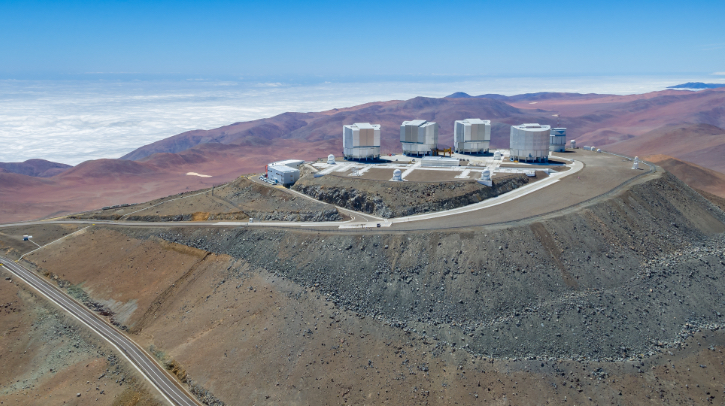
By combining all four telescope units of the European Southern Observatory’s very large telescope (VLT), the team found powerful winds carrying chemical elements like iron and titanium, creating intricate weather patterns across the planet’s atmosphere. The discovery “opens the door for detailed studies of the chemical make-up and weather of other alien worlds,” according to IREx.
“This planet’s atmosphere behaves in ways that challenge our understanding of how weather works – not just on Earth, but on all planets. It feels like something out of science fiction,” said Julia Victoria Seidel, a researcher at the European Southern Observatory (ESO) in Chile and lead author of the study, published in Nature.
The planet, WASP-121b (also known as Tylos), is approximately 900 light-years away in the constellation Puppis. It’s an ultra-hot Jupiter, a gas giant orbiting its host star so closely that a year there lasts only about 30 Earth hours. Moreover, one side of the planet is scorching, as it is always facing the star, while the other side is much cooler.
The team has now probed deep inside Tylos’s atmosphere and revealed distinct winds in separate layers, forming a map of the atmosphere’s 3D structure. According to the team, it’s the first time astronomers have been able to study the atmosphere of a planet outside our solar system in such depth and detail.
A climate never before observed on any other planet
“What we found was surprising: a jet stream rotates material around the planet’s equator, while a separate flow at lower levels of the atmosphere moves gas from the hot side to the cooler side. This kind of climate has never been seen before on any planet,” added Seidel, who is also a researcher at the Lagrange Laboratory, part of the Observatoire de la Côte d’Azur, in France.
The observed jet stream spans half of the planet, gaining speed and violently churning the atmosphere high up in the sky as it crosses the hot side of Tylos. “Even the strongest hurricanes in the Solar System seem calm in comparison,” she noted.
Joost Wardenier, a postdoctoral researcher at IREx-member institution Université de Montréal who contributed to the interpretation of the data with 3D atmospheric models of the planet, commented, “The most powerful instrument of its kind, ESPRESSO [Echelle SPectrograph for Rocky Exoplanets and Stable Spectroscopic Observations] on VLT, has provided us with a unique glimpse of the 3D wind profile of WASP-121b. It is a spectacular observation that gives us key insights into the extreme climate of ultra-hot gas giants.”
To uncover the 3D structure of the exoplanet’s atmosphere, the team had to combine the light of the four large telescope units of ESO’s VLT into a single signal. This combined mode of the VLT collects four times as much light as an individual telescope unit, revealing fainter details. By observing the planet for one full transit in front of its host star, ESPRESSO was able to detect signatures of multiple chemical elements, probing different layers of the atmosphere as a result.
“The VLT enabled us to probe three different layers of the exoplanet’s atmosphere in one fell swoop,” stated study co-author Leonardo A. dos Santos, an assistant astronomer at the Space Telescope Science Institute in Baltimore, Maryland. The team tracked the movements of iron, sodium and hydrogen, which enabled them to trace winds in the deep, mid and shallow layers of the planet’s atmosphere, respectively.
“It’s the kind of observation that is very challenging to do with space telescopes, highlighting the importance of ground-based observations of exoplanets,” he said.
Well-hidden titanium
The observations also revealed the presence of titanium just below the jet stream, as highlighted in a companion study published in Astronomy and Astrophysics. The team highlighted that this was another surprise since previous observations of the planet had shown this element to be absent, possibly because it’s hidden deep in the atmosphere.
“It’s truly mind-blowing that we’re able to study details like the chemical make-up and weather patterns of a planet at such a vast distance,” said Bibiana Prinoth, a PhD student at Lund University, Sweden, and ESO, who led the companion study and is a co-author of the Nature paper.
To uncover the atmosphere of smaller, Earth-like planets, though, larger telescopes will be needed. They will include ESO’s extremely large telescope (ELT), which is currently under construction in Chile’s Atacama Desert.
IREx researcher Romain Allart, who contributed to securing, analysing and interpreting the data, saod, “The level of detail we achieved on the dynamic of Tylos is mind-blowing but only possible due to ESPRESSO’s unique capability to collect photons from the largest optical telescope. Yet, it is only a glimpse of what we will be able to do with ELT in the next decade. What an exciting time for astronomy!”
In related news, NASA’s Nancy Grace Roman Space Telescope team recently integrated the mission’s deployable aperture cover – a visor-like sunshade that will help prevent unwanted light from entering the telescope – to the outer barrel assembly (‘exoskeleton’), another structure that is designed to shield the telescope from stray light and keep it at a stable temperature. Click here to read the full story.