


Close Menu
Meteorological Technology International
  • News
    • A-E
      • Agriculture
      • Automated Weather Stations
      • Aviation
      • Climate Measurement
      • Data
      • Developing Countries
      • Digital Applications
      • Early Warning Systems
      • Extreme Weather
    • G-P
      • Hydrology
      • Lidar
      • Lightning Detection
      • New Appointments
      • Nowcasting
      • Numerical Weather Prediction
      • Polar Weather
    • R-S
      • Radar
      • Rainfall
      • Remote Sensing
      • Renewable Energy
      • Satellites
      • Solar
      • Space Weather
      • Supercomputers
    • T-Z
      • Training
      • Transport
      • Weather Instruments
      • Wind
      • World Meteorological Organization
      • Meteorological Technology World Expo
  • Features
  • Online Magazines
    • January 2026
    • April 2025
    • January 2025
    • September 2024
    • April 2024
    • Archive Issues
    • Subscribe Free!
  • Opinion
  • Videos
  • Supplier Spotlight
  • Expo
LinkedIn X (Twitter) Facebook
  • Sign-up for Free Weekly E-Newsletter
  • Meet the Editors
  • Contact Us
  • Media Pack
LinkedIn Facebook
Subscribe
Meteorological Technology International
  • News
      • Agriculture
      • Automated Weather Stations
      • Aviation
      • Climate Measurement
      • Data
      • Developing Countries
      • Digital Applications
      • Early Warning Systems
      • Extreme Weather
      • Hydrology
      • Lidar
      • Lightning Detection
      • New Appointments
      • Nowcasting
      • Numerical Weather Prediction
      • Polar Weather
      • Radar
      • Rainfall
      • Remote Sensing
      • Renewable Energy
      • Satellites
      • Solar
      • Space Weather
      • Supercomputers
      • Training
      • Transport
      • Weather Instruments
      • Wind
      • World Meteorological Organization
      • Meteorological Technology World Expo
  • Features
  • Online Magazines
    1. January 2026
    2. September 2025
    3. April 2025
    4. January 2025
    5. September 2024
    6. April 2024
    7. January 2024
    8. September 2023
    9. April 2023
    10. Archive Issues
    11. Subscribe Free!
    Featured
    November 27, 2025

    In this Issue – January 2026

    By Hazel KingNovember 27, 2025
    Recent

    In this Issue – January 2026

    November 27, 2025

    In this Issue – September 2025

    August 11, 2025

    In this Issue – April 2025

    April 15, 2025
  • Opinion
  • Videos
  • Supplier Spotlight
  • Expo
Facebook LinkedIn
Subscribe
Meteorological Technology International
Data

NASA joins sunshade to Roman Observatory’s ‘exoskeleton’

Elizabeth BakerBy Elizabeth BakerFebruary 19, 20254 Mins Read
Share LinkedIn Facebook Twitter Email
NASA’s Nancy Grace Roman Space Telescope team has integrated the mission’s deployable aperture cover – a visor-like sunshade that will help prevent unwanted light from entering the telescope – to the outer barrel assembly, another structure designed to shield the telescope from stray light in addition to keeping it at a stable temperature.
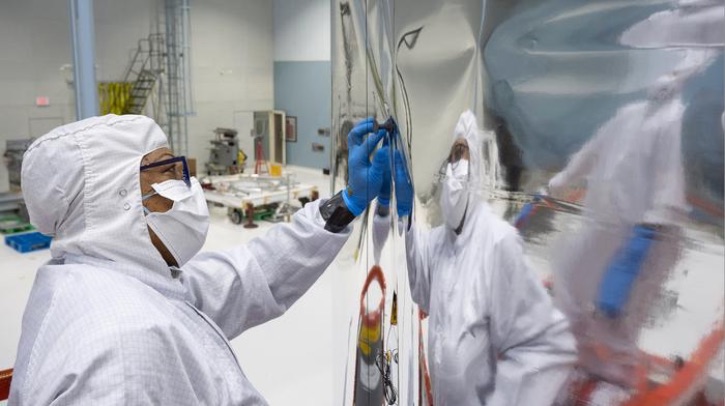
In this photo, technician Brenda Estavia is installing the innermost layer of the sunshade onto the deployable aperture cover structure of NASA’s Nancy Grace Roman Space Telescope. Credit: NASA/Jolearra Tshiteya
Share
LinkedIn Facebook Twitter Email

NASA’s Nancy Grace Roman Space Telescope team has integrated the mission’s deployable aperture cover – a visor-like sunshade that will help prevent unwanted light from entering the telescope – to the outer barrel assembly (‘exoskeleton’), another structure designed to shield the telescope from stray light in addition to keeping it at a stable temperature.

“It’s been incredible to see these major components go from computer models to building and now integrating them,” said Sheri Thorn, an aerospace engineer working on Roman’s sunshade at NASA’s Goddard Space Flight Center in Greenbelt, Maryland. “Since it’s all coming together at Goddard, we get a front-row seat to the process. We’ve seen it mature, kind of like watching a child grow up, and it’s a really gratifying experience.”
Credit: NASA/Chris Gunn

Increasing accuracy and sensitivity

According to NASA, the sunshade functions like a heavy-duty version of blackout curtains you might use to keep your room extra dark. It is intended to make the telescope more sensitive to faint light from across the universe, helping astronomers see dimmer and farther objects. Made of two layers of reinforced thermal blankets, the sunshade is designed to remain folded during launch and deploy after Roman is in space. Three booms will spring upward when triggered electronically, raising the sunshade like a page in a pop-up book.

The sunshade blanket has an inner and outer layer separated by about an inch, much like a double-paned window. “We’re prepared for micrometeoroid impacts that could occur in space, so the blanket is heavily fortified,” said Brian Simpson, Roman’s deployable aperture cover lead at NASA Goddard.

“One layer is even reinforced with Kevlar, the same thing that lines bulletproof vests. By placing some space in between the layers we reduce the risk that light would leak in because it’s unlikely that the light would pass through both layers at the exact same points where the holes were.”

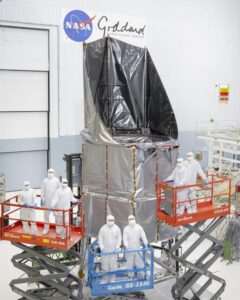
Over the course of a few hours, technicians meticulously joined the sunshade to the outer barrel assembly – both Goddard-designed components – in the largest clean room at NASA Goddard. The outer barrel assembly will help keep the telescope at a stable temperature and, like the sunshade, help shield the telescope from stray light and micrometeoroid impacts. It’s fitted with heaters to help ensure the telescope’s mirrors won’t experience wide temperature swings, which make materials expand and contract.

“Roman is made up of a lot of separate components that come together after years of design and fabrication,” said Laurence Madison, a mechanical engineer at NASA Goddard. “The deployable aperture cover and outer barrel assembly were built at the same time, and up until the integration, the two teams mainly used reference drawings to make sure everything would fit together as they should. So the successful integration was both a proud moment and a relief!”

Both the sunshade and outer barrel assembly have been extensively tested individually, but now that they’re connected engineers are assessing them again. Following the integration, the team tested the sunshade deployment.

“Since the sunshade was designed to deploy in space, the system isn’t actually strong enough to deploy itself in Earth’s gravity,” said Matthew Neuman, a mechanical engineer working on Roman’s sunshade at NASA Goddard. “So we used a gravity negation system to offset its weight and verified that everything works as expected.”
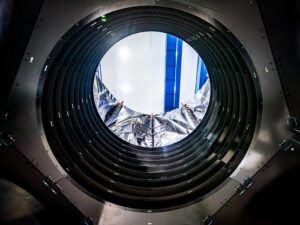
This photo shows the deployable aperture cover for NASA’s Nancy Grace Roman Space Telescope as seen through the outer barrel assembly. Both components will help shield the telescope from stray light, improving Roman’s sensitivity to faint light from across the universe. Credit: NASA/Chris Gunn

Next steps

The components will now undergo thermal vacuum testing together to ensure they will function as planned in the temperature and pressure environment of space. Then they’ll move to a shake test to assess their performance during the extreme vibrations they’ll experience during launch.

Technicians will join Roman’s solar panels to the outer barrel assembly and sunshade this spring, and then integrate them with the rest of the observatory by the end of the year.

The mission has now passed a milestone called Key Decision Point-D, marking the official transition from the fabrication stage that culminated in the delivery of major components to the phase involving assembly, integration, testing and launch. The Roman observatory remains on track for completion by the autumn of 2026 and launch no later than May 2027.

In related news, researchers from Northern Arizona University (NAU) have used NASA’s spaceborne lidar to discover that ladder fuels may be the most important factor in predicting wildfire severity even in extreme conditions. Click here to read the full story.

Previous ArticleSatellites can provide warnings for volcanic eruption and tsunamis, Penn State discovers
Next Article Green Climate Fund invests US$103m in early warning systems for vulnerable countries

Read Similar Stories

Space Weather

Northumbria University secures £4m to study Earth’s radiation belts

April 16, 20262 Mins Read
Extreme Weather

AI model improves real-time prediction of wildfire spread

April 16, 20263 Mins Read
Satellites

AI tool uses weather satellite data to map ocean currents in near real time

April 14, 20263 Mins Read
Latest News

Northumbria University secures £4m to study Earth’s radiation belts

April 16, 2026

AI model improves real-time prediction of wildfire spread

April 16, 2026

Study identifies atmospheric trigger behind flash droughts in Puerto Rico

April 15, 2026

Receive breaking stories and features in your inbox each week, for free


Enter your email address:


Supplier Spotlights
  • Adolf Thies GmbH & Co. KG
Getting in Touch
  • Contact Us / Advertise
  • Meet the Editors
  • Media Pack
  • Free Weekly E-Newsletter
Our Social Channels
  • Facebook
  • LinkedIn
© 2026 UKi Media & Events a division of UKIP Media & Events Ltd
  • Cookie Policy
  • Privacy Policy
  • Terms and Conditions
  • Notice and Takedown Policy

Type above and press Enter to search. Press Esc to cancel.