


Close Menu
Meteorological Technology International
  • News
    • A-E
      • Agriculture
      • Automated Weather Stations
      • Aviation
      • Climate Measurement
      • Data
      • Developing Countries
      • Digital Applications
      • Early Warning Systems
      • Extreme Weather
    • G-P
      • Hydrology
      • Lidar
      • Lightning Detection
      • New Appointments
      • Nowcasting
      • Numerical Weather Prediction
      • Polar Weather
    • R-S
      • Radar
      • Rainfall
      • Remote Sensing
      • Renewable Energy
      • Satellites
      • Solar
      • Space Weather
      • Supercomputers
    • T-Z
      • Training
      • Transport
      • Weather Instruments
      • Wind
      • World Meteorological Organization
      • Meteorological Technology World Expo
  • Features
  • Online Magazines
    • January 2026
    • April 2025
    • January 2025
    • September 2024
    • April 2024
    • Archive Issues
    • Subscribe Free!
  • Opinion
  • Videos
  • Supplier Spotlight
  • Expo
LinkedIn X (Twitter) Facebook
  • Sign-up for Free Weekly E-Newsletter
  • Meet the Editors
  • Contact Us
  • Media Pack
LinkedIn Facebook
Subscribe
Meteorological Technology International
  • News
      • Agriculture
      • Automated Weather Stations
      • Aviation
      • Climate Measurement
      • Data
      • Developing Countries
      • Digital Applications
      • Early Warning Systems
      • Extreme Weather
      • Hydrology
      • Lidar
      • Lightning Detection
      • New Appointments
      • Nowcasting
      • Numerical Weather Prediction
      • Polar Weather
      • Radar
      • Rainfall
      • Remote Sensing
      • Renewable Energy
      • Satellites
      • Solar
      • Space Weather
      • Supercomputers
      • Training
      • Transport
      • Weather Instruments
      • Wind
      • World Meteorological Organization
      • Meteorological Technology World Expo
  • Features
  • Online Magazines
    1. January 2026
    2. September 2025
    3. April 2025
    4. January 2025
    5. September 2024
    6. April 2024
    7. January 2024
    8. September 2023
    9. April 2023
    10. Archive Issues
    11. Subscribe Free!
    Featured
    November 27, 2025

    In this Issue – January 2026

    By Hazel KingNovember 27, 2025
    Recent

    In this Issue – January 2026

    November 27, 2025

    In this Issue – September 2025

    August 11, 2025

    In this Issue – April 2025

    April 15, 2025
  • Opinion
  • Videos
  • Supplier Spotlight
  • Expo
Facebook LinkedIn
Subscribe
Meteorological Technology International
Extreme Weather

NASA’s spaceborne lidar increases predictability of wildland fires

Elizabeth BakerBy Elizabeth BakerFebruary 11, 20253 Mins Read
Share LinkedIn Facebook Twitter Email
Recent research from Northern Arizona University (NAU) used NASA’s spaceborne lidar to discover that ladder fuels – which are shrubs, small trees and lower branches – may be the most important factor in predicting wildfire severity even in extreme conditions.
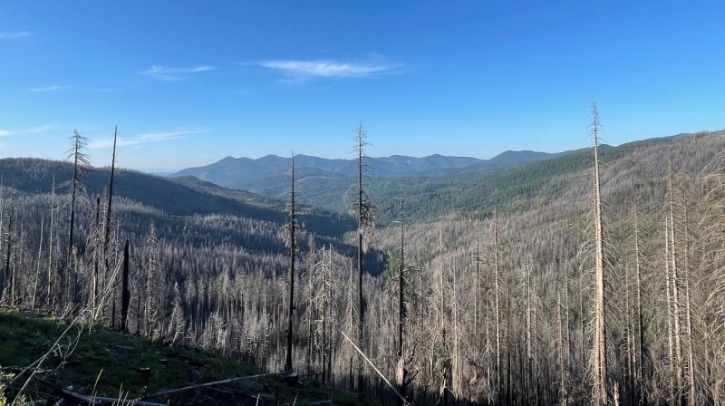
The aftereffects of the Slater Fire, which burned in northern California in 2020
Share
LinkedIn Facebook Twitter Email

Researchers from Northern Arizona University (NAU) have used NASA’s spaceborne lidar to discover that ladder fuels – which are shrubs, small trees and lower branches – may be the most important factor in predicting wildfire severity even in extreme conditions. Further, management efforts that focus on ladder fuels can help reduce the size and severity of wildfires in the US Southwest no matter what the weather is doing.

Chris Hakkenberg, an assistant research professor in the School of Informatics, Computing and Cyber Systems (SICCS) at NAU, was the lead author of the study. He collaborated with researchers in California as well as senior research scientist Patrick Burns and and Regents professor Scott Goetz, both at NAU.

NASA’s Global Ecosystem Dynamics Investigation lidar

NASA’s spaceborne lidar Global Ecosystem Dynamics Investigation (GEDI) was used in the study to characterize pre-fire fuel for 42 large California fires from 2019-2021. According to the researchers, it was uniquely able to peer into forests, providing consistent data on fuel structure for large areas and over multiple years. With this data, the team was able to determine that, among all measures of forest fuel – such as canopy height or volume – the presence of ladder fuels was the single most consistent determinant of high-severity fire. Likewise, fewer ladder fuels were associated with reduced burn severity.

The researchers highlight that, as a result of this discovery, land and fire managers can use satellite data on weather and fuels well before a fire to find out which areas are at greatest risk and how to reduce that risk by working with managers on the ground to implement pre-fire ladder fuel treatments and guide suppression efforts.

Limitations and future implications

However, the team underlines that ladder fuels were an exception to the rule and that forest fuels are usually not a great predictor of severity, especially when extreme weather is part of the equation.

“This research uses large-scale satellite data to show that if fire weather is extreme and there’s ignition, let’s say from burning embers blown by the wind, a fire is more likely to result in a high severity burn due to factors like low humidity and wind speed versus the sheer fuel volumes,” commented Hakkenberg.

“That said, we were surprised to find a critical exception to this trend – specifically with ladder fuels. Put simply, even in extreme weather conditions, forests with fewer ladder fuels tended to experience less severe fires.”

Overall, the scientists concluded that the need to develop ways to adapt to a new climate normal across landscapes with historically dense forest fuels is great, but focusing management on ladder fuels is one promising approach.

“While wildfires are a natural component of Western USA fire-adapted ecosystems, this trend from mixed-severity toward large, high-severity fires has resulted in wildfire regimes that are more destructive to forest ecosystems and more dangerous to human communities,” Hakkenberg added. “These high-severity fires also run the risk of altering our forestlands to a new normal – converting them to shrub or grasslands where trees are unable to establish due to high-intensity fire’s impact on microclimate, soil conditions and the seed bank.”

In related news, NASA recently awarded a two-year, US$1.23m grant to a team led by Penn State College of Information Sciences and Technology (IST) to improve atmosphere and ocean forecasts by incorporating artificial intelligence (AI) and satellite data into current forecasting models. Click here to read the full story.

Previous ArticleNOAA partners with Brightband to make observational data AI-ready
Next Article MIT develops spatial validation technique to increase forecast accuracy

Read Similar Stories

Space Weather

Northumbria University secures £4m to study Earth’s radiation belts

April 16, 20262 Mins Read
Extreme Weather

AI model improves real-time prediction of wildfire spread

April 16, 20263 Mins Read
Climate Measurement

Study identifies atmospheric trigger behind flash droughts in Puerto Rico

April 15, 20263 Mins Read
Latest News

Northumbria University secures £4m to study Earth’s radiation belts

April 16, 2026

AI model improves real-time prediction of wildfire spread

April 16, 2026

Study identifies atmospheric trigger behind flash droughts in Puerto Rico

April 15, 2026

Receive breaking stories and features in your inbox each week, for free


Enter your email address:


Supplier Spotlights
  • LCJ Capteurs
Getting in Touch
  • Contact Us / Advertise
  • Meet the Editors
  • Media Pack
  • Free Weekly E-Newsletter
Our Social Channels
  • Facebook
  • LinkedIn
© 2026 UKi Media & Events a division of UKIP Media & Events Ltd
  • Cookie Policy
  • Privacy Policy
  • Terms and Conditions
  • Notice and Takedown Policy

Type above and press Enter to search. Press Esc to cancel.