


Close Menu
Meteorological Technology International
  • News
    • A-E
      • Agriculture
      • Automated Weather Stations
      • Aviation
      • Climate Measurement
      • Data
      • Developing Countries
      • Digital Applications
      • Early Warning Systems
      • Extreme Weather
    • G-P
      • Hydrology
      • Lidar
      • Lightning Detection
      • New Appointments
      • Nowcasting
      • Numerical Weather Prediction
      • Polar Weather
    • R-S
      • Radar
      • Rainfall
      • Remote Sensing
      • Renewable Energy
      • Satellites
      • Solar
      • Space Weather
      • Supercomputers
    • T-Z
      • Training
      • Transport
      • Weather Instruments
      • Wind
      • World Meteorological Organization
      • Meteorological Technology World Expo
  • Features
  • Online Magazines
    • January 2026
    • April 2025
    • January 2025
    • September 2024
    • April 2024
    • Archive Issues
    • Subscribe Free!
  • Opinion
  • Videos
  • Supplier Spotlight
  • Expo
LinkedIn X (Twitter) Facebook
  • Sign-up for Free Weekly E-Newsletter
  • Meet the Editors
  • Contact Us
  • Media Pack
LinkedIn Facebook
Subscribe
Meteorological Technology International
  • News
      • Agriculture
      • Automated Weather Stations
      • Aviation
      • Climate Measurement
      • Data
      • Developing Countries
      • Digital Applications
      • Early Warning Systems
      • Extreme Weather
      • Hydrology
      • Lidar
      • Lightning Detection
      • New Appointments
      • Nowcasting
      • Numerical Weather Prediction
      • Polar Weather
      • Radar
      • Rainfall
      • Remote Sensing
      • Renewable Energy
      • Satellites
      • Solar
      • Space Weather
      • Supercomputers
      • Training
      • Transport
      • Weather Instruments
      • Wind
      • World Meteorological Organization
      • Meteorological Technology World Expo
  • Features
  • Online Magazines
    1. January 2026
    2. September 2025
    3. April 2025
    4. January 2025
    5. September 2024
    6. April 2024
    7. January 2024
    8. September 2023
    9. April 2023
    10. Archive Issues
    11. Subscribe Free!
    Featured
    November 27, 2025

    In this Issue – January 2026

    By Hazel KingNovember 27, 2025
    Recent

    In this Issue – January 2026

    November 27, 2025

    In this Issue – September 2025

    August 11, 2025

    In this Issue – April 2025

    April 15, 2025
  • Opinion
  • Videos
  • Supplier Spotlight
  • Expo
Facebook LinkedIn
Subscribe
Meteorological Technology International
Hydrology

Researchers develop model to track drought effects in real time with satellites

Elizabeth BakerBy Elizabeth BakerFebruary 27, 20253 Mins Read
Share LinkedIn Facebook Twitter Email
A team of researchers from the China University of Geosciences (Wuhan), the Institute of Geographic Sciences and Natural Resources Research (CAS), and East China Normal University have introduced a solar-induced chlorophyll fluorescence (SIF) model to track drought effects in real-time.
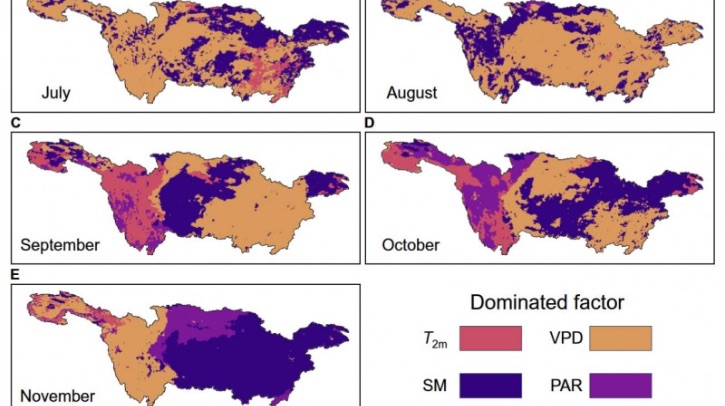
Spatial distribution of dominant factors contributing to the SIF decline in YRB. Credit: Journal of Remote Sensing
Share
LinkedIn Facebook Twitter Email

A team of researchers from the China University of Geosciences (Wuhan), the Institute of Geographic Sciences and Natural Resources Research (CAS) and East China Normal University have introduced a solar-induced chlorophyll fluorescence (SIF) model to track drought effects in real time. The study, published in the Journal of Remote Sensing, details how the method generates SIF data from the OCO-2 and OCO-3 satellites.

According to the team, the key innovation of the study is the development of a continuous hourly SIF dataset, HC-SIFoco, which tracks vegetation photosynthesis dynamics during droughts. With a high level of accuracy, the dataset demonstrated R² values of 0.89 for SIF and 0.94 for gross primary productivity (GPP) when compared to ground-based observations.

Findings revealed that drought stress causes a rapid decrease in vegetation fluorescence efficiency (Φf), leading to anomalies in SIF and canopy structure. The study also showed that midday depression in photosynthesis increased by around 3% during the 2022 drought in the Yangtze River Basin, and that the seasonal peak of photosynthesis occurred earlier than in previous years.

Integrating satellite data

To create the HC-SIFoco dataset, the team employed machine learning (ML) techniques, specifically the LightGBM model, to fuse SIF data from OCO-2 and OCO-3 satellites. The model integrated variables such as photosynthetically active radiation (PAR), temperature, vapor pressure deficit (VPD), soil moisture (SM) and land cover types.

Spanning September 2014 to September 2023, the dataset covers the Yangtze River Basin with a spatial resolution of 0.05°. Validation against ground-based and satellite data confirmed the accuracy of the dataset in capturing both diurnal and seasonal photosynthesis dynamics. Notably, the research highlighted that VPD accounted for over 70% of the decline in SIF during drought conditions, with soil moisture playing a key role in the later stages.

Developing early warning systems

“Our study provides a new lens through which to observe how vegetation responds to drought in real-time,” said Dr Zhuoying Deng, lead author of the study. “The hourly SIF dataset not only deepens our understanding of drought impacts but also presents exciting new opportunities for early drought warning systems and ecosystem management.”

The researchers used advanced ML algorithms to extend the spatiotemporal coverage of OCO-2 and OCO-3 SIF data. The LightGBM model was specifically designed to process large datasets efficiently and capture complex, non-linear interactions among environmental variables. The model was trained using critical factors such as PAR, temperature, VPD, SM and land cover, and rigorously validated against both ground-based SIF and GPP observations.

This high-resolution SIF dataset is said to hold great potential for real-time drought monitoring and ecosystem management. The researchers state that, in the future, it could be integrated with climate models to forecast vegetation responses to extreme weather events.

The dataset could also play a key role in developing strategies to mitigate drought impacts on agriculture and biodiversity, contributing to global efforts to combat climate change.

In related news, researchers from the Military University of Technology Poland and Griffith University have combined two advanced satellite-based methods – the Global Positioning System (GPS) and the Gravity Recovery and Climate Experiment (GRACE) – to improve the monitoring of hydrological droughts. Click here to read the full story.

Previous ArticleOPINION: Advancing the monitoring of space weather events
Next Article European Southern Observatory telescope reveals first 3D observations of an exoplanet’s atmosphere

Read Similar Stories

Space Weather

Northumbria University secures £4m to study Earth’s radiation belts

April 16, 20262 Mins Read
Extreme Weather

AI model improves real-time prediction of wildfire spread

April 16, 20263 Mins Read
Climate Measurement

Study identifies atmospheric trigger behind flash droughts in Puerto Rico

April 15, 20263 Mins Read
Latest News

Northumbria University secures £4m to study Earth’s radiation belts

April 16, 2026

AI model improves real-time prediction of wildfire spread

April 16, 2026

Study identifies atmospheric trigger behind flash droughts in Puerto Rico

April 15, 2026

Receive breaking stories and features in your inbox each week, for free


Enter your email address:


Supplier Spotlights
  • Adolf Thies GmbH & Co. KG
Getting in Touch
  • Contact Us / Advertise
  • Meet the Editors
  • Media Pack
  • Free Weekly E-Newsletter
Our Social Channels
  • Facebook
  • LinkedIn
© 2026 UKi Media & Events a division of UKIP Media & Events Ltd
  • Cookie Policy
  • Privacy Policy
  • Terms and Conditions
  • Notice and Takedown Policy

Type above and press Enter to search. Press Esc to cancel.