


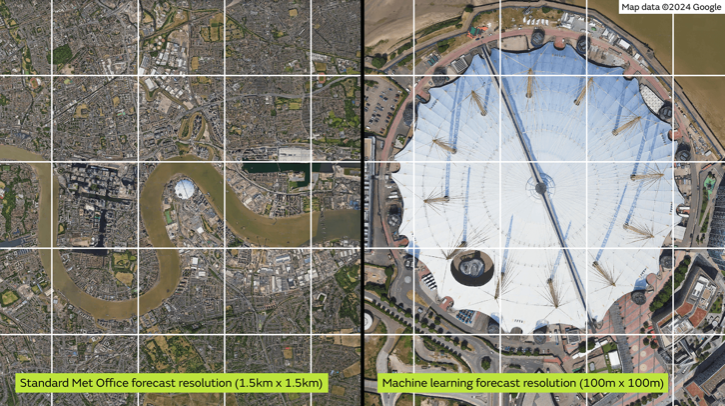
The Met Office has released a paper thought to be the first of its kind to study the use of citizen observations and machine learning (ML) to enhance the accuracy of temperature forecasts at a hyper-local level.
The paper, published in the Royal Meteorological Society’s Meteorological Applications journal, highlights a number of potential improvements to hyper-local forecasts for heatwaves in urban areas by harnessing citizen observations, land cover data and ML.
The research was funded in part by the Met Office Weather and Climate Science for Service Partnership India project, which is supported by the Department for Science, Innovation and Technology. Additional support was provided by the Natural Environment Research Council and the Science and Technology Facilities Council.
ML-powered hyper-local forecasts
Supported by the University of Reading and the Australian Bureau of Meteorology, the proof-of-concept study investigated eight heat events in London from 2019 to 2021. The study integrated operational Met Office UK Variable forecasts, quality-controlled citizen observations from the Weather Observations Network and land-use data from ESA World Cover to train the machine learning (ML) model. After training on these heat events, the models would then forecast the temperatures for other heat events within the period.
The study found that ML methods of forecasting urban heatwaves improved the prediction of air temperatures by up to 11% compared to the original weather forecast data. In addition, ML enabled temperature forecasts to be made at 225 times the resolution of standard operational Met Office forecasts. Forecasting the weather using physics-based models means dividing the atmosphere over the UK into equal-sized boxes to facilitate weather predictions to be made for each square.
The researchers looked at three different possible ML algorithms with further detail explored as part of the peer-reviewed paper. If citizen observations across the UK and during all weather conditions were incorporated, the ML technique could be extended to make hyper-local predictions year-round in UK cities. It’s also hoped the study will provide a base for further research into the applications of ML in meteorology.
The authors also demonstrated that as the number of citizen observations and heatwaves used to train the ML models was increased, the better the ML predictions became. It is therefore believed that the method will become more powerful in the future, since the number of citizens sharing their weather observation data is increasing and the time length of their records will keep growing.
This method, combined with citizen observations and urban land cover data to aid the ML, enables the temperature forecast to learn from previous events and account for natural and man-made influences on the temperature, which can vary significantly within relatively short distances in cities.
Preparing for extreme urban heat
Lewis Blunn, lead author and Met Office urban modeling expert, said, “We can already observe an increase in extreme heat events in the UK and the greatest impacts are often felt in cities. In a warming world, ML can be used to better understand impacts on communities at a much finer scale and could increase resilience and ultimately save lives.
“The prediction of urban heat at hyper-local scale has often been tricky for operational weather forecast models due to the complexity of urban areas. By combining quality-controlled citizen observations and land cover data with forecast models and ML, this paper demonstrates the potential for enhanced temperature forecasts in urban areas at a much higher resolution.
“Being able to accurately predict heat in cities could help better inform decision makers on where to direct resources during heatwaves, enabling improved protection of human health and infrastructure. Using ML to get the resolution to a 100m level would also improve the efficiency of creating highly detailed forecasts, allowing forecasts to be made more quickly and with less energy consumption.”
Reading PhD students Flynn Ames, Hannah Croad, Adam Gainford, Ieuan Higgs and Brian Lo played a key role in the research, helping to develop the ML techniques. Croad, one of the team of PhD researchers working on the project, commented, “This has been a fantastic opportunity to collaborate with the Met Office and other PhD students while learning about ML and its application to weather forecasting. As a team, we all contributed to building the code, which meant we developed a good understanding of each step of the process. It is exciting to think that our work may provide the blueprint for new forecasting systems in the future.”
Team member Ames said, “The use of ML in weather and climate science is growing at a tremendous pace, and our work further highlights its wide-reaching applicability. We look forward to using our newly gained skills in upcoming projects to explore further applications of ML within weather forecasting.”
In related news, scientists at the US National Science Foundation National Center for Atmospheric Research (NSF NCAR) recently found that fires that blaze through the wildland-urban interface (WUI) are becoming more common around the globe – a trend that is likely to continue for at least the next two decades. Click here to read the full story.