


Close Menu
Meteorological Technology International
  • News
    • A-E
      • Agriculture
      • Automated Weather Stations
      • Aviation
      • Climate Measurement
      • Data
      • Developing Countries
      • Digital Applications
      • Early Warning Systems
      • Extreme Weather
    • G-P
      • Hydrology
      • Lidar
      • Lightning Detection
      • New Appointments
      • Nowcasting
      • Numerical Weather Prediction
      • Polar Weather
    • R-S
      • Radar
      • Rainfall
      • Remote Sensing
      • Renewable Energy
      • Satellites
      • Solar
      • Space Weather
      • Supercomputers
    • T-Z
      • Training
      • Transport
      • Weather Instruments
      • Wind
      • World Meteorological Organization
      • Meteorological Technology World Expo
  • Features
  • Online Magazines
    • January 2026
    • April 2025
    • January 2025
    • September 2024
    • April 2024
    • Archive Issues
    • Subscribe Free!
  • Opinion
  • Videos
  • Supplier Spotlight
  • Expo
LinkedIn X (Twitter) Facebook
  • Sign-up for Free Weekly E-Newsletter
  • Meet the Editors
  • Contact Us
  • Media Pack
LinkedIn Facebook
Subscribe
Meteorological Technology International
  • News
      • Agriculture
      • Automated Weather Stations
      • Aviation
      • Climate Measurement
      • Data
      • Developing Countries
      • Digital Applications
      • Early Warning Systems
      • Extreme Weather
      • Hydrology
      • Lidar
      • Lightning Detection
      • New Appointments
      • Nowcasting
      • Numerical Weather Prediction
      • Polar Weather
      • Radar
      • Rainfall
      • Remote Sensing
      • Renewable Energy
      • Satellites
      • Solar
      • Space Weather
      • Supercomputers
      • Training
      • Transport
      • Weather Instruments
      • Wind
      • World Meteorological Organization
      • Meteorological Technology World Expo
  • Features
  • Online Magazines
    1. January 2026
    2. September 2025
    3. April 2025
    4. January 2025
    5. September 2024
    6. April 2024
    7. January 2024
    8. September 2023
    9. April 2023
    10. Archive Issues
    11. Subscribe Free!
    Featured
    November 27, 2025

    In this Issue – January 2026

    By Hazel KingNovember 27, 2025
    Recent

    In this Issue – January 2026

    November 27, 2025

    In this Issue – September 2025

    August 11, 2025

    In this Issue – April 2025

    April 15, 2025
  • Opinion
  • Videos
  • Supplier Spotlight
  • Expo
Facebook LinkedIn
Subscribe
Meteorological Technology International
Climate Measurement

China inaugurates 27th national climate observatory in Hebei

Alex PackBy Alex PackApril 9, 20262 Mins Read
Share LinkedIn Facebook Twitter Email
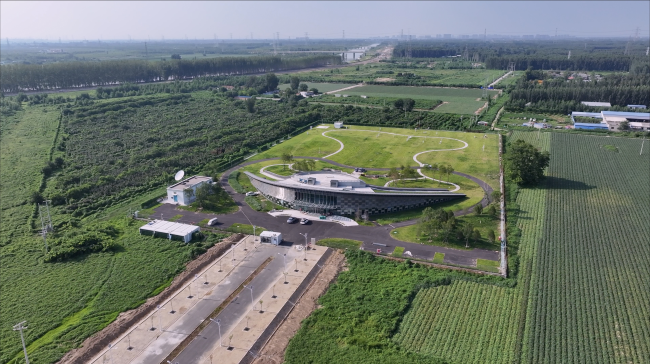
The Xiong’an national climate observatory in a rural area surrounded by green field.
Image: GUAN Zisheng
Share
LinkedIn Facebook Twitter Email

Xiong’an National Climate Observatory was officially inaugurated on April 1 in Xiong’an New Area, Hebei. The facility – China’s 27th national climate observatory – will transmit basic meteorological observation data in real time to the TianQing meteorological big data cloud platform, supporting climate monitoring and assessment, high-resolution forecasting, early warning and sector-specific meteorological services.

National climate observatories in China are ground-based, comprehensive stations designed for long-term, continuous and integrated observation of the climate system and its interactions. They also serve as platforms for scientific research, collaboration and talent development.

The new observatory is expected to support regional priorities in Xiong’an, including ecological protection of Baiyangdian Lake, urban safety operations and the development of emerging sectors such as the low-altitude economy, all of which require higher-precision and continuous climate observations.

The facility operates under a structure of one main station and eight auxiliary stations. The main station is supported by auxiliary stations in Rongcheng, Anxin, Dawang, Zhaili, Laohetou, Zangang, Maozhou and the Dianqu wetland area. This network is designed to cover the region’s urban and rural geographies, covering key ecological zones such as urban areas, forests, wetlands and farmland.

Following its launch, the observatory will focus on ground-based baseline climate observation, basic meteorological observation and surface-layer flux monitoring.

Research activities will include integrated ground-space-air observation, adaptive observation experiments linked to numerical weather prediction needs, and studies of boundary layer structure, turbulence and energy exchange across different surface types. The facility will also examine the impact of rapid urbanization on weather, climate and the ecological environment.

These efforts are intended to strengthen support for climate resource analysis, climate change monitoring and disaster risk identification.

The observatory builds on recent developments in Xiong’an’s “smart meteorology” framework, including the establishment and integration of a “One Brain, Three Networks” system. This includes a meteorological data platform, observation networks, a ubiquitous sensing network and an Internet of Things-based meteorological system. Together, these form an integrated ground-space-air monitoring network covering climate, radiation, atmospheric composition and ecosystem observations.

“We will deepen the application of observation data and forecast products in key industries, key areas and key scenarios, and continuously enhance our capabilities in meteorological disaster risk monitoring and early warning, ecological meteorological support and urban operation services,” said Guo Yitao, deputy director of the observatory.

Related news, Unmanned Antarctica atmospheric observation experiment advances in China

Previous ArticleFEATURE: How the Arctic oscillation fueled widespread winter storms
Next Article New tool speeds up climate model evaluation

Read Similar Stories

Climate Measurement

Study identifies atmospheric trigger behind flash droughts in Puerto Rico

April 15, 20263 Mins Read
Satellites

AI tool uses weather satellite data to map ocean currents in near real time

April 14, 20263 Mins Read
Climate Measurement

New tool speeds up climate model evaluation

April 13, 20262 Mins Read
Latest News

Northumbria University secures £4m to study Earth’s radiation belts

April 16, 2026

AI model improves real-time prediction of wildfire spread

April 16, 2026

Study identifies atmospheric trigger behind flash droughts in Puerto Rico

April 15, 2026

Receive breaking stories and features in your inbox each week, for free


Enter your email address:


Supplier Spotlights
  • Sommer GmbH
Getting in Touch
  • Contact Us / Advertise
  • Meet the Editors
  • Media Pack
  • Free Weekly E-Newsletter
Our Social Channels
  • Facebook
  • LinkedIn
© 2026 UKi Media & Events a division of UKIP Media & Events Ltd
  • Cookie Policy
  • Privacy Policy
  • Terms and Conditions
  • Notice and Takedown Policy

Type above and press Enter to search. Press Esc to cancel.