


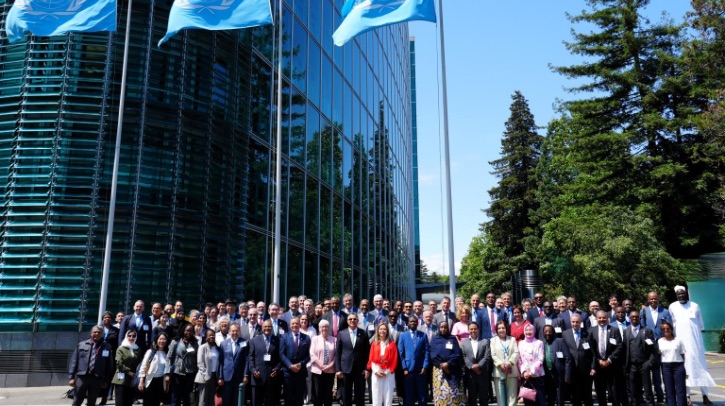
The World Meteorological Organization’s Executive Council has opened its annual session. According to the organization, AI is high on the council’s agenda due to its potential to revolutionize forecasts and help build resilience to more extreme weather and climate impacts.
The five-day meeting, taking place June 16-20 in Geneva, Switzerland, will address progress on priority initiatives such as Early Warnings for All. It will also seek to ensure that the WMO community continues to deliver its life-saving services and trusted science in a rapidly changing, more uncertain world.
Abdulla Al Mandous, president of the WMO, said, “The WMO must become more effective, more efficient and far more responsive to the challenges facing humanity and the urgent needs of the people we serve.”
“WMO has always been a place where cooperation precedes crisis. Where data is openly shared. Where operational trust is not aspirational – it is daily practice,” said WMO secretary-general Celeste Saulo. “That foundation remains our strength. But the world around us is shifting. And we must decide – together – how to evolve, preserving our core identity and coming out stronger on the other side. There is no resilient development, no food security, no disaster risk reduction, no climate action – without the services, science and infrastructure that we, collectively, provide.”

Artificial intelligence
The research and operationalization of such new approaches is expected to accelerate in the coming decade, providing new opportunities for meteorological, climate and hydrological services at an unprecedented use scale.
As AI and machine learning increasingly permeate Earth system science, the WMO Executive Council will discuss how to ensure that these tools are reliable, sustainable and grounded in WMO standards – in particular the WMO Integrated Processing and Prediction System (WIPPS).
A high-level session of the Open Consultative Platform on public-private sector engagement on artificial intelligence brought together representatives of the WMO community, Big Tech and academia to share knowledge and experience on the opportunities and challenges ahead.
“AI is rapidly reshaping how we work, creating a demand for new skills and increased adoption of AI technology. We need to embrace this challenge, balancing short-term caution with long-term engagement with AI innovation and its expansion,” added Al Mandous.
Strategic positioning
The Executive Council will also discuss WMO’s strategic priorities at a time when, the organization states, the WMO secretariat is being asked to do more, and to move faster, with fewer resources. One of the top priorities remains ensuring that everyone is covered by early warning services (EWS) by the end of 2027.
“Early Warnings for All remains within reach,” said Al Mandous. “We are witnessing tangible progress, and this success is fortified by our indispensable allies. The Systematic Observations Financing Facility is acting as our shield by closing critical data gaps. The Climate Risk and Early Warnings Systems Initiative, our sword, translating data into immediate, actionable warnings.”
Saulo concluded, “WMO remains under-recognized in the wider United Nations and multilateral system – at a time of reforms and restructuring as part of the UN80 initiative and to cope with growing budgetary constraints. This must change. This is not a communication problem. It is a strategic positioning challenge. And it is solvable – if we align our narrative with broader global priorities, and if we demonstrate impact in terms that others understand. When we talk about data exchange, let’s connect it to diplomacy and security. When we discuss warnings, let’s link them to public trust and institutional legitimacy. When we invest in hydrology, let’s show how it underpins peace and agricultural and food systems. What we offer is not minor. It is essential infrastructure. It is continuity. It is foresight. And it is global public good in its purest form.”
The EC session takes place during the 75th anniversary of WMO, which has the theme of Science for Action. Rather than purely looking back on past achievements, the anniversary has a forward-looking approach, intended to emphasize the value of WMO services to the global economy and society, and unlock more benefits for the global good.
In related news, the WMO recently released its Global Annual to Decadal Climate Update report, in which global climate predictions show temperatures are expected to continue at or near record levels in the next five years, increasing climate risks and impacts on societies, economies and sustainable development. Read the full story here