


Close Menu
Meteorological Technology International
  • News
    • A-E
      • Agriculture
      • Automated Weather Stations
      • Aviation
      • Climate Measurement
      • Data
      • Developing Countries
      • Digital Applications
      • Early Warning Systems
      • Extreme Weather
    • G-P
      • Hydrology
      • Lidar
      • Lightning Detection
      • New Appointments
      • Nowcasting
      • Numerical Weather Prediction
      • Polar Weather
    • R-S
      • Radar
      • Rainfall
      • Remote Sensing
      • Renewable Energy
      • Satellites
      • Solar
      • Space Weather
      • Supercomputers
    • T-Z
      • Training
      • Transport
      • Weather Instruments
      • Wind
      • World Meteorological Organization
      • Meteorological Technology World Expo
  • Features
  • Online Magazines
    • January 2026
    • April 2025
    • January 2025
    • September 2024
    • April 2024
    • Archive Issues
    • Subscribe Free!
  • Opinion
  • Videos
  • Supplier Spotlight
  • Expo
LinkedIn X (Twitter) Facebook
  • Sign-up for Free Weekly E-Newsletter
  • Meet the Editors
  • Contact Us
  • Media Pack
LinkedIn Facebook
Subscribe
Meteorological Technology International
  • News
      • Agriculture
      • Automated Weather Stations
      • Aviation
      • Climate Measurement
      • Data
      • Developing Countries
      • Digital Applications
      • Early Warning Systems
      • Extreme Weather
      • Hydrology
      • Lidar
      • Lightning Detection
      • New Appointments
      • Nowcasting
      • Numerical Weather Prediction
      • Polar Weather
      • Radar
      • Rainfall
      • Remote Sensing
      • Renewable Energy
      • Satellites
      • Solar
      • Space Weather
      • Supercomputers
      • Training
      • Transport
      • Weather Instruments
      • Wind
      • World Meteorological Organization
      • Meteorological Technology World Expo
  • Features
  • Online Magazines
    1. January 2026
    2. September 2025
    3. April 2025
    4. January 2025
    5. September 2024
    6. April 2024
    7. January 2024
    8. September 2023
    9. April 2023
    10. Archive Issues
    11. Subscribe Free!
    Featured
    November 27, 2025

    In this Issue – January 2026

    By Hazel KingNovember 27, 2025
    Recent

    In this Issue – January 2026

    November 27, 2025

    In this Issue – September 2025

    August 11, 2025

    In this Issue – April 2025

    April 15, 2025
  • Opinion
  • Videos
  • Supplier Spotlight
  • Expo
Facebook LinkedIn
Subscribe
Meteorological Technology International
Climate Measurement

Embry‑Riddle Aeronautical University receives US$1m NSF grant for continuous 3D atmospheric measurements

Elizabeth BakerBy Elizabeth BakerOctober 22, 20243 Mins Read
Share LinkedIn Facebook Twitter Email
The National Science Foundation (NSF) has awarded a US$1m grant to Embry Riddle Aeronautical University’s Dr. Alan Liu to expand a meteor radar network named CONDOR in Chile, enabling the network to provide continuous measurements of three-dimensional wind structure roughly 70-110km above Earth.
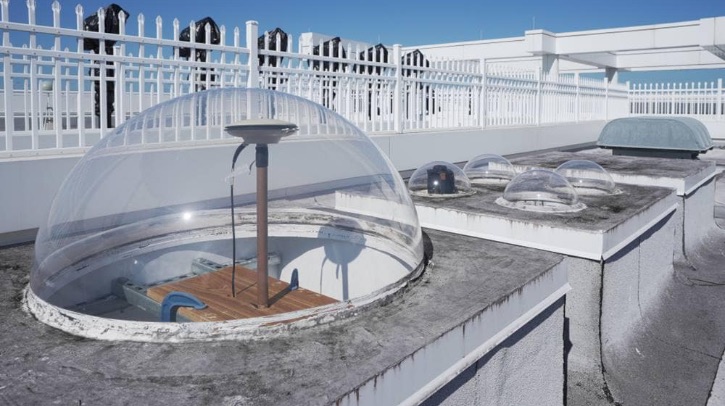
This photo, taken on the roof of the College of Arts and Sciences building at Embry‑Riddle’s Daytona Beach Campus, shows domes through which imagers that Dr. Alan Liu's group uses to observe the Earth's atmosphere will be tested. Credit: Embry‑Riddle/Bernard Wilchusky
Share
LinkedIn Facebook Twitter Email

The National Science Foundation (NSF) has awarded a US$1m grant to Embry‑Riddle Aeronautical University’s Dr Alan Liu to expand a meteor radar network named Chilean Observation Network De Meteor Radars (CONDOR) in Chile, enabling the network to provide continuous measurements of three-dimensional wind structure roughly 70-110km above Earth. The expansion will also provide mapping of atmospheric waves from multiple angles at multiple altitudes in the liminal region between Earth’s atmosphere and space.

Chilean Observation Network De Meteor Radars

Liu, a professor in the Department of Physical Sciences, was awarded a previous NSF grant in 2019 that supported the deployment of the CONDOR meteor radar network with the transmitter at the Andes Lidar Observatory in Cerro Pachón, Chile, and three receivers at separate sites. The new grant will support the addition of two more receiver sites in Argentina, as well as seven all-sky cameras and a Fabry-Perot Interferometer that provide maps of atmospheric wave motion at multiple altitudes, as well as atmospheric winds, at even higher altitudes (of 200-300km). Collaborating on the project will be the University of Illinois Urbana-Champaign and SRI, an independent non-profit research institution.

“The combination of all of these measurements will give an extremely detailed three-dimensional picture of atmospheric waves that is not yet available anywhere else,” said Liu. “Multiple imagers from multiple sites can be used to reconstruct the three-dimensional atmospheric wave field through complex mathematical algorithms.”

Such information is used to improve models of global circulation, space weather prediction and global satellite navigation systems. The observatory’s location enable Liu and his team to gather measurements in a region known to generate atmospheric waves because of the high mountains of the Andes and strong convections in the Amazonian rainforest.

Mapping of atmospheric waves
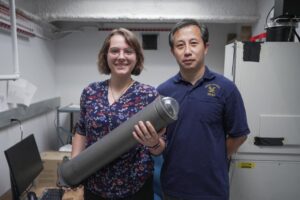
Dr Alan Liu (right) poses with PhD student Adriana Feener, who is holding an imager like the ones that will be built to examine the Earth’s upper atmosphere. Credit: Embry‑Riddle/Bernard Wilchusky

“The expanded capabilities of the Andes Lidar Observatory will open a new window of information on the rate at which meteors enter the Earth’s atmosphere and the physics of the uppermost atmosphere,” said Dr Terry Oswalt, associate dean of the College of Arts & Sciences and professor of physics and astronomy. “Only cutting-edge research wins such recognition from the NSF. We are fortunate to have faculty like Dr Liu.”

A postdoc researcher and one or two PhD students will work on Liu’s current grant project at Embry‑Riddle, and each will gain experience, he said. PhD student Adriana Feener was chosen at the beginning of the autumn 2024 semester to participate as one of the researchers on the project.

“PhD students will have hands-on experience in building the instruments and will have opportunities to travel to Chile to participate in the installation and testing. They will then be responsible for monitoring the instruments’ operation and will use the data to develop their research project that will lead to their PhD dissertations,” Liu said. “They will be trained in both engineering and scientific research skills through this project, which will be valuable for their careers.”

In related news, NSF NCAR recently ran simulations on the Cheyenne supercomputer at the NCAR-Wyoming Supercomputing Center to tease out the influence of Kelvin waves – the large-scale atmospheric waves that can extend more than 1,000 miles in the atmosphere and shape global weather patterns – and anticipate clusters of hurricanes days to weeks in advance. Click here to read the full story.

Previous ArticleNCEO receives five-year £8.6m NERC investment
Next Article Researchers combine two satellite methods to improve drought detection

Read Similar Stories

Climate Measurement

Study identifies atmospheric trigger behind flash droughts in Puerto Rico

April 15, 20263 Mins Read
Satellites

AI tool uses weather satellite data to map ocean currents in near real time

April 14, 20263 Mins Read
Climate Measurement

New tool speeds up climate model evaluation

April 13, 20262 Mins Read
Latest News

Northumbria University secures £4m to study Earth’s radiation belts

April 16, 2026

AI model improves real-time prediction of wildfire spread

April 16, 2026

Study identifies atmospheric trigger behind flash droughts in Puerto Rico

April 15, 2026

Receive breaking stories and features in your inbox each week, for free


Enter your email address:


Supplier Spotlights
  • Reuniwatt
Getting in Touch
  • Contact Us / Advertise
  • Meet the Editors
  • Media Pack
  • Free Weekly E-Newsletter
Our Social Channels
  • Facebook
  • LinkedIn
© 2026 UKi Media & Events a division of UKIP Media & Events Ltd
  • Cookie Policy
  • Privacy Policy
  • Terms and Conditions
  • Notice and Takedown Policy

Type above and press Enter to search. Press Esc to cancel.