


Close Menu
Meteorological Technology International
  • News
    • A-E
      • Agriculture
      • Automated Weather Stations
      • Aviation
      • Climate Measurement
      • Data
      • Developing Countries
      • Digital Applications
      • Early Warning Systems
      • Extreme Weather
    • G-P
      • Hydrology
      • Lidar
      • Lightning Detection
      • New Appointments
      • Nowcasting
      • Numerical Weather Prediction
      • Polar Weather
    • R-S
      • Radar
      • Rainfall
      • Remote Sensing
      • Renewable Energy
      • Satellites
      • Solar
      • Space Weather
      • Supercomputers
    • T-Z
      • Training
      • Transport
      • Weather Instruments
      • Wind
      • World Meteorological Organization
      • Meteorological Technology World Expo
  • Features
  • Online Magazines
    • January 2026
    • April 2025
    • January 2025
    • September 2024
    • April 2024
    • Archive Issues
    • Subscribe Free!
  • Opinion
  • Videos
  • Supplier Spotlight
  • Expo
LinkedIn X (Twitter) Facebook
  • Sign-up for Free Weekly E-Newsletter
  • Meet the Editors
  • Contact Us
  • Media Pack
LinkedIn Facebook
Subscribe
Meteorological Technology International
  • News
      • Agriculture
      • Automated Weather Stations
      • Aviation
      • Climate Measurement
      • Data
      • Developing Countries
      • Digital Applications
      • Early Warning Systems
      • Extreme Weather
      • Hydrology
      • Lidar
      • Lightning Detection
      • New Appointments
      • Nowcasting
      • Numerical Weather Prediction
      • Polar Weather
      • Radar
      • Rainfall
      • Remote Sensing
      • Renewable Energy
      • Satellites
      • Solar
      • Space Weather
      • Supercomputers
      • Training
      • Transport
      • Weather Instruments
      • Wind
      • World Meteorological Organization
      • Meteorological Technology World Expo
  • Features
  • Online Magazines
    1. January 2026
    2. September 2025
    3. April 2025
    4. January 2025
    5. September 2024
    6. April 2024
    7. January 2024
    8. September 2023
    9. April 2023
    10. Archive Issues
    11. Subscribe Free!
    Featured
    November 27, 2025

    In this Issue – January 2026

    By Hazel KingNovember 27, 2025
    Recent

    In this Issue – January 2026

    November 27, 2025

    In this Issue – September 2025

    August 11, 2025

    In this Issue – April 2025

    April 15, 2025
  • Opinion
  • Videos
  • Supplier Spotlight
  • Expo
Facebook LinkedIn
Subscribe
Meteorological Technology International
Early Warning Systems

NSF NCAR anticipates hurricane clusters weeks in advance

Elizabeth BakerBy Elizabeth BakerSeptember 2, 20243 Mins Read
Share LinkedIn Facebook Twitter Email
The US National Science Foundation National Center for Atmospheric Research (NSF NCAR) has published a study that showed that twice as many hurricanes form two days after the passing of large-scale atmospheric waves called Kelvin waves than in the days before. This finding may enable forecasters and emergency managers to anticipate clusters of hurricanes days to weeks in advance.
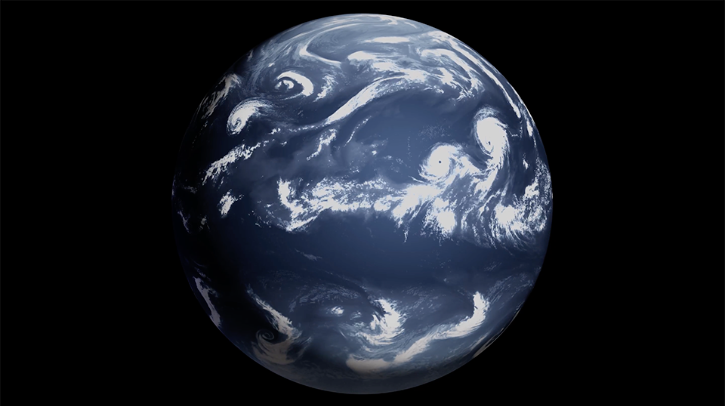
Simulation of Kelvin waves modeled in MPAS with the Aquaplanet configuration. 
Share
LinkedIn Facebook Twitter Email

The US National Science Foundation National Center for Atmospheric Research (NSF NCAR) has run simulations on the Cheyenne supercomputer at the NCAR-Wyoming Supercomputing Center to tease out the influence of Kelvin waves – the large-scale atmospheric waves that can extend more than 1,000 miles in the atmosphere and shape global weather patterns – and anticipate clusters of hurricanes days to weeks in advance.

The study, published in Monthly Weather Review, showed that twice as many hurricanes form two days after the passing of these large-scale atmospheric waves (Kelvin waves) than in the days before. This finding may enable forecasters and emergency managers to anticipate clusters of hurricanes days to weeks in advance.

Aquaplanet 

For decades, scientists have noticed that hurricanes form in clusters followed by several weeks of little to no hurricane activity. Several studies have suggested that Kelvin waves could be responsible for the surge in hurricanes, but scientists were unable to separate other potential factors and prove Kelvin waves were responsible. To overcome this, NSF NCAR scientist Rosimar Rios-Berrios and her colleagues used a novel combination of computer modeling tools to confirm that Kelvin waves do indeed boost hurricane formation.

The research team used a simulation called aquaplanet that was run on NSF NCAR’s Model for Prediction Across Scales (MPAS), which is a next-generation computer model that can capture fine-scale weather phenomena and global-scale atmospheric patterns simultaneously. Aquaplanet is a configuration that simulates a hypothetical world that behaves like Earth but doesn’t have land or seasons. The simplified world acts like a lab and makes it easier to isolate the effects of Kelvin waves on hurricane formation.

To investigate the connection between Kelvin waves and hurricanes, the research team measured the number of days between hurricane formation and Kelvin wave crests. The measurements showed a significant peak after two days, with hurricane development being twice as likely. Because the aquaplanet simulations capture the physical process of hurricane formation, the results went beyond correlation and suggest that Kelvin waves are actually affecting hurricane formation.

The new study also emphasized the importance of recent research that Rios-Berrios co-authored with NSF NCAR postdoc Quinton Lawton about the need to improve the ability of weather forecast models to simulate Kelvin waves.

Improved early warning systems

“If weather forecasters can detect a Kelvin wave over the Pacific Ocean, for example, then they can anticipate that a few days after the wave there will be an uptick in hurricanes forming over the Atlantic,” said Rios-Berrios, the lead author of the paper. “This would help them communicate with emergency managers and local governments who could prepare for the likelihood of an active hurricane period and alert the public. This research has the potential to save many lives.”

“I started this research on Kelvin waves in 2017. It was a big project that took years to go from an idea to scientific results and really highlights why this type of research is so valuable,” said Rios-Berrios. “There are still a lot of gaps in scientific knowledge about how hurricanes form and research like this helps us narrow where scientists should focus to better understand these powerful storms.”

In related news, a study by NSF NCAR recently found that increased atmospheric moisture may alter critical weather patterns over Africa, making it more difficult for the predecessors of many Atlantic hurricanes to form. Click here to read the full story.

Previous ArticleVaisala receives €25m to modernize weather systems at 14 Indonesian airports
Next Article Tata Power partners with Tomorrow.io for enhanced weather forecasting in India

Read Similar Stories

Extreme Weather

AI model improves real-time prediction of wildfire spread

April 16, 20263 Mins Read
Climate Measurement

Study identifies atmospheric trigger behind flash droughts in Puerto Rico

April 15, 20263 Mins Read
Climate Measurement

Regional training aims to improve flood forecasting in Central Africa

April 1, 20263 Mins Read
Latest News

Northumbria University secures £4m to study Earth’s radiation belts

April 16, 2026

AI model improves real-time prediction of wildfire spread

April 16, 2026

Study identifies atmospheric trigger behind flash droughts in Puerto Rico

April 15, 2026

Receive breaking stories and features in your inbox each week, for free


Enter your email address:


Supplier Spotlights
  • Meteomatics AG
Getting in Touch
  • Contact Us / Advertise
  • Meet the Editors
  • Media Pack
  • Free Weekly E-Newsletter
Our Social Channels
  • Facebook
  • LinkedIn
© 2026 UKi Media & Events a division of UKIP Media & Events Ltd
  • Cookie Policy
  • Privacy Policy
  • Terms and Conditions
  • Notice and Takedown Policy

Type above and press Enter to search. Press Esc to cancel.