


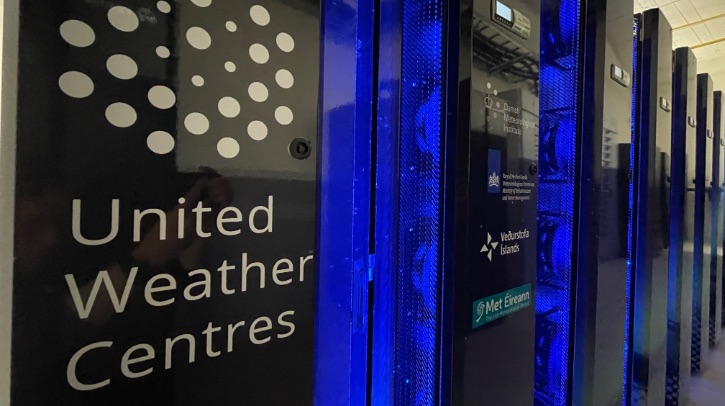
The national meteorological services of Ireland, Denmark, Iceland and the Netherlands have joined forces to respond to climate change with more timely weather forecasting with a new, now-operational, common supercomputer. This solution is expected to help prepare each nation for the impacts of weather patterns, which are expected to become more extreme and more challenging to forecast.
New supercomputing model coverage and characteristics
The supercomputer consists of two units, one dedicated to operational weather forecasting and another one dedicated to climate research. Its new NWP model is based on the Harmonie-Arome source code that Met Éireann has been developing in collaboration with many other met services for more than two decades and using operationally (in different upgraded versions) since 2011. The supercomputer is located in Iceland and runs on renewable Icelandic hydropower and geothermal energy. The new model domain covers an area from East Greenland to southern Italy, dividing the geographical area into squares 2km in size, an improvement over the previous 2.5km grid of the previous model version Met Éireann operated.
The model represents the atmosphere vertically in the form of 90 levels, a substantial increase from the 65 levels of the previous operational model. These are resolution improvements that translate into a better representation of the meteorological parameters across the domain.
The model updates hourly, with 30 EPS members running every six hours, while previous computing capabilities only let run every three hours. This means more timely model updates to the forecasters, feeding the Met Éireann processes for updating the forecast and issuing warnings.
United Weather Centres West collaboration
The organizations procured a common supercomputing system when the collaboration between the national meteorological services of Ireland, Denmark, Iceland and the Netherlands was established in 2019. The United Weather Centres West collaboration (UWC-West) is now running a common weather forecasting model on a new supercomputer supporting the provision of services to society in a changing climate.
Building on five years of close collaboration between the four national meteorological services and improved common computational capabilities, this supercomputer calculates forecasts at a higher level of detail for a much larger area than before.
Eoin Moran, director of Met Éireann, said, “Pulling together the expertise from our four countries allows us to prepare for the future faster and more efficiently. Making our common forecasting system operational is the culmination of five years of intense cooperation on computer and models by the four institutes. It represents not only a technical achievement but the confirmation that joining expertise and experience can lead to greater things. My colleagues in Denmark, Iceland and the Netherlands all agree that, through the UWC-West collaboration, we are paving new ways for weather services to work.”
Eoin Sherlock, head of forecasting at Met Éireann, added, “Overall, this new model version allows us to get a better handle on the uncertainty of the predictions. Numerical weather prediction (NWP) models are run a number of times with slightly different initial conditions, each of these then providing slightly different outcomes. This is known as an ensemble prediction system (EPS) and Met Éireann’s previous operational model consisted of 15 EPS members, or individual runs. With the new supercomputer, we have doubled that number, so our probabilistic analyses and the forecasters’ understanding of complex scenarios will certainly benefit from that.”
Understanding extreme weather
The latest reports from the IPCC and the WMO show that climate change is already causing more heatwaves, floods and heavy rainfall around the world.
Moran said, “All the experts who made this project possible acknowledge that by working together, the four national institutes can now respond better to weather events, helping to protect lives and property, and make smarter decisions as our climate continues to change.”
While the system is now operational, the four national meteorological services plan to keep on working together on continuously evolving and improving the common forecasting model and implementing the latest improvements on it.
Moran said, “The powerful collaboration we have started is here to stay. The advancements of weather and climate research on AI, big data and computing technology make our collaboration more needed than ever. Together we will gain more knowledge, push our weather models further and share much more data than before.”
In related news, the Bipartisan Infrastructure Law and Inflation Reduction Act recently awarded US$100m in funding to General Dynamics Information Technology for NOAA’s newest high-performance computer (HPC) system, called Rhea. Rhea will be used to advance research on weather, climate, ocean and ecosystem prediction. Click here to read the full story.