


Close Menu
Meteorological Technology International
  • News
    • A-E
      • Agriculture
      • Automated Weather Stations
      • Aviation
      • Climate Measurement
      • Data
      • Developing Countries
      • Digital Applications
      • Early Warning Systems
      • Extreme Weather
    • G-P
      • Hydrology
      • Lidar
      • Lightning Detection
      • New Appointments
      • Nowcasting
      • Numerical Weather Prediction
      • Polar Weather
    • R-S
      • Radar
      • Rainfall
      • Remote Sensing
      • Renewable Energy
      • Satellites
      • Solar
      • Space Weather
      • Supercomputers
    • T-Z
      • Training
      • Transport
      • Weather Instruments
      • Wind
      • World Meteorological Organization
      • Meteorological Technology World Expo
  • Features
  • Online Magazines
    • January 2026
    • April 2025
    • January 2025
    • September 2024
    • April 2024
    • Archive Issues
    • Subscribe Free!
  • Opinion
  • Videos
  • Supplier Spotlight
  • Expo
LinkedIn X (Twitter) Facebook
  • Sign-up for Free Weekly E-Newsletter
  • Meet the Editors
  • Contact Us
  • Media Pack
LinkedIn Facebook
Subscribe
Meteorological Technology International
  • News
      • Agriculture
      • Automated Weather Stations
      • Aviation
      • Climate Measurement
      • Data
      • Developing Countries
      • Digital Applications
      • Early Warning Systems
      • Extreme Weather
      • Hydrology
      • Lidar
      • Lightning Detection
      • New Appointments
      • Nowcasting
      • Numerical Weather Prediction
      • Polar Weather
      • Radar
      • Rainfall
      • Remote Sensing
      • Renewable Energy
      • Satellites
      • Solar
      • Space Weather
      • Supercomputers
      • Training
      • Transport
      • Weather Instruments
      • Wind
      • World Meteorological Organization
      • Meteorological Technology World Expo
  • Features
  • Online Magazines
    1. January 2026
    2. September 2025
    3. April 2025
    4. January 2025
    5. September 2024
    6. April 2024
    7. January 2024
    8. September 2023
    9. April 2023
    10. Archive Issues
    11. Subscribe Free!
    Featured
    November 27, 2025

    In this Issue – January 2026

    By Hazel KingNovember 27, 2025
    Recent

    In this Issue – January 2026

    November 27, 2025

    In this Issue – September 2025

    August 11, 2025

    In this Issue – April 2025

    April 15, 2025
  • Opinion
  • Videos
  • Supplier Spotlight
  • Expo
Facebook LinkedIn
Subscribe
Meteorological Technology International
Space Weather

Semi-empirical model improves forecasting of Earth’s magnetic storms

Elizabeth BakerBy Elizabeth BakerJuly 21, 20253 Mins Read
Share LinkedIn Facebook Twitter Email
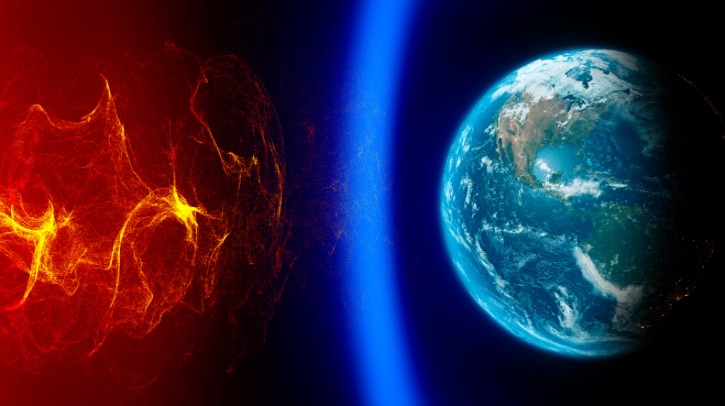
A visual representation of how the Earth's magnetic field sits between the Earth and solar wind.
Share
LinkedIn Facebook Twitter Email

A study, led by PhD candidate JiaWen Yue and Dr XiaoCheng Guo from the National Space Science Center at the Chinese Academy of Sciences, has introduced a novel semi-empirical approach to simulating the Dst index and developed a model that it says outperforms traditional empirical approaches in accuracy while retaining computational efficiency. The study also highlights the model’s adaptability and that its modular design enables seamless integration into existing global MHD simulation frameworks.

Integrating empirical methods
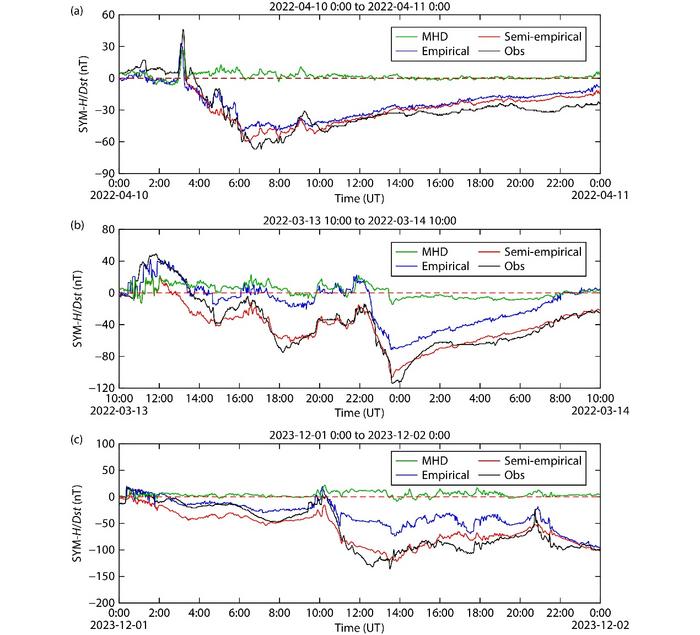
Panels a, b, and c show comparisons between simulated and observed data, corresponding to the magnetic storm events indicated by the times above each panel. The one-minute resolution Dst index calculated using the magnetohydrodynamic (MHD) model, empirical model and semi-empirical model is represented by solid green, blue and red lines, respectively. The black solid line represents the observed SYM-H index obtained from the OMNI database. The red dashed line indicates the zero-value reference line for the SYM-H/Dst index. 
Credit: Beijing Zhongke Journal Publising

The Dst index, widely used for decades to quantify the strength of geomagnetic storms, is influenced by complex interactions between the solar wind and Earth’s magnetosphere. The team highlighted that traditional empirical models, such as Burton’s, rely on statistical correlations but lack the ability to capture dynamic physical processes. Physics-based models typically require a significant number of computational resources and pose challenges in describing ring currents. The new semi-empirical model aims to bridge this gap by combining the strengths of both methodologies.

In this approach, the ring current contribution to the Dst index is derived from Burton’s empirical framework, while contributions from other current systems – such as the magnetotail current – are calculated using high-resolution global MHD simulations. This hybrid strategy enables the model to retain the speed of empirical methods while incorporating the physical realism of MHD simulations.

Improving space weather forecasting

To validate the model, the team tested it against a series of recent geomagnetic storm events, comparing simulated results with observed Dst data using metrics such as correlation coefficient (CC), prediction efficiency (PE), root mean square error (RMSE) and central RMSE (CRMSE).

The team found that during moderate to intense geomagnetic storms, the semi-empirical model achieved significantly higher CC and PE values and lower RMSE and CRMSE compared to purely empirical models. These results demonstrate the model’s robustness in capturing both the timing and magnitude of Dst variations.

“This model provides more possibilities for space weather forecasting,” said Yue. “By merging empirical simplicity with MHD physics, we’ve created a tool that is both accurate and practical for space environment applications.”

“The ability to simulate the Dst index within a global MHD framework opens new avenues for understanding storm-time magnetospheric dynamics,” said Guo. “As space weather becomes an increasingly critical area of study, this semi-empirical approach offers a scalable solution for improving the accuracy and reliability of geomagnetic storm predictions.”

In related news, read about a proposal to launch a UK-led satellite mission concept named UK-ODESSI (UK-Orbital pathfinDEr for Space-borne, Space-weather Instrumentation), which was presented at the Royal Astronomical Society’s National Astronomy Meeting 2025 in the UK

Previous ArticleUniversity of Surrey launches space institute to drive the UK’s space economy
Next Article Climate model simulates weather phenomena at scales of 9km worldwide

Read Similar Stories

Space Weather

Northumbria University secures £4m to study Earth’s radiation belts

April 16, 20262 Mins Read
Solar

Mauna Loa Solar Observatory reopens to support Artemis II mission

April 8, 20262 Mins Read
Satellites

NCAR researchers create breakthrough tool to enhance space weather prediction

February 24, 20262 Mins Read
Latest News

Northumbria University secures £4m to study Earth’s radiation belts

April 16, 2026

AI model improves real-time prediction of wildfire spread

April 16, 2026

Study identifies atmospheric trigger behind flash droughts in Puerto Rico

April 15, 2026

Receive breaking stories and features in your inbox each week, for free


Enter your email address:


Supplier Spotlights
  • ELDES S.r.l.
Getting in Touch
  • Contact Us / Advertise
  • Meet the Editors
  • Media Pack
  • Free Weekly E-Newsletter
Our Social Channels
  • Facebook
  • LinkedIn
© 2026 UKi Media & Events a division of UKIP Media & Events Ltd
  • Cookie Policy
  • Privacy Policy
  • Terms and Conditions
  • Notice and Takedown Policy

Type above and press Enter to search. Press Esc to cancel.