


Close Menu
Meteorological Technology International
  • News
    • A-E
      • Agriculture
      • Automated Weather Stations
      • Aviation
      • Climate Measurement
      • Data
      • Developing Countries
      • Digital Applications
      • Early Warning Systems
      • Extreme Weather
    • G-P
      • Hydrology
      • Lidar
      • Lightning Detection
      • New Appointments
      • Nowcasting
      • Numerical Weather Prediction
      • Polar Weather
    • R-S
      • Radar
      • Rainfall
      • Remote Sensing
      • Renewable Energy
      • Satellites
      • Solar
      • Space Weather
      • Supercomputers
    • T-Z
      • Training
      • Transport
      • Weather Instruments
      • Wind
      • World Meteorological Organization
      • Meteorological Technology World Expo
  • Features
  • Online Magazines
    • January 2026
    • April 2025
    • January 2025
    • September 2024
    • April 2024
    • Archive Issues
    • Subscribe Free!
  • Opinion
  • Videos
  • Supplier Spotlight
  • Expo
LinkedIn X (Twitter) Facebook
  • Sign-up for Free Weekly E-Newsletter
  • Meet the Editors
  • Contact Us
  • Media Pack
LinkedIn Facebook
Subscribe
Meteorological Technology International
  • News
      • Agriculture
      • Automated Weather Stations
      • Aviation
      • Climate Measurement
      • Data
      • Developing Countries
      • Digital Applications
      • Early Warning Systems
      • Extreme Weather
      • Hydrology
      • Lidar
      • Lightning Detection
      • New Appointments
      • Nowcasting
      • Numerical Weather Prediction
      • Polar Weather
      • Radar
      • Rainfall
      • Remote Sensing
      • Renewable Energy
      • Satellites
      • Solar
      • Space Weather
      • Supercomputers
      • Training
      • Transport
      • Weather Instruments
      • Wind
      • World Meteorological Organization
      • Meteorological Technology World Expo
  • Features
  • Online Magazines
    1. January 2026
    2. September 2025
    3. April 2025
    4. January 2025
    5. September 2024
    6. April 2024
    7. January 2024
    8. September 2023
    9. April 2023
    10. Archive Issues
    11. Subscribe Free!
    Featured
    November 27, 2025

    In this Issue – January 2026

    By Hazel KingNovember 27, 2025
    Recent

    In this Issue – January 2026

    November 27, 2025

    In this Issue – September 2025

    August 11, 2025

    In this Issue – April 2025

    April 15, 2025
  • Opinion
  • Videos
  • Supplier Spotlight
  • Expo
Facebook LinkedIn
Subscribe
Meteorological Technology International
Solar

NSF approves funding for next stage of NCAR’s new solar observatory

Hazel KingBy Hazel KingDecember 10, 20203 Mins Read
Share LinkedIn Facebook Twitter Email
Share
LinkedIn Facebook Twitter Email

The National Center for Atmospheric Research (NCAR) has received funding approval to survey prospective locations for the Coronal Solar Magnetism Observatory (COSMO).

According to NCAR, the new observatory offers the potential to transform our fundamental understanding of magnetic fields in the sun’s atmosphere and how they drive the formation of solar eruptions and other space weather that can affect technologies on Earth.

The National Science Foundation (NSF) has approved US$5.6m in funding for the next stage of the project, which will include searching for a suitable location for the observatory. Ground-based solar telescopes are best placed in areas with stable, largely clear weather – they can’t see through cloud cover – and high elevation, which raises the telescope above the distortions that can be caused by the thicker atmosphere closer to sea level.
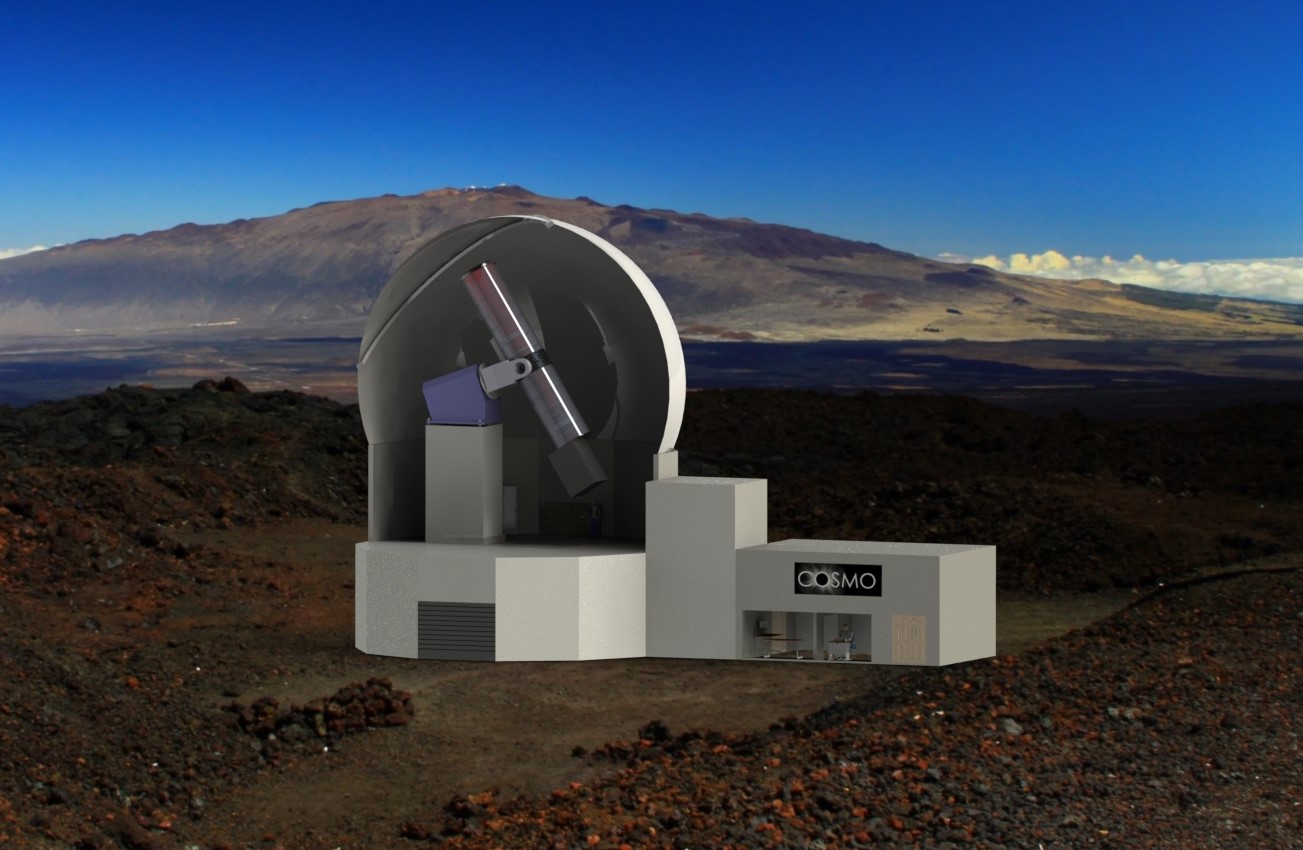
A rendering of the Large Coronagraph dome. ©UCAR

The funding will also go to completing the design of the 1.5m Large Coronagraph telescope, which will provide a rare, large-scale view of magnetism in the solar corona, the tenuous extended atmosphere of the sun. This will enable scientists to quantify the energy stored in the looping magnetic fields that emanate from the sun and to study how these fields may change before a solar eruption.

These observations will complement those taken from existing ground- and space-based solar observatories, including NSF’s new Inouye Solar Telescope, which sacrifices its wide view of the sun in favor of unprecedented high resolution of a much smaller area.

“COSMO will provide the big picture on coronal magnetism,” said NCAR scientist Steve Tomczyk, who is leading the project. “The ability to track changes in the magnetic field across the layers of the sun’s atmosphere on global scales will be a powerful tool for identifying and characterizing the sources of potentially damaging space weather and, ultimately, will provide better, more accurate, and more timely forecasts of the risk here on Earth.”

The COSMO Site and Design Advancement (COSADA) is being undertaken by a team of NCAR scientists and engineers, including Tomczyk, Sarah Gibson, Krista Laursen and Scott Sewell, and will be conducted across three years. NCAR developed COSMO in partnership with the University of Michigan, the University of Hawaii, George Mason University, the Smithsonian Astrophysical Observatory, the University of Colorado, and the National Solar Observatory, along with other support in the solar community.

The project was also endorsed as a high priority in the latest Solar and Space Physics Decadal Survey of The National Academies of Sciences, Engineering, and Medicine.

Previous ArticleWinners of WMO International Weather Apps Awards 2020 to be announced on December 15
Next Article CAMS research reveals global fire emissions are decreasing despite extreme hotspots

Read Similar Stories

Space Weather

Northumbria University secures £4m to study Earth’s radiation belts

April 16, 20262 Mins Read
Solar

Mauna Loa Solar Observatory reopens to support Artemis II mission

April 8, 20262 Mins Read
Satellites

NCAR researchers create breakthrough tool to enhance space weather prediction

February 24, 20262 Mins Read
Latest News

Northumbria University secures £4m to study Earth’s radiation belts

April 16, 2026

AI model improves real-time prediction of wildfire spread

April 16, 2026

Study identifies atmospheric trigger behind flash droughts in Puerto Rico

April 15, 2026

Receive breaking stories and features in your inbox each week, for free


Enter your email address:


Supplier Spotlights
  • Synoptic Data PBC
Getting in Touch
  • Contact Us / Advertise
  • Meet the Editors
  • Media Pack
  • Free Weekly E-Newsletter
Our Social Channels
  • Facebook
  • LinkedIn
© 2026 UKi Media & Events a division of UKIP Media & Events Ltd
  • Cookie Policy
  • Privacy Policy
  • Terms and Conditions
  • Notice and Takedown Policy

Type above and press Enter to search. Press Esc to cancel.