


Close Menu
Meteorological Technology International
  • News
    • A-E
      • Agriculture
      • Automated Weather Stations
      • Aviation
      • Climate Measurement
      • Data
      • Developing Countries
      • Digital Applications
      • Early Warning Systems
      • Extreme Weather
    • G-P
      • Hydrology
      • Lidar
      • Lightning Detection
      • New Appointments
      • Nowcasting
      • Numerical Weather Prediction
      • Polar Weather
    • R-S
      • Radar
      • Rainfall
      • Remote Sensing
      • Renewable Energy
      • Satellites
      • Solar
      • Space Weather
      • Supercomputers
    • T-Z
      • Training
      • Transport
      • Weather Instruments
      • Wind
      • World Meteorological Organization
      • Meteorological Technology World Expo
  • Features
  • Online Magazines
    • January 2026
    • April 2025
    • January 2025
    • September 2024
    • April 2024
    • Archive Issues
    • Subscribe Free!
  • Opinion
  • Videos
  • Supplier Spotlight
  • Expo
LinkedIn X (Twitter) Facebook
  • Sign-up for Free Weekly E-Newsletter
  • Meet the Editors
  • Contact Us
  • Media Pack
LinkedIn Facebook
Subscribe
Meteorological Technology International
  • News
      • Agriculture
      • Automated Weather Stations
      • Aviation
      • Climate Measurement
      • Data
      • Developing Countries
      • Digital Applications
      • Early Warning Systems
      • Extreme Weather
      • Hydrology
      • Lidar
      • Lightning Detection
      • New Appointments
      • Nowcasting
      • Numerical Weather Prediction
      • Polar Weather
      • Radar
      • Rainfall
      • Remote Sensing
      • Renewable Energy
      • Satellites
      • Solar
      • Space Weather
      • Supercomputers
      • Training
      • Transport
      • Weather Instruments
      • Wind
      • World Meteorological Organization
      • Meteorological Technology World Expo
  • Features
  • Online Magazines
    1. January 2026
    2. September 2025
    3. April 2025
    4. January 2025
    5. September 2024
    6. April 2024
    7. January 2024
    8. September 2023
    9. April 2023
    10. Archive Issues
    11. Subscribe Free!
    Featured
    November 27, 2025

    In this Issue – January 2026

    By Hazel KingNovember 27, 2025
    Recent

    In this Issue – January 2026

    November 27, 2025

    In this Issue – September 2025

    August 11, 2025

    In this Issue – April 2025

    April 15, 2025
  • Opinion
  • Videos
  • Supplier Spotlight
  • Expo
Facebook LinkedIn
Subscribe
Meteorological Technology International
Climate Measurement

MetOp-SG-B1 satellite enters third round of pre-launch tests ahead of 2026 launch

Alex PackBy Alex PackNovember 25, 20252 Mins Read
Share LinkedIn Facebook Twitter Email
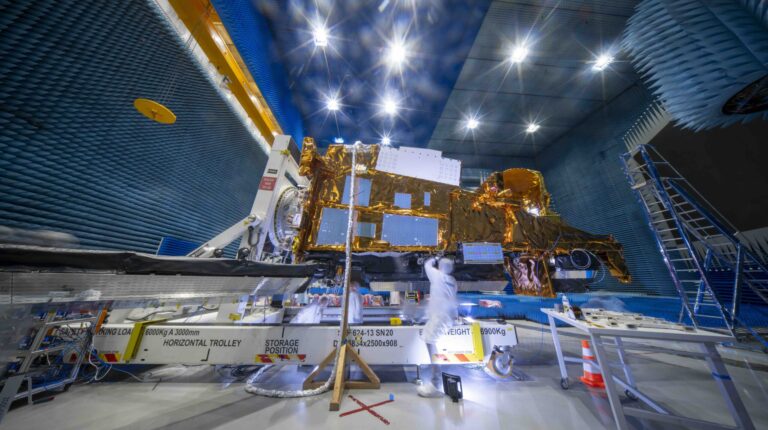
The MetOp-SG-B1 satellite – with white metal structure and bright gold pieces – undergoing tests in a large warehouse space, with a high ceiling a a scientists in the foreground in white overalls
MetOp Second Generation-B1 heads for electromagnetic compatibility tests. Image credit: ESA
Share
LinkedIn Facebook Twitter Email

The MetOP Second Generation-B1 satellite, developed by the European Space Agency (ESA) and EUMETSAT, has entered its third round of pre-launch testing, marking another step toward strengthening Europe’s weather forecasting capability. It is the second satellite in a series of six, and will join MetOp-SG-A1, which was launched on August 13 from French Guiana.

Engineers are putting the satellite through rigorous electromagnetic compatibility tests to ensure its electronic systems can operate without interfering with one another once the new weather satellite is in orbit around Earth next year, when it will partner with MetOp-SG-A1. The two are equipped with a complementary suite of instruments – 11 between them – to provide high resolution measurements of temperature, precipitation, clouds, winds and other key atmospheric and environmental variables.

Referred to by the ESA as “one of the most advanced atmospheric monitoring systems ever deployed”, the MetOp-SG mission, comprising three successive pairs of satellites, will supply meteorologists with the global data essential for predicting storms, tracking climate trends and improving the accuracy of everyday weather forecasts for more than two decades.

The MetOp-SG B-type satellites carry five instruments: a scatterometer, to provide ocean-surface wind vectors and land-surface soil moisture; a radio occultation sounder (which is also on the A-type satellites) to provide atmospheric temperature and humidity profiles as well as information about the ionosphere; a microwave imager to monitor precipitation and to assess sea-ice extent; an ice cloud imager to measure cloud-ice water; and an Argos-4 advanced data collection system, which gathers and transmits data from surface, buoy, ship, balloon and airborne platforms.

The satellite also carries a typical array of onboard computers, power systems and high-rate transmitters operating in S-, X- and Ka-bands to stream down the massive volumes of data the satellite collects.

Engineers have placed MetOp-SG-B1 inside a fully shielded anechoic chamber in Toulouse, France, to carry out exhaustive electromagnetic compatibility checks, ensuring all onboard systems can operate without interfering with one another.

The campaign includes launcher-compatibility tests, receiver-margin measurements and full-power auto-compatibility trials to confirm that the satellite’s instruments remain stable and sensitive in a harsh electromagnetic environment.

Spanning several weeks, the process blends advanced analysis with practical troubleshooting, marking the final major environmental hurdle before the satellite’s planned 2026 launch.

In related news, Sentinel-6B launches to advance global sea-level record

Previous ArticleShanghai’s MAZU-Urban early warning system rolls out globally
Next Article Zhejiang’s early warning system boosts port resilience and village safety

Read Similar Stories

Space Weather

Northumbria University secures £4m to study Earth’s radiation belts

April 16, 20262 Mins Read
Extreme Weather

AI model improves real-time prediction of wildfire spread

April 16, 20263 Mins Read
Climate Measurement

Study identifies atmospheric trigger behind flash droughts in Puerto Rico

April 15, 20263 Mins Read
Latest News

Northumbria University secures £4m to study Earth’s radiation belts

April 16, 2026

AI model improves real-time prediction of wildfire spread

April 16, 2026

Study identifies atmospheric trigger behind flash droughts in Puerto Rico

April 15, 2026

Receive breaking stories and features in your inbox each week, for free


Enter your email address:


Supplier Spotlights
  • ZX Lidars
Getting in Touch
  • Contact Us / Advertise
  • Meet the Editors
  • Media Pack
  • Free Weekly E-Newsletter
Our Social Channels
  • Facebook
  • LinkedIn
© 2026 UKi Media & Events a division of UKIP Media & Events Ltd
  • Cookie Policy
  • Privacy Policy
  • Terms and Conditions
  • Notice and Takedown Policy

Type above and press Enter to search. Press Esc to cancel.