


Close Menu
Meteorological Technology International
  • News
    • A-E
      • Agriculture
      • Automated Weather Stations
      • Aviation
      • Climate Measurement
      • Data
      • Developing Countries
      • Digital Applications
      • Early Warning Systems
      • Extreme Weather
    • G-P
      • Hydrology
      • Lidar
      • Lightning Detection
      • New Appointments
      • Nowcasting
      • Numerical Weather Prediction
      • Polar Weather
    • R-S
      • Radar
      • Rainfall
      • Remote Sensing
      • Renewable Energy
      • Satellites
      • Solar
      • Space Weather
      • Supercomputers
    • T-Z
      • Training
      • Transport
      • Weather Instruments
      • Wind
      • World Meteorological Organization
      • Meteorological Technology World Expo
  • Features
  • Online Magazines
    • January 2026
    • April 2025
    • January 2025
    • September 2024
    • April 2024
    • Archive Issues
    • Subscribe Free!
  • Opinion
  • Videos
  • Supplier Spotlight
  • Expo
LinkedIn X (Twitter) Facebook
  • Sign-up for Free Weekly E-Newsletter
  • Meet the Editors
  • Contact Us
  • Media Pack
LinkedIn Facebook
Subscribe
Meteorological Technology International
  • News
      • Agriculture
      • Automated Weather Stations
      • Aviation
      • Climate Measurement
      • Data
      • Developing Countries
      • Digital Applications
      • Early Warning Systems
      • Extreme Weather
      • Hydrology
      • Lidar
      • Lightning Detection
      • New Appointments
      • Nowcasting
      • Numerical Weather Prediction
      • Polar Weather
      • Radar
      • Rainfall
      • Remote Sensing
      • Renewable Energy
      • Satellites
      • Solar
      • Space Weather
      • Supercomputers
      • Training
      • Transport
      • Weather Instruments
      • Wind
      • World Meteorological Organization
      • Meteorological Technology World Expo
  • Features
  • Online Magazines
    1. January 2026
    2. September 2025
    3. April 2025
    4. January 2025
    5. September 2024
    6. April 2024
    7. January 2024
    8. September 2023
    9. April 2023
    10. Archive Issues
    11. Subscribe Free!
    Featured
    November 27, 2025

    In this Issue – January 2026

    By Hazel KingNovember 27, 2025
    Recent

    In this Issue – January 2026

    November 27, 2025

    In this Issue – September 2025

    August 11, 2025

    In this Issue – April 2025

    April 15, 2025
  • Opinion
  • Videos
  • Supplier Spotlight
  • Expo
Facebook LinkedIn
Subscribe
Meteorological Technology International
Lightning Detection

University of Osaka performs first observation of gamma-ray burst unleashed by lightning collision

Elizabeth BakerBy Elizabeth BakerJune 10, 20253 Mins Read
Share LinkedIn Facebook Twitter Email
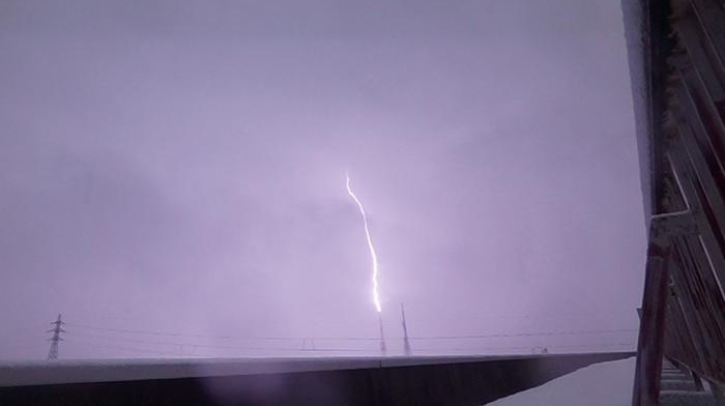
An upward positive leader that produced a downward terrestrial gamma-ray flash, extending from a television broadcast tower.
Credit: Yuuki Wada
Share
LinkedIn Facebook Twitter Email

A world-first multi-sensor detection of an intense gamma-ray flash has been observed by researchers from the University of Osaka, when two lightning leaders collided. Observations across a wide radiation spectrum enabled precise measurement of the electric current produced during this extreme event and demonstrated that the gamma-ray flash preceded the collision of the lightning leaders between the thundercloud and the ground.

The article Downward Terrestrial Gamma-ray Flash Associated with Collision of Lightning Leaders will be published in Science Advances. Led by researchers from the University of Osaka, it describes how the observation of the intense burst, known as a terrestrial gamma-ray flash (TGF), synchronized with a lightning discharge.

It had been hypothesized that TGFs arise from lightning discharges as a result of the acceleration of electrons to very high speeds. However, before the multi-sensor setup, the transient nature of this phenomenon made it difficult to confirm this hypothesis as it lasts for only tens of microseconds.

A multi-sensor setup

In this study, a multi-sensor setup was used to observe TGFs emerging from lightning storms in Kanazawa City, Ishikawa Prefecture, including optical, radiofrequency and high-energy radiation.

“The multi-sensor observations performed here are a world-first; although some mysteries remain, this technique has brought us closer to understanding the mechanism of these fascinating radiation bursts,”  said Harufumi Tsuchiya, senior author.

The research offers not only a rare glimpse into the inner workings of lightning, but also valuable data that could be used to improve the safety and resilience of structures vulnerable to high-energy atmospheric phenomena.

“The ability to study extreme processes such as TGFs originating in lightning allows us to better understand the high-energy processes occurring in Earth’s atmosphere,” explained Yuuki Wada, lead author of the study and physicist at the university.
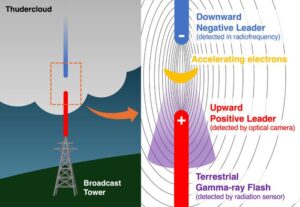
A schematic of a downward terrestrial gamma-ray flash associated with a collision of leaders.
Credit: Yuuki Wada

Discharge observation

Two discharge paths were observed, one descending from the thundercloud to the ground-based transmission tower and one ascending in the opposite direction. The researchers found that a TGF occurred just before the two discharge paths met, creating a highly concentrated electric field that accelerated electrons in the air to near light speed.

The first TGF photon was observed 31µs before the collision of the discharge paths, and the full burst lasted for 20µs after they met to form the lightning strike. A discharge of −56kA occurred as a result of the collision of lightning leaders.

According to the researchers, this observation contributes critical data to the longstanding mystery of how lightning generates enough energy to produce gamma rays – phenomena typically associated with outer space events like supernovae or black hole jets. The study also supports emerging theories about lightning leader dynamics and the potential role of thermal runaway or relativistic feedback in these extreme bursts.

In related news, researchers at the China National Energy Key Laboratory of Lightning Disaster Detection, Early Warning and Safety Protection and the Laboratory of Lightning Monitoring and Protection Technology of State Grid Corporation of China recently developed a deep learning-based nowcasting lightning model. Read the full story here

Previous ArticleSOFF Investment Phase Project in the Maldives launches with investment workshop
Next Article OPINION: How will AI weather forecasts make maximum impacts for users?

Read Similar Stories

Climate Measurement

US lightning activity reaches eight-year high in 2025, Vaisala report finds

January 14, 20263 Mins Read
Lightning Detection

MIT-developed lightning prediction tool targets safety of future aircraft

November 5, 20252 Mins Read
Lightning Detection

Arizona State University discovers record-setting lightning with geostationary satellites

August 1, 20253 Mins Read
Latest News

Northumbria University secures £4m to study Earth’s radiation belts

April 16, 2026

AI model improves real-time prediction of wildfire spread

April 16, 2026

Study identifies atmospheric trigger behind flash droughts in Puerto Rico

April 15, 2026

Receive breaking stories and features in your inbox each week, for free


Enter your email address:


Supplier Spotlights
  • Sommer GmbH
Getting in Touch
  • Contact Us / Advertise
  • Meet the Editors
  • Media Pack
  • Free Weekly E-Newsletter
Our Social Channels
  • Facebook
  • LinkedIn
© 2026 UKi Media & Events a division of UKIP Media & Events Ltd
  • Cookie Policy
  • Privacy Policy
  • Terms and Conditions
  • Notice and Takedown Policy

Type above and press Enter to search. Press Esc to cancel.