


Close Menu
Meteorological Technology International
  • News
    • A-E
      • Agriculture
      • Automated Weather Stations
      • Aviation
      • Climate Measurement
      • Data
      • Developing Countries
      • Digital Applications
      • Early Warning Systems
      • Extreme Weather
    • G-P
      • Hydrology
      • Lidar
      • Lightning Detection
      • New Appointments
      • Nowcasting
      • Numerical Weather Prediction
      • Polar Weather
    • R-S
      • Radar
      • Rainfall
      • Remote Sensing
      • Renewable Energy
      • Satellites
      • Solar
      • Space Weather
      • Supercomputers
    • T-Z
      • Training
      • Transport
      • Weather Instruments
      • Wind
      • World Meteorological Organization
      • Meteorological Technology World Expo
  • Features
  • Online Magazines
    • January 2026
    • April 2025
    • January 2025
    • September 2024
    • April 2024
    • Archive Issues
    • Subscribe Free!
  • Opinion
  • Videos
  • Supplier Spotlight
  • Expo
LinkedIn X (Twitter) Facebook
  • Sign-up for Free Weekly E-Newsletter
  • Meet the Editors
  • Contact Us
  • Media Pack
LinkedIn Facebook
Subscribe
Meteorological Technology International
  • News
      • Agriculture
      • Automated Weather Stations
      • Aviation
      • Climate Measurement
      • Data
      • Developing Countries
      • Digital Applications
      • Early Warning Systems
      • Extreme Weather
      • Hydrology
      • Lidar
      • Lightning Detection
      • New Appointments
      • Nowcasting
      • Numerical Weather Prediction
      • Polar Weather
      • Radar
      • Rainfall
      • Remote Sensing
      • Renewable Energy
      • Satellites
      • Solar
      • Space Weather
      • Supercomputers
      • Training
      • Transport
      • Weather Instruments
      • Wind
      • World Meteorological Organization
      • Meteorological Technology World Expo
  • Features
  • Online Magazines
    1. January 2026
    2. September 2025
    3. April 2025
    4. January 2025
    5. September 2024
    6. April 2024
    7. January 2024
    8. September 2023
    9. April 2023
    10. Archive Issues
    11. Subscribe Free!
    Featured
    November 27, 2025

    In this Issue – January 2026

    By Hazel KingNovember 27, 2025
    Recent

    In this Issue – January 2026

    November 27, 2025

    In this Issue – September 2025

    August 11, 2025

    In this Issue – April 2025

    April 15, 2025
  • Opinion
  • Videos
  • Supplier Spotlight
  • Expo
Facebook LinkedIn
Subscribe
Meteorological Technology International
Lightning Detection

Arizona State University discovers record-setting lightning with geostationary satellites

Elizabeth BakerBy Elizabeth BakerAugust 1, 20253 Mins Read
Share LinkedIn Facebook Twitter Email
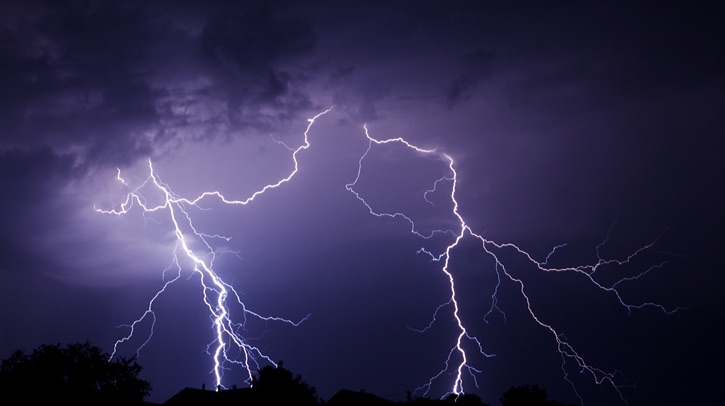
A lightning strike lights up the sky
Share
LinkedIn Facebook Twitter Email

Researchers at Arizona State University have used satellite-borne lightning detectors to measure a record-setting lightning megaflash that streaked across the Great Plains for 515 miles during a major thunderstorm in October 2017. Its horizontal reach surpassed the previous record-holder by 38 miles yet went unnoticed until this re-examination of satellite observations of the storm.

Leveraging geostationary satellites

Satellite-borne lightning detectors in orbit since 2017 have made it possible to continuously detect lightning and measure it accurately at continental-scale distances. Parked in geostationary orbit, the National Oceanic and Atmospheric Administration’s GOES-16 satellite detects around one million lightning flashes per day. It is the first of four NOAA satellites equipped with geostationary lightning mappers, joined by similar satellites launched by Europe and China.

“Our weather satellites carry very exacting lightning detection equipment that we can use to document to the millisecond when a lightning flash starts and how far it travels,” said  Randy Cerveny, an Arizona State University president’s professor in the School of Geographical Sciences and Urban Planning.

“Adding continuous measurements from geostationary orbit was a major advance,” said Michael Peterson at the Georgia Tech Research Institute. “We are now at a point where most of the global megaflash hotspots are covered by a geostationary satellite, and data processing techniques have improved to properly represent flashes in the vast quantity of observational data at all scales.” Peterson is first author of a report in the Bulletin of the American Meteorological Society documenting the new lightning record.
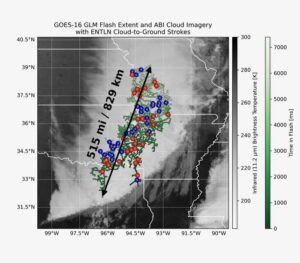
GOES-16 satellite image recording a record-setting 515-mile lightning megaflash during a storm in October 2017. Red circles mark positively charged branches of the lightning, and blue circles mark negatively charged branches. Credit: World Meteorological Organization, American Meteorological Society

Studying lightning megaflashes

According to satellite observations analyzed by Peterson, less than 1% of thunderstorms produce megaflash lightning (a lightning bolt that reaches beyond 100km). They arise from storms that are long-lived, typically brewing for 14 hours or more, and massive in size, covering an area comparable in square miles to the state of New Jersey. The average megaflash shoots off five to seven ground-striking branches from its horizontal path across the sky.

“We call it megaflash lightning and we’re just now figuring out the mechanics of how and why it occurs,” said Cerveny, who serves as rapporteur of weather and climate extremes for the World Meteorological Organization, the weather agency of the United Nations. “It is likely that even greater extremes still exist, and that we will be able to observe them as additional high-quality lightning measurements accumulate over time.”

While megaflashes that extend hundreds of miles are rare, it’s not at all unusual for lightning to strike 10 or 15 miles from its storm-cloud origin, Cerveny said. And that adds to the danger. Cerveny highlighted that people don’t realize how far lightning can reach from its parent thunderstorm.

“That’s why you should wait at least a half an hour after a thunderstorm passes before you go out and resume normal activities,” Cerveny said. “The storm that produces a lightning strike doesn’t have to be over the top of you.”

In related news, a world-first multi-sensor detection of an intense gamma-ray flash was recently observed by researchers from the University of Osaka, when two lightning leaders collided. Observations across a wide radiation spectrum enabled precise measurement of the electric current produced during this extreme event and demonstrated that the gamma-ray flash preceded the collision of the lightning leaders between the thundercloud and the ground. Read the full story here

Previous ArticleCyprus launches AI funding program to develop early warning system for extreme weather
Next Article Weathernews Inc. signs MOU with Vietnam Meteorological and Hydrological Administration for AI-based typhoon and heavy rain forecasting

Read Similar Stories

Space Weather

Northumbria University secures £4m to study Earth’s radiation belts

April 16, 20262 Mins Read
Extreme Weather

AI model improves real-time prediction of wildfire spread

April 16, 20263 Mins Read
Satellites

AI tool uses weather satellite data to map ocean currents in near real time

April 14, 20263 Mins Read
Latest News

Northumbria University secures £4m to study Earth’s radiation belts

April 16, 2026

AI model improves real-time prediction of wildfire spread

April 16, 2026

Study identifies atmospheric trigger behind flash droughts in Puerto Rico

April 15, 2026

Receive breaking stories and features in your inbox each week, for free


Enter your email address:


Supplier Spotlights
  • Raymetrics
Getting in Touch
  • Contact Us / Advertise
  • Meet the Editors
  • Media Pack
  • Free Weekly E-Newsletter
Our Social Channels
  • Facebook
  • LinkedIn
© 2026 UKi Media & Events a division of UKIP Media & Events Ltd
  • Cookie Policy
  • Privacy Policy
  • Terms and Conditions
  • Notice and Takedown Policy

Type above and press Enter to search. Press Esc to cancel.