


Close Menu
Meteorological Technology International
  • News
    • A-E
      • Agriculture
      • Automated Weather Stations
      • Aviation
      • Climate Measurement
      • Data
      • Developing Countries
      • Digital Applications
      • Early Warning Systems
      • Extreme Weather
    • G-P
      • Hydrology
      • Lidar
      • Lightning Detection
      • New Appointments
      • Nowcasting
      • Numerical Weather Prediction
      • Polar Weather
    • R-S
      • Radar
      • Rainfall
      • Remote Sensing
      • Renewable Energy
      • Satellites
      • Solar
      • Space Weather
      • Supercomputers
    • T-Z
      • Training
      • Transport
      • Weather Instruments
      • Wind
      • World Meteorological Organization
      • Meteorological Technology World Expo
  • Features
  • Online Magazines
    • January 2026
    • April 2025
    • January 2025
    • September 2024
    • April 2024
    • Archive Issues
    • Subscribe Free!
  • Opinion
  • Videos
  • Supplier Spotlight
  • Expo
LinkedIn X (Twitter) Facebook
  • Sign-up for Free Weekly E-Newsletter
  • Meet the Editors
  • Contact Us
  • Media Pack
LinkedIn Facebook
Subscribe
Meteorological Technology International
  • News
      • Agriculture
      • Automated Weather Stations
      • Aviation
      • Climate Measurement
      • Data
      • Developing Countries
      • Digital Applications
      • Early Warning Systems
      • Extreme Weather
      • Hydrology
      • Lidar
      • Lightning Detection
      • New Appointments
      • Nowcasting
      • Numerical Weather Prediction
      • Polar Weather
      • Radar
      • Rainfall
      • Remote Sensing
      • Renewable Energy
      • Satellites
      • Solar
      • Space Weather
      • Supercomputers
      • Training
      • Transport
      • Weather Instruments
      • Wind
      • World Meteorological Organization
      • Meteorological Technology World Expo
  • Features
  • Online Magazines
    1. January 2026
    2. September 2025
    3. April 2025
    4. January 2025
    5. September 2024
    6. April 2024
    7. January 2024
    8. September 2023
    9. April 2023
    10. Archive Issues
    11. Subscribe Free!
    Featured
    November 27, 2025

    In this Issue – January 2026

    By Hazel KingNovember 27, 2025
    Recent

    In this Issue – January 2026

    November 27, 2025

    In this Issue – September 2025

    August 11, 2025

    In this Issue – April 2025

    April 15, 2025
  • Opinion
  • Videos
  • Supplier Spotlight
  • Expo
Facebook LinkedIn
Subscribe
Meteorological Technology International
Hydrology

Virginia Tech researchers use deep learning to predict flooding

Elizabeth BakerBy Elizabeth BakerJune 3, 20253 Mins Read
Share LinkedIn Facebook Twitter Email
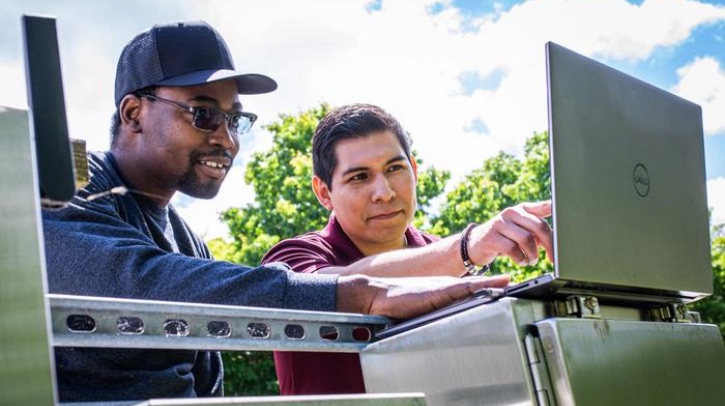
Two men work cheerfully at a laptop, with a blue sky and trees in the background.
(From left) Samuel Daramola and David Munoz analyze water level data to better predict future storms. Credit: Peter Means for Virginia Tech
Share
LinkedIn Facebook Twitter Email

A recent study published in Water Resources Research by civil and environmental engineering graduate student Samuel Daramola – along with faculty advisor David F. Muñoz and collaborators Siddharth Saksena, Jennifer Irish, and Paul Muñoz from Vrije Universiteit Brussel in Belgium – has introduced a deep learning framework to predict the rise and fall of water levels during storms – even in places where tide gauges fail or data is scarce – through a technique known as ‘transfer learning’.

This research was made possible by support from the National Science Foundation, CAS-Climate Program, and the Virginia Sea Grant Fellowship. The framework, called Long Short-Term Memory Station Approximated Models (LSTM-SAM), offers faster and more affordable predictions that enable smarter decisions about when to evacuate, where to place emergency resources, and how to protect infrastructure when hurricanes approach, the researchers said. It is expected to have applications for emergency planners, local governments and disaster response teams.

Predicting floods with transfer learning

LSTM-SAM analyzes patterns from past storms to predict water level rise during future storms. According to the researchers, what makes this model especially useful is its ability to extrapolate from one geographic area’s data to make predictions for another locale that doesn’t have a lot of its own data. By borrowing knowledge and applying it locally, it is expected to make accurate flood prediction more widely available than it has been under conventional physical-based models, due to their reliance on long-term data records and high-powered computers.

“Our goal was to create an efficient transfer learning method that leverages pre-trained deep learning models,” said Daramola. “This is key to quickly assessing many flood-prone areas after a hurricane.”

Testing with coastal flood predictions

The researchers tested LSTM-SAM at tide gauge stations along the Atlantic coast of the USA, a region frequently affected by hurricanes and other major storms. They found that the model was able to accurately predict the onset, peak and decline of storm-driven water levels. The model was even able to reconstruct water levels for tide-gauge stations damaged by hurricanes, such as the station in Sandy Hook, New Jersey, which failed during Hurricane Sandy in 2012.

Researchers plan on using the LSTM-SAM framework during the upcoming hurricane season, where they can test it as storms roll in near real time. They’ve also made the code available in the GitHub repository of the CoRAL Lab, where scientists, emergency planners and government leaders can download it for free. The program has been designed to run on a laptop in a matter of minutes so it can be helpful for smaller towns or regions in developing countries where access to high-end computing tools or detailed environmental data is limited.

“Other studies have relied on repetitive patterns in the training data,” Daramola said. “Our approach is different. We highlight extreme changes in water levels during training, which helps the model better recognize important patterns and perform more reliably in those areas.”

In related news, India’s Ministry of Earth Sciences (MoES) has recently begun exploring the integration of AI technologies into weather and climate forecasting systems and physics-based numerical models. Read the full story here

Previous ArticleIndia unveils indigenously developed high-resolution forecast system
Next Article Tajikistan hosts international conference on preservation of glaciers

Read Similar Stories

Extreme Weather

AI model improves real-time prediction of wildfire spread

April 16, 20263 Mins Read
Climate Measurement

Study identifies atmospheric trigger behind flash droughts in Puerto Rico

April 15, 20263 Mins Read
Satellites

AI tool uses weather satellite data to map ocean currents in near real time

April 14, 20263 Mins Read
Latest News

Northumbria University secures £4m to study Earth’s radiation belts

April 16, 2026

AI model improves real-time prediction of wildfire spread

April 16, 2026

Study identifies atmospheric trigger behind flash droughts in Puerto Rico

April 15, 2026

Receive breaking stories and features in your inbox each week, for free


Enter your email address:


Supplier Spotlights
  • GAMIC GmbH
Getting in Touch
  • Contact Us / Advertise
  • Meet the Editors
  • Media Pack
  • Free Weekly E-Newsletter
Our Social Channels
  • Facebook
  • LinkedIn
© 2026 UKi Media & Events a division of UKIP Media & Events Ltd
  • Cookie Policy
  • Privacy Policy
  • Terms and Conditions
  • Notice and Takedown Policy

Type above and press Enter to search. Press Esc to cancel.