


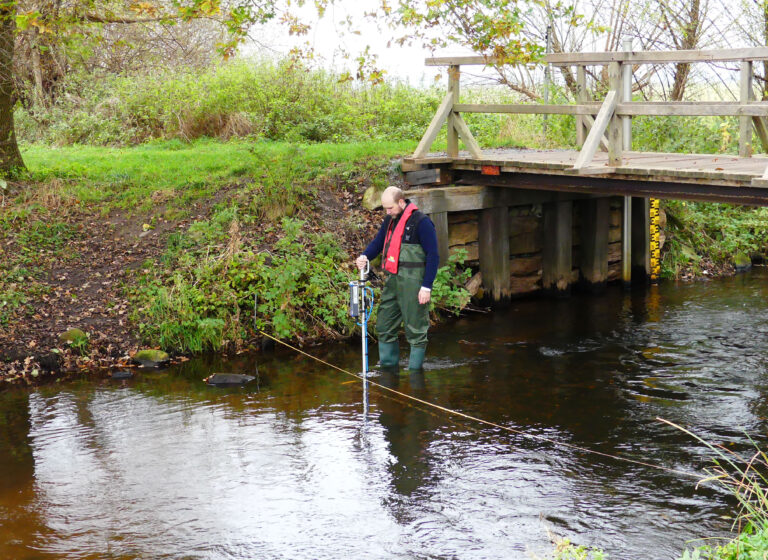
Instrumentation company Nivus has developed a handheld portable flow monitoring technology in response to a requirement that was originally identified by the Environment Agency (EA).
In 2018, the EA hydrometry team challenged the instrumentation sector to develop a handheld portable flow monitoring solution for small rivers and streams. This prompted a development program at Nivus that culminated in the launch of a new instrument, the ‘NivuFlow Stick’ which is now used by regulators, hydrologists, consultants and academia worldwide.
In addition to flood risk, the Environment Agency’s (EA) responsibilities also include conservation, ecology, water resources, fisheries, rivers and estuaries. The management of these responsibilities is informed by measurement data, so the agency operates a comprehensive flow monitoring program in England, which includes around 1,500 structures, such as flumes and weirs.
The EA also operates a fleet of portable flow monitoring devices, which are used on smaller flows, on investigations, and to check the ongoing accuracy of the agency’s continuous monitors. “Portable flow meters perform a vital role, but flexibility is important,” explained Olly Baldwyn, a senior advisor in the EA’s national hydrometry team. “They need to be able to measure shallow flow conditions both at fixed monitoring stations and at other remote locations such as abstraction points… and this is where we identified a gap in the available technology.
“In 2018 we were using floating ADCP instruments and portable single-point velocity meters in our work, but neither of these solutions was ideal for water between 4cm and 30cm in depth. We therefore included this in our procurement specifications, with the additional requirement to be able to take multi-point velocity measurements more efficiently.”
Flow monitoring at the EA informs flood warning and forecasting operations, as well as helping to manage and protect water resources. This includes the management of abstraction licenses for drinking water, agriculture and industry, as well as the protection of water resources for recreation and biodiversity. Flow monitoring also informs the agency’s work to monitor long-term indicators of change in climate or catchments.
Explaining the company’s response to the opportunity, Andy Kenworthy, technical sales engineer at Nivus, said, “We already manufactured fixed continuous flow monitoring devices employing ultrasonic cross-correlation technology, so we focused on the development of a portable version, that could deliver the EA’s performance requirements in a lightweight, battery-powered instrument.
“A prototype was demonstrated in late 2018 and the first evaluation units were delivered to the EA early the next year. These instruments were successfully tested at reference sites, and production versions of the NivuFlow Stick were available soon thereafter,” Kenworthy said. “NivuFlow Stick instruments are now employed by the majority of the Agency’s 23 hydrometry teams, and routinely used in the training of new recruits. As well as meeting the EA’s performance requirements, I know the NivuFlow Stick is particularly useful in training sessions because it can connect wirelessly with up to four devices simultaneously – such as mobiles, tablets and laptops.”
Developed in accordance with the requirements of BS EN ISO 748:2021, the NivuFlow Stick has been designed to be a simple-to-use, handheld portable instrument for fast, accurate flow velocity measurements using the ultrasonic cross-correlation measurement principle. In contrast with more traditional methods, it simultaneously measures water velocities at multiple heights through the water column with very high resolution.
“In the time that it takes a single-point velocity meter to make a single reading at one height in the water column, the NivuFlow Stick is able calculate a full water depth velocity profile using up to 16 measurements, which means that monitoring work is faster, safer and more accurate,” explained Kenworthy.
Read more of the latest weather instruments updates from the meteorological technology industry, here.