


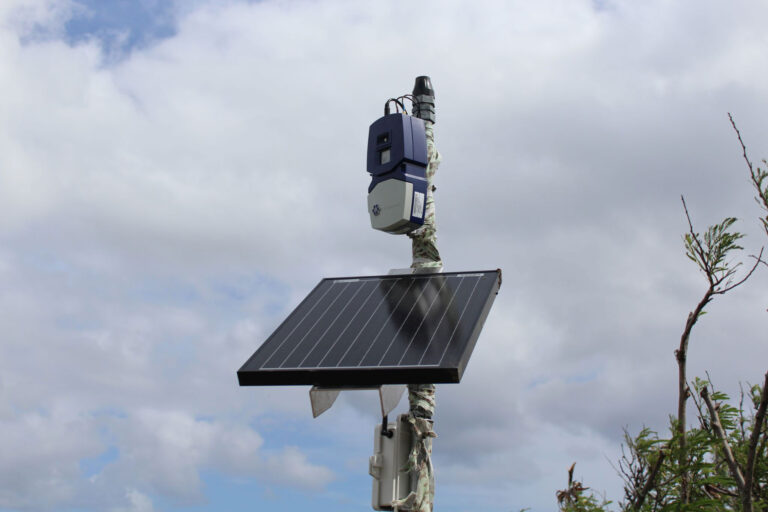
The US Department of Homeland Security (DHS) Science and Technology Directorate (S&T) and US Fire Administration (USFA) is to deploy 80 wildfire sensors and 16 wind sensors across the Hawaiian Islands.
Hawaii will be the first location to receive the new Beta wildfire sensors developed by DHS S&T and USFA in coordination with small business N5 Sensors. The Department will deploy 200 Beta wildfire sensors to high-risk areas across the USA in 2024 for operational testing and evaluation, including the 80 sensors across the Hawaiian Islands. This first round of fire sensors is being provided at no cost to the state of Hawaii.
These wildfire detection sensors identify changes in conditions before wildfires start, providing 24-hour sensing and alerting capabilities. The sensors continuously transmit information and send an email or text notification to a pre-programmed contact when these components are detected. The system housing the sensors is small and compact, able to sit on a utility pole or a traffic light and can work in all weather conditions.
DHS S&T, in collaboration with FEMA and USFA, undertook wildfire sensor research after a successful five-year effort to test and develop flood sensors. In 2023, the wildfire sensor initiative deployed 200 initial Alpha phase pilot sensors in collaboration with state and local government stakeholders throughout the USA and Canada. Those sensors continue to provide fire alerts and warnings and have collected over 1,000,000 hours of data in the field to enhance the artificial intelligence (AI) learning algorithms now being deployed in the Beta version, which requires less solar power to recharge, is equipped with wind sensors to increase the accuracy of wildfire location prediction, and has a better ability to operate in areas with limited cellular coverage.
The initiative is intended to support long-term recovery efforts following the unprecedented August 2023 wildfires on Maui, Hawaii and drive responses to extreme weather events. As wildfires become more frequent and severe, advanced sensors will enable first responders to suppress an initial blaze before it spreads and grant time needed for communities to make life-saving evacuation decisions.
“In the aftermath of the devastating wildfires that struck Maui last summer, the Biden-Harris Administration and the Department of Homeland Security vowed not just to help Hawaii recover, but also to help safeguard it against the tragic destruction of another such fire,” said Secretary of Homeland Security Alejandro N Mayorkas.
“We continue to execute on that promise. Today we are deploying dozens of state-of-the-art fire and wind sensors in strategic locations across the Hawaiian Islands to enable local officials and firefighters to quickly target an initial blaze and initiate evacuation procedures. As wildfires and other climate change-driven challenges increase in frequency and severity, our department will continue working every day to develop innovative solutions and deploy them across the country for the safety and security of our communities.”
“Wildfire risk continues to increase across the nation as we live through unprecedented heatwaves and drought spurred by climate change,” said Federal Emergency Management Agency (FEMA) Administrator Deanne Criswell. “This collaboration between the US Fire Administration, the Department of Homeland Security and S&T to deploy these new wildfire and wind sensors is a huge step forward in the work we’re doing to prevent and mitigate against future wildfires in Hawaii. Ultimately, this technology will help our firefighters respond faster, save lives and keep residents safe from future fire events.”
“The wildfire challenge we face as a nation today, and the solutions to it, are complex,” said US Fire Administrator Dr Lori Moore Merrell. “Protecting our nation’s homelands against fire and hazardous threats requires continued collaborative research and development in the field of firefighting. The deployment of these sensors marks a major step forward in wildfire prevention and mitigation, enhancing our capabilities for predicting the incidence and spread of large-scale fires.”
“DHS S&T’s research and development is laying the groundwork for breakthroughs that have the potential to improve fire safety and firefighting efforts,” said Dr Dimitri Kusnezov, Under Secretary for Science and Technology. “The sensors deployed today are more effective than traditional optical cameras or thermal imaging sensors as they ‘sniff’ out the fires as soon as they start. This announcement today reflects our continued commitment to utilizing the latest advancements in technology and data-driven insights to ensure communities have the resources needed to respond in real time to wildfires.”
Read more of the latest remote sensing updates from the meteorological technology industry, here.