


Close Menu
Meteorological Technology International
  • News
    • A-E
      • Agriculture
      • Automated Weather Stations
      • Aviation
      • Climate Measurement
      • Data
      • Developing Countries
      • Digital Applications
      • Early Warning Systems
      • Extreme Weather
    • G-P
      • Hydrology
      • Lidar
      • Lightning Detection
      • New Appointments
      • Nowcasting
      • Numerical Weather Prediction
      • Polar Weather
    • R-S
      • Radar
      • Rainfall
      • Remote Sensing
      • Renewable Energy
      • Satellites
      • Solar
      • Space Weather
      • Supercomputers
    • T-Z
      • Training
      • Transport
      • Weather Instruments
      • Wind
      • World Meteorological Organization
      • Meteorological Technology World Expo
  • Features
  • Online Magazines
    • January 2026
    • April 2025
    • January 2025
    • September 2024
    • April 2024
    • Archive Issues
    • Subscribe Free!
  • Opinion
  • Videos
  • Supplier Spotlight
  • Expo
LinkedIn X (Twitter) Facebook
  • Sign-up for Free Weekly E-Newsletter
  • Meet the Editors
  • Contact Us
  • Media Pack
LinkedIn Facebook
Subscribe
Meteorological Technology International
  • News
      • Agriculture
      • Automated Weather Stations
      • Aviation
      • Climate Measurement
      • Data
      • Developing Countries
      • Digital Applications
      • Early Warning Systems
      • Extreme Weather
      • Hydrology
      • Lidar
      • Lightning Detection
      • New Appointments
      • Nowcasting
      • Numerical Weather Prediction
      • Polar Weather
      • Radar
      • Rainfall
      • Remote Sensing
      • Renewable Energy
      • Satellites
      • Solar
      • Space Weather
      • Supercomputers
      • Training
      • Transport
      • Weather Instruments
      • Wind
      • World Meteorological Organization
      • Meteorological Technology World Expo
  • Features
  • Online Magazines
    1. January 2026
    2. September 2025
    3. April 2025
    4. January 2025
    5. September 2024
    6. April 2024
    7. January 2024
    8. September 2023
    9. April 2023
    10. Archive Issues
    11. Subscribe Free!
    Featured
    November 27, 2025

    In this Issue – January 2026

    By Hazel KingNovember 27, 2025
    Recent

    In this Issue – January 2026

    November 27, 2025

    In this Issue – September 2025

    August 11, 2025

    In this Issue – April 2025

    April 15, 2025
  • Opinion
  • Videos
  • Supplier Spotlight
  • Expo
Facebook LinkedIn
Subscribe
Meteorological Technology International
Developing Countries

Djibouti successfully issues first Common Alerting Protocol warning

Alex PackBy Alex PackOctober 7, 20252 Mins Read
Share LinkedIn Facebook Twitter Email
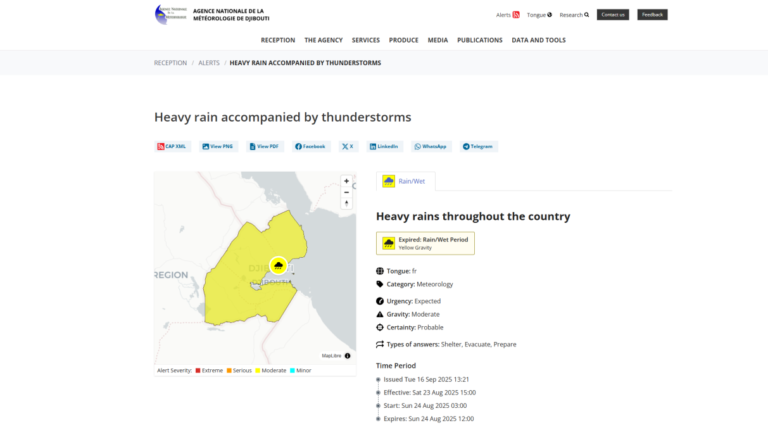
A screenshot of Djibouti's Common Alerting Protocol warning system.
Share
LinkedIn Facebook Twitter Email

The National Meteorological Agency of Djibouti (ANM) successfully issued its first Common Alerting Protocol (CAP) warning in September through its new website.

A CAP warning is a standardized format for exchanging all-hazard emergency alerts and public warnings. It delivers real-time actionable risk information to relevant stakeholders and at-risk communities.

The upgraded platform, developed by the WMO Regional Office for Africa, is said to be the first centralized hub for disseminating critical risk information and strengthening early warning communication in the country.

The modern CMS web template has tools for marketing integration and for advanced interactive climate data visualization to personalize user experience.

Additionally, the website has an integrated CAP editor – a key element in ensuring that early warnings are issued and communicated to the entire population.

The moderate warning issued by ANM warned of heavy rain of more than 50mm throughout the country, with a risk of localized flooding in low-lying areas and flash flooding in urban areas.

In the message, a set of instructions was shared as guidelines for the public, ensuring better preparedness for this hydrometeorological event.

The move marks a significant step in Djibouti’s US$3.6m Climate Risk and Early Warning Systems Initiative (CREWS) project.

Jointly implemented by the WMO and the United Nations Agency for Disaster Risk Reduction (UNDR), the project aims to improve the production, delivery and dissemination of multi-hazard early warning systems, enabling better preparedness, early action and response to hazardous hydrometeorological events affecting Djibouti.

The WMO is mandated to ensure its members are CAP compliant to enhance preparedness, early action and response efforts related to hazardous hydrometeorological events.

In related news, Uganda is set to upgrade its early warning systems with support from the FMI and WMO

Previous ArticleWildfire smoke and urban pollution are merging to create more toxic air in US cities, Colorado State study finds
Next Article Dr Stuart Minchin appointed CEO of the Australian Bureau of Meteorology

Read Similar Stories

Extreme Weather

AI model improves real-time prediction of wildfire spread

April 16, 20263 Mins Read
Climate Measurement

Study identifies atmospheric trigger behind flash droughts in Puerto Rico

April 15, 20263 Mins Read
Climate Measurement

Regional training aims to improve flood forecasting in Central Africa

April 1, 20263 Mins Read
Latest News

Northumbria University secures £4m to study Earth’s radiation belts

April 16, 2026

AI model improves real-time prediction of wildfire spread

April 16, 2026

Study identifies atmospheric trigger behind flash droughts in Puerto Rico

April 15, 2026

Receive breaking stories and features in your inbox each week, for free


Enter your email address:


Supplier Spotlights
  • ELDES S.r.l.
Getting in Touch
  • Contact Us / Advertise
  • Meet the Editors
  • Media Pack
  • Free Weekly E-Newsletter
Our Social Channels
  • Facebook
  • LinkedIn
© 2026 UKi Media & Events a division of UKIP Media & Events Ltd
  • Cookie Policy
  • Privacy Policy
  • Terms and Conditions
  • Notice and Takedown Policy

Type above and press Enter to search. Press Esc to cancel.