


Close Menu
Meteorological Technology International
  • News
    • A-E
      • Agriculture
      • Automated Weather Stations
      • Aviation
      • Climate Measurement
      • Data
      • Developing Countries
      • Digital Applications
      • Early Warning Systems
      • Extreme Weather
    • G-P
      • Hydrology
      • Lidar
      • Lightning Detection
      • New Appointments
      • Nowcasting
      • Numerical Weather Prediction
      • Polar Weather
    • R-S
      • Radar
      • Rainfall
      • Remote Sensing
      • Renewable Energy
      • Satellites
      • Solar
      • Space Weather
      • Supercomputers
    • T-Z
      • Training
      • Transport
      • Weather Instruments
      • Wind
      • World Meteorological Organization
      • Meteorological Technology World Expo
  • Features
  • Online Magazines
    • January 2026
    • April 2025
    • January 2025
    • September 2024
    • April 2024
    • Archive Issues
    • Subscribe Free!
  • Opinion
  • Videos
  • Supplier Spotlight
  • Expo
LinkedIn X (Twitter) Facebook
  • Sign-up for Free Weekly E-Newsletter
  • Meet the Editors
  • Contact Us
  • Media Pack
LinkedIn Facebook
Subscribe
Meteorological Technology International
  • News
      • Agriculture
      • Automated Weather Stations
      • Aviation
      • Climate Measurement
      • Data
      • Developing Countries
      • Digital Applications
      • Early Warning Systems
      • Extreme Weather
      • Hydrology
      • Lidar
      • Lightning Detection
      • New Appointments
      • Nowcasting
      • Numerical Weather Prediction
      • Polar Weather
      • Radar
      • Rainfall
      • Remote Sensing
      • Renewable Energy
      • Satellites
      • Solar
      • Space Weather
      • Supercomputers
      • Training
      • Transport
      • Weather Instruments
      • Wind
      • World Meteorological Organization
      • Meteorological Technology World Expo
  • Features
  • Online Magazines
    1. January 2026
    2. September 2025
    3. April 2025
    4. January 2025
    5. September 2024
    6. April 2024
    7. January 2024
    8. September 2023
    9. April 2023
    10. Archive Issues
    11. Subscribe Free!
    Featured
    November 27, 2025

    In this Issue – January 2026

    By Hazel KingNovember 27, 2025
    Recent

    In this Issue – January 2026

    November 27, 2025

    In this Issue – September 2025

    August 11, 2025

    In this Issue – April 2025

    April 15, 2025
  • Opinion
  • Videos
  • Supplier Spotlight
  • Expo
Facebook LinkedIn
Subscribe
Meteorological Technology International
Climate Measurement

September 2025 was the third warmest on record, says Copernicus

Alex PackBy Alex PackOctober 9, 20253 Mins Read
Share LinkedIn Facebook Twitter Email
A thermometer measuring the outdoor temperature on a sunny day with blue skies
Share
LinkedIn Facebook Twitter Email

The Copernicus Climate Change Service (C3S) has reported that September 2025 was the third-warmest September globally, continuing a persistent trend of exceptional warmth across both land and ocean surfaces.

According to data from the ERA5 reanalysis dataset, the global average surface air temperature reached 16.11°C, which is 0.66°C above the 1991-2020 average for September and 1.47°C higher than pre-industrial levels. This makes September 2025 only marginally cooler – by 0.07° – than September 2024, and 0.27°C cooler than the record set in 2023.

“The global temperature in September 2025 was the third warmest on record, nearly as high as in September 2024, less than a tenth of a degree cooler,” said Samantha Burgess, strategic lead for climate at ECMWF. “A year on, the global temperature context remains much the same, with persistently high land and sea surface temperatures reflecting the continuing influence of greenhouse gas accumulation in the atmosphere.”
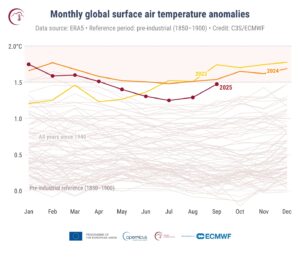
September 2025 was the third warmest on record, says Copernicus.
Monthly global surface air temperature anomalies (°C) relative to the 1850–1900 pre-industrial reference period from January 1940 to September 2025, plotted as time series for each year. The year 2025 as well as the two warmest calendar years are shown in colour: 2025 in dark red, 2024 in orange and 2023 in yellow. All other years are shown with thin grey lines. Data source: ERA5. Credit: Copernicus Climate Change Service / ECMWF

Regional temperature patterns

Across Europe, average land temperatures were 1.23°C above the 1991–2020 average, making it the fifth-warmest September on record for the continent. The most significant above-average anomalies were observed over Fennoscandia and Eastern Europe, while only parts of Western Europe were slightly cooler than average.

Globally, above-average warmth was particularly pronounced over Canada, Greenland, northwestern Siberia, and large areas of Antarctica, with cooler-than-average conditions limited to northern central Siberia, western Australia, and parts of eastern Antarctica.

Sea surface and sea ice conditions

The global sea surface temperature (SST) averaged 20.72°C, the third-highest for September on record, remaining exceptionally high in the North Pacific and around Northern Europe. ENSO-neutral conditions prevailed, with near- or below-average SSTs in the central and eastern equatorial Pacific.

In the Arctic, daily sea ice extent reached its 14th-lowest annual minimum, and its monthly extent was 12% below the long-term average, while Antarctic daily sea ice extent recorded its third-lowest annual maximum, and the monthly extent was about 5% below average.

Hydrological extremes

September brought wetter-than-average conditions to northwestern and central Europe, Fennoscandia and parts of southern and eastern Europe, with localized flooding. Drier-than-average conditions persisted over the Iberian Peninsula, the Balkans, and parts of Ukraine and western Russia.

Beyond Europe, heavy rainfall and flooding affected regions from the southwestern USA to eastern China, often linked to tropical cyclone activity. Conversely, drought-like conditions persisted in parts of Canada, eastern USA, northern India and northeastern Brazil.

In related news, Study finds climate change may lead to less frequent but more devastating hailstorms in Europe

Previous ArticleMet Office launches space weather modeling suite for upper atmosphere forecasting
Next Article Meteomatics reaches milestone in US expansion with new headquarters

Read Similar Stories

Extreme Weather

AI model improves real-time prediction of wildfire spread

April 16, 20263 Mins Read
Climate Measurement

Study identifies atmospheric trigger behind flash droughts in Puerto Rico

April 15, 20263 Mins Read
Satellites

AI tool uses weather satellite data to map ocean currents in near real time

April 14, 20263 Mins Read
Latest News

Northumbria University secures £4m to study Earth’s radiation belts

April 16, 2026

AI model improves real-time prediction of wildfire spread

April 16, 2026

Study identifies atmospheric trigger behind flash droughts in Puerto Rico

April 15, 2026

Receive breaking stories and features in your inbox each week, for free


Enter your email address:


Supplier Spotlights
  • Raymetrics
Getting in Touch
  • Contact Us / Advertise
  • Meet the Editors
  • Media Pack
  • Free Weekly E-Newsletter
Our Social Channels
  • Facebook
  • LinkedIn
© 2026 UKi Media & Events a division of UKIP Media & Events Ltd
  • Cookie Policy
  • Privacy Policy
  • Terms and Conditions
  • Notice and Takedown Policy

Type above and press Enter to search. Press Esc to cancel.