


Close Menu
Meteorological Technology International
  • News
    • A-E
      • Agriculture
      • Automated Weather Stations
      • Aviation
      • Climate Measurement
      • Data
      • Developing Countries
      • Digital Applications
      • Early Warning Systems
      • Extreme Weather
    • G-P
      • Hydrology
      • Lidar
      • Lightning Detection
      • New Appointments
      • Nowcasting
      • Numerical Weather Prediction
      • Polar Weather
    • R-S
      • Radar
      • Rainfall
      • Remote Sensing
      • Renewable Energy
      • Satellites
      • Solar
      • Space Weather
      • Supercomputers
    • T-Z
      • Training
      • Transport
      • Weather Instruments
      • Wind
      • World Meteorological Organization
      • Meteorological Technology World Expo
  • Features
  • Online Magazines
    • January 2026
    • April 2025
    • January 2025
    • September 2024
    • April 2024
    • Archive Issues
    • Subscribe Free!
  • Opinion
  • Videos
  • Supplier Spotlight
  • Expo
LinkedIn X (Twitter) Facebook
  • Sign-up for Free Weekly E-Newsletter
  • Meet the Editors
  • Contact Us
  • Media Pack
LinkedIn Facebook
Subscribe
Meteorological Technology International
  • News
      • Agriculture
      • Automated Weather Stations
      • Aviation
      • Climate Measurement
      • Data
      • Developing Countries
      • Digital Applications
      • Early Warning Systems
      • Extreme Weather
      • Hydrology
      • Lidar
      • Lightning Detection
      • New Appointments
      • Nowcasting
      • Numerical Weather Prediction
      • Polar Weather
      • Radar
      • Rainfall
      • Remote Sensing
      • Renewable Energy
      • Satellites
      • Solar
      • Space Weather
      • Supercomputers
      • Training
      • Transport
      • Weather Instruments
      • Wind
      • World Meteorological Organization
      • Meteorological Technology World Expo
  • Features
  • Online Magazines
    1. January 2026
    2. September 2025
    3. April 2025
    4. January 2025
    5. September 2024
    6. April 2024
    7. January 2024
    8. September 2023
    9. April 2023
    10. Archive Issues
    11. Subscribe Free!
    Featured
    November 27, 2025

    In this Issue – January 2026

    By Hazel KingNovember 27, 2025
    Recent

    In this Issue – January 2026

    November 27, 2025

    In this Issue – September 2025

    August 11, 2025

    In this Issue – April 2025

    April 15, 2025
  • Opinion
  • Videos
  • Supplier Spotlight
  • Expo
Facebook LinkedIn
Subscribe
Meteorological Technology International
Climate Measurement

Met Office research could enhance long-range forecasting

Elizabeth BakerBy Elizabeth BakerOctober 11, 20243 Mins Read
Share LinkedIn Facebook Twitter Email
Scientists at the Met Office have discovered that, away from the tropics, the El Niño-Southern Oscillation (ENSO) can influence Atlantic weather patterns a full year from the original event.
Share
LinkedIn Facebook Twitter Email

Scientists at the Met Office have discovered that, away from the tropics, the El Niño-Southern Oscillation (ENSO) can influence Atlantic weather patterns a full year from the original event.

Their paper, named ENSO affects the North Atlantic Oscillation one year later, was published in Science and written by Adam A. Scaife, Nick Dunstone, Steven Hardiman, Sarah Ineson, Chaofan Li, Riyu Lu, Bo Pang, Albert Klein-Tank, Doug Smith, Annelize van Niekerk, James Renwick and Ned Williams.

Key findings from the ENSO research paper

The research showed this one-year lagged extratropical response to ENSO is as strong as the simultaneous response but with an opposite impact. For example, it has now been shown El Niño, which can increase the chance of colder winters in the UK, can result in a milder winter period the following year. While ENSO is just one of many drivers that influence the UK weather, it can be important, particularly in the winter months.

Adam Scaife, the report’s lead researcher and a professor at the Met Office, said, “This latest research reveals that El Niño is often followed by positive North Atlantic Oscillation (NAO) a whole year later, while La Niña is followed by negative NAO one year later. This has major implications for understanding ENSO, explaining our winter climate variability and interpreting long-range predictions.”
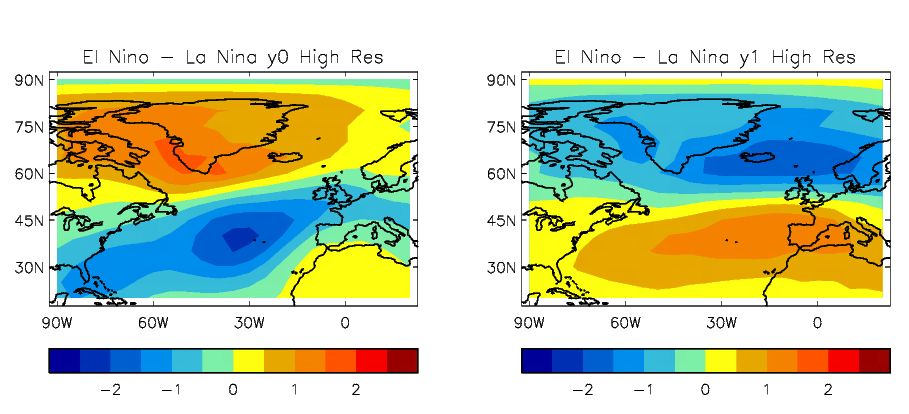
Effects on Atlantic winter weather patterns during (left) and one year after (right) El Nino-Southern Oscillation events in the tropical Pacific. See level pressure changes (hPa) are plotted for El Nino minus La Nina cases from a high resolution climate model. After Scaife et al 2024.

Implications for winter predictions

Professor Rowan Sutton, director of the Met Office Hadley Centre, said, “This is exciting new research which reveals unexpected potential for valuable forecasts of UK and European winter weather over a year ahead.  Such forecasts could be valuable for long-range risk and contingency planning, for example in the energy sector or in flood preparedness.”

The research showed that knowledge of the previous winter ENSO event is also important for understanding some of extreme winters. In cases in which El Niño is followed by La Niña, or vice versa, the lagged effects can boost expected impacts. For example, La Nina was followed by El Nino in 1968/69, 1976/77 and 2009/10, boosting the resulting cold weather, while we saw mild and stormy weather in the winters of 1988/89, 1998/99 and 2007/8 when El Nino was followed by La Nina.

ENSO shifts back and forth irregularly every two to seven years, bringing predictable shifts in ocean surface temperature and disrupting wind, rainfall and global temperature patterns across the tropics. With an increased understanding of the teleconnections and impacts of ENSO, scientists will be better able to plan for variations in winter weather patterns.

In related news, the UK Met Office recently developed guidance and tools to improve the prediction of life-threatening flash flooding. Click here to read the full story.

Previous ArticleNOAA funds CIRES to advance research on water-related climate impacts
Next Article NOAA to receive US$15.3m to improve climate projections of extreme weather

Read Similar Stories

Extreme Weather

AI model improves real-time prediction of wildfire spread

April 16, 20263 Mins Read
Climate Measurement

Study identifies atmospheric trigger behind flash droughts in Puerto Rico

April 15, 20263 Mins Read
Satellites

AI tool uses weather satellite data to map ocean currents in near real time

April 14, 20263 Mins Read
Latest News

Northumbria University secures £4m to study Earth’s radiation belts

April 16, 2026

AI model improves real-time prediction of wildfire spread

April 16, 2026

Study identifies atmospheric trigger behind flash droughts in Puerto Rico

April 15, 2026

Receive breaking stories and features in your inbox each week, for free


Enter your email address:


Supplier Spotlights
  • Senseca
Getting in Touch
  • Contact Us / Advertise
  • Meet the Editors
  • Media Pack
  • Free Weekly E-Newsletter
Our Social Channels
  • Facebook
  • LinkedIn
© 2026 UKi Media & Events a division of UKIP Media & Events Ltd
  • Cookie Policy
  • Privacy Policy
  • Terms and Conditions
  • Notice and Takedown Policy

Type above and press Enter to search. Press Esc to cancel.