


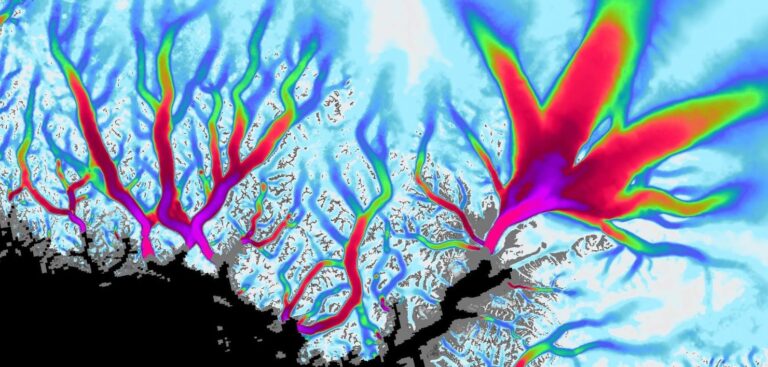
A new study published in by the American Geophysical Union (AGU) looking at Greenland’s ice sheet indicates that not only is it retreating but it is undergoing other physical changes, some of which are causing the rerouting of freshwater rivers beneath the glaciers where they meet the bedrock.
These rivers carry nutrients into the ocean, and according to the study’s authors, this reconfiguring has the potential to affect the local ecology as well as the human communities that depend on it.
“The coastal environment in Greenland is undergoing a major transformation,” said Alex Gardner, a research scientist at NASA’s Jet Propulsion Laboratory (JPL) and co-author of the study. “We are already seeing new sections of the ocean and fjords opening up as the ice sheet retreats, and now we have evidence of changes to these freshwater flows. So losing ice is not just about changing sea level, it’s also about reshaping Greenland’s coastline and altering the coastal ecology.”
The study, published in the AGU’s Journal of Geophysical Research: Earth Surface, provides a detailed look at physical changes to 225 of Greenland’s ocean-connected glaciers, which are narrow fingers of ice that flow from the ice sheet interior out into the ocean.
The data used in the paper was compiled as part of a project based at JPL called Inter-mission Time Series of Land Ice Velocity and Elevation, or ITS_LIVE, which brings together observations of glaciers around the globe – collected by multiple satellites between 1985 and 2015 – into a single data set open to scientists and the public.
The paper notes that as glaciers flow toward the sea they are replenished by new snowfall on the interior of the ice sheet that gets compacted into ice. Some glaciers extend past the coastline and can break off as icebergs. Due to rising atmospheric and ocean temperatures, the balance between glacier melting and replenishment, as well as iceberg calving, is changing. Over time, a glacier’s front may naturally advance or retreat, but the new research shows that none of the 225 ocean-terminating glaciers surveyed has substantially advanced since 2000, while 200 have retreated.
Although this is in line with other Greenland findings, the new survey captures a trend that hasn’t been apparent in previous work: as individual glaciers retreat, they are also changing in ways that are likely rerouting freshwater flows under the ice. For example, glaciers change in thickness not only as warmer air melts ice off their surfaces, but also as their flow speed changes in response to the ice front advancing or retreating.
Both scenarios were observed in the study, and both can lead to changes in the distribution of pressure beneath the ice; scientists can infer these pressure changes based on changes in thickness analyzed in the study. This, in turn, can change the path of a subglacial river, since water will always take the path of least resistance, flowing in the direction of lowest pressure.
Research has shown that glacial meltwater rivers directly affect the productivity of phytoplankton –the amount of biomass they produce – which serves as a foundation of the marine food chain. Combined with the opening up of new fjords and sections of ocean as glaciers retreat, these changes amount to a transformation of the local environment.
“The speed of ice loss in Greenland is stunning,” said Twila Moon, deputy lead scientist of the National Snow and Ice Data Center and lead author on the study. “As the ice sheet edge responds to rapid ice loss, the character and behavior of the system as a whole are changing, with the potential to influence ecosystems and people who depend on them.”
The changes described in the new study seem to depend on the unique features of its environment, such as the slope of the land that the glacier flows down, the properties of the ocean water that touch the glacier, as well as the glacier’s interaction with neighboring glaciers. That suggests scientists would need detailed knowledge not only of the glacier itself, but also of the glacier’s unique environment in order to predict how it will respond to continued ice loss.
“It makes modeling glacial evolution far more complex when we’re trying to anticipate how these systems will evolve both in the short term and two or three decades out,” Gardner concluded. “It’s going to be more challenging than we previously thought, but we now have a better understanding of the processes driving the variety of responses, which will help us make better ice sheet models.”