


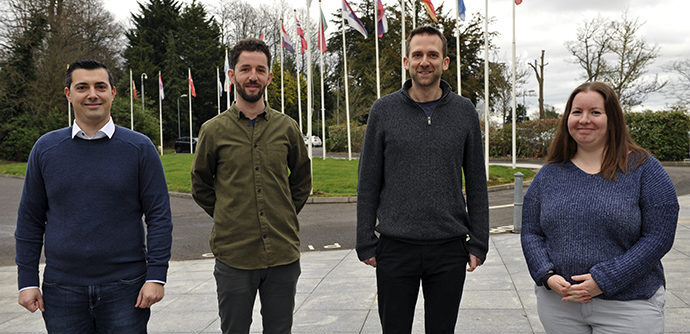
The European Organisation for the Exploitation of Meteorological Satellites (EUMETSAT) has allocated four of its research fellows to help the European Centre for Medium-Range Weather Forecasts (ECMWF) to fully exploit satellite data for weather forecasting.
Satellite data is crucial in establishing the initial conditions of forecasts through a process called data assimilation. The work of the EUMETSAT research fellows covers many of the large range of instruments on geostationary and polar-orbiting satellites that contribute to data assimilation at the ECMWF.
Paolo Ruti, chief scientist at EUMETSAT, said, “EUMETSAT, in close partnership with member states, supports young scientists in developing new uses and applications of EUMETSAT satellite data. These fellows work in research and operational host institutions from across Europe, and they are a key asset for EUMETSAT and member states. Through this program we entrain talented early-career scientists into our operational environment.”
Microwave imagers
Tracy Scanlon joined ECMWF in September 2021 on a five-year fellowship. She is working on the all-sky assimilation of radiances recorded by microwave imagers. These instruments provide information on water vapor, cloud and precipitation, particularly in the lowermost troposphere. They are carried by polar-orbiting satellites and the radiances they measure are prominent targets in ECMWF’s all-sky/all-surface strategy.
“I’ve been working on including new data in ECMWF’s Integrated Forecasting System,” said Scanlon. “These are from the Special Sensor Microwave Imager Sounder (SSMIS) on board the US Defense Meteorological Satellite Program-F18 (DMSP-F18).”
Scanlon is also looking to improve the ‘forward operator’; in other words, simulated values that can be compared directly with observations in convective cloud situations.
“Other work I will undertake during my fellowship includes preparation for new imagers on board the second generation of EUMETSAT’s polar-orbiting Metop satellites (EPS-SG), which are expected to go into orbit from 2023,” she said.
Geostationary infrared radiances
Samuel Quesada-Ruiz started a three-year fellowship at ECMWF in October 2020. He works on the assimilation of infrared radiances from geostationary satellites. They mainly provide information about atmospheric water vapor content and temperature.
Last year, Quesada-Ruiz worked on adding the GOES-17 satellite to the GOES-16, Meteosat-11, Meteosat-8 and Himawari-8 satellites. In liaison with the US National Oceanic and Atmospheric Administration (NOAA), he adapted the code of ECMWF’s Integrated Forecasting System to be able to ingest a newer version of the GOES-16/-17 radiance product.
He also identified an issue with the Meteosat-11 and Meteosat-8 radiance product, which was reported to EUMETSAT. They implemented corresponding changes, and the result was an improved radiance product, a gain of one hour of data per day and a correction of the observation timing.
On the research side, Quesada-Ruiz’s focus has been on investigating further use of the geostationary infrared information over the ocean. Currently, only radiances from the water vapor channels are actively assimilated, with those from the window channel used as an additional quality control check for cloud contamination. However, the window channel is the only source of information to constrain the full diurnal cycle of the skin temperature.
“My plan for this year is to start working with colleagues in ECMWF’s modeling section to improve the balance between the observed and modeled values,” said Quesada-Ruiz. “This will allow the active assimilation of the geostationary window channels providing information on sea-surface temperature.”
Atmospheric motion vectors
Francis Warrick joined ECMWF in October 2020 on a five-year fellowship. His focus is on improving the use of atmospheric motion vectors (AMVs).
AMVs provide information on winds around the world by tracking cloud or water vapor features through a series of satellite images. ECMWF currently uses AMVs from five geostationary and nine polar-orbiting satellites.
“So far in my fellowship I have overseen some operational changes in the satellites and data format used in our AMV assimilation,” said Warrick. “I have also been running assimilation experiments to test the forecast impact of AMV data that combines images from multiple satellites, and the forecast impact of a new version of the GOES AMVs we receive from NOAA.”
One theme for the remainder of the fellowship will be the comparison of AMVs to data from the Aeolus satellite. Aeolus is carrying the world’s first functioning space-based Doppler wind lidar. It provides a new way of assessing the AMVs’ quality.
Warrick will also make use of the cloud physics information available from the AMVs. It is hoped that this information will enable smarter decisions to be made about which AMVs to assimilate and which errors to assign to them.
Microwave sounders
David Duncan joined ECMWF in May 2019 on a three-year fellowship. His responsibility is for microwave sounders. These satellite instruments are installed on polar-orbiting satellites and provide profile information on temperature and moisture.
Duncan said, “We showed in a 2021 paper that sounders rank among the most impactful observations used in global numerical weather prediction. We demonstrated that forecasts improve dramatically with the first sounders assimilated and continue to improve with more sounders added.”
Part of his job is to maintain the optimal usage of these sensors in the operational system. Duncan has also moved the AMSU-A microwave sounder to all-sky assimilation. This has increased data assimilation in cloudy regions and improved the observation capability for severe events such as tropical cyclones.