


Close Menu
Meteorological Technology International
  • News
    • A-E
      • Agriculture
      • Automated Weather Stations
      • Aviation
      • Climate Measurement
      • Data
      • Developing Countries
      • Digital Applications
      • Early Warning Systems
      • Extreme Weather
    • G-P
      • Hydrology
      • Lidar
      • Lightning Detection
      • New Appointments
      • Nowcasting
      • Numerical Weather Prediction
      • Polar Weather
    • R-S
      • Radar
      • Rainfall
      • Remote Sensing
      • Renewable Energy
      • Satellites
      • Solar
      • Space Weather
      • Supercomputers
    • T-Z
      • Training
      • Transport
      • Weather Instruments
      • Wind
      • World Meteorological Organization
      • Meteorological Technology World Expo
  • Features
  • Online Magazines
    • January 2026
    • April 2025
    • January 2025
    • September 2024
    • April 2024
    • Archive Issues
    • Subscribe Free!
  • Opinion
  • Videos
  • Supplier Spotlight
  • Expo
LinkedIn X (Twitter) Facebook
  • Sign-up for Free Weekly E-Newsletter
  • Meet the Editors
  • Contact Us
  • Media Pack
LinkedIn Facebook
Subscribe
Meteorological Technology International
  • News
      • Agriculture
      • Automated Weather Stations
      • Aviation
      • Climate Measurement
      • Data
      • Developing Countries
      • Digital Applications
      • Early Warning Systems
      • Extreme Weather
      • Hydrology
      • Lidar
      • Lightning Detection
      • New Appointments
      • Nowcasting
      • Numerical Weather Prediction
      • Polar Weather
      • Radar
      • Rainfall
      • Remote Sensing
      • Renewable Energy
      • Satellites
      • Solar
      • Space Weather
      • Supercomputers
      • Training
      • Transport
      • Weather Instruments
      • Wind
      • World Meteorological Organization
      • Meteorological Technology World Expo
  • Features
  • Online Magazines
    1. January 2026
    2. September 2025
    3. April 2025
    4. January 2025
    5. September 2024
    6. April 2024
    7. January 2024
    8. September 2023
    9. April 2023
    10. Archive Issues
    11. Subscribe Free!
    Featured
    November 27, 2025

    In this Issue – January 2026

    By Hazel KingNovember 27, 2025
    Recent

    In this Issue – January 2026

    November 27, 2025

    In this Issue – September 2025

    August 11, 2025

    In this Issue – April 2025

    April 15, 2025
  • Opinion
  • Videos
  • Supplier Spotlight
  • Expo
Facebook LinkedIn
Subscribe
Meteorological Technology International
Climate Measurement

Copernicus finds contrasting fire seasons in the southern tropics

Elizabeth BakerBy Elizabeth BakerNovember 9, 20233 Mins Read
Share LinkedIn Facebook Twitter Email
Share
LinkedIn Facebook Twitter Email

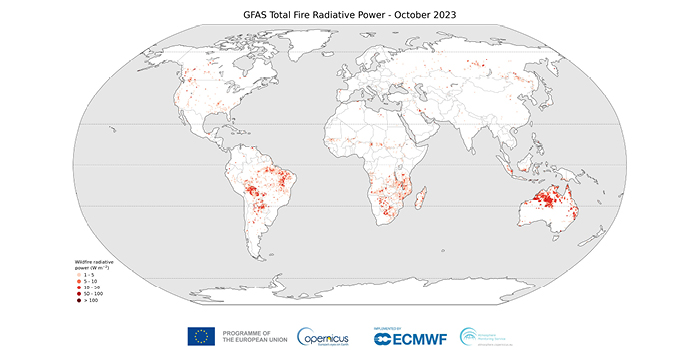
The Copernicus Atmosphere Monitoring Service (CAMS) has been tracking seasonal fires around the tropics in the Southern Hemisphere since the beginning of August 2023 and seeing variability in wildfire emissions among different countries.

One of the regions experiencing significant large-scale fires, and associated emissions, particularly through October 2023, is northern Australia. The number and intensity of the fires (shown as daily total Fire Radiative Power (FRP)) for the country started to increase significantly during the first half of September 2023, with the highest levels of the season being registered in October 2023 with many fires in Western Australia, Northern Territory, Queensland, and, especially in the last days of October, New South Wales. Currently, the total estimated carbon emissions from fires for the period August 1 to October 31, 2023, are the highest since 2012, at around 120 megatons, while significant wildfire activity is still being reported.

The Amazon and Central parts of South America, despite widespread drought conditions, experienced generally below-average fire emissions between August and October 2023, with Brazil as a whole experiencing its lowest emissions since 2019. Nevertheless, significant wildfire activity has been occurring in parts of Northern Argentina, Paraguay and Bolivia. In Bolivia, high wildfire carbon emissions reached approximately 16 megatons for October 2023, making them the highest emissions for any October in the last two decades.

In Indonesia, the regions of Sumatra and southern Kalimantan generally experienced below-average fire emissions between August and October 2023, with Indonesia as a whole following the same trend, according to CAMS data. This happens despite the El Niño and positive phase of the Indian Ocean Dipole (IOD) leading to increased fire emissions for the Maritime Continent compared to the last three years. Both El Niño and the IOD typically enhance drier conditions across the region, which is related to a higher chance of wildfires to emerge. For example, the El Niño years of 2006 and 2015 and the positive IOD of 2019 are the years with higher wildfire emissions in Indonesia during the last 21 years.

Mark Parrington, senior scientist at CAMS, commented, “The predictions for El Niño this year have given us extra incentive for our emissions monitoring around the southern tropics since the beginning of August. We have observed increased fire emissions from Indonesia and the Amazon relative to recent years. While not reaching the extreme levels of the previous El Niño years, they have still produced significant amounts of smoke and degradation of air quality. The monitoring work we do in CAMS is essential for understanding the potential atmospheric impacts of fire emissions such as these when they are occurring.”

For more key extreme weather updates from the meteorological technology industry, click here

This article was originally posted on the ECMWF website, and can be viewed here.

Headline and opening paragraph adapted to suit the Meteorological Technology International website. Content shared under Creative Commons — Attribution 4.0 International — CC BY 4.0

 

Previous ArticleFinnish Meteorological Institute relaunches weather data download service
Next Article Thies Clima launches precipitation analyzer for black ice

Read Similar Stories

Extreme Weather

AI model improves real-time prediction of wildfire spread

April 16, 20263 Mins Read
Climate Measurement

Study identifies atmospheric trigger behind flash droughts in Puerto Rico

April 15, 20263 Mins Read
Satellites

AI tool uses weather satellite data to map ocean currents in near real time

April 14, 20263 Mins Read
Latest News

Northumbria University secures £4m to study Earth’s radiation belts

April 16, 2026

AI model improves real-time prediction of wildfire spread

April 16, 2026

Study identifies atmospheric trigger behind flash droughts in Puerto Rico

April 15, 2026

Receive breaking stories and features in your inbox each week, for free


Enter your email address:


Supplier Spotlights
  • Meteomatics AG
Getting in Touch
  • Contact Us / Advertise
  • Meet the Editors
  • Media Pack
  • Free Weekly E-Newsletter
Our Social Channels
  • Facebook
  • LinkedIn
© 2026 UKi Media & Events a division of UKIP Media & Events Ltd
  • Cookie Policy
  • Privacy Policy
  • Terms and Conditions
  • Notice and Takedown Policy

Type above and press Enter to search. Press Esc to cancel.