


Close Menu
Meteorological Technology International
  • News
    • A-E
      • Agriculture
      • Automated Weather Stations
      • Aviation
      • Climate Measurement
      • Data
      • Developing Countries
      • Digital Applications
      • Early Warning Systems
      • Extreme Weather
    • G-P
      • Hydrology
      • Lidar
      • Lightning Detection
      • New Appointments
      • Nowcasting
      • Numerical Weather Prediction
      • Polar Weather
    • R-S
      • Radar
      • Rainfall
      • Remote Sensing
      • Renewable Energy
      • Satellites
      • Solar
      • Space Weather
      • Supercomputers
    • T-Z
      • Training
      • Transport
      • Weather Instruments
      • Wind
      • World Meteorological Organization
      • Meteorological Technology World Expo
  • Features
  • Online Magazines
    • January 2026
    • April 2025
    • January 2025
    • September 2024
    • April 2024
    • Archive Issues
    • Subscribe Free!
  • Opinion
  • Videos
  • Supplier Spotlight
  • Expo
LinkedIn X (Twitter) Facebook
  • Sign-up for Free Weekly E-Newsletter
  • Meet the Editors
  • Contact Us
  • Media Pack
LinkedIn Facebook
Subscribe
Meteorological Technology International
  • News
      • Agriculture
      • Automated Weather Stations
      • Aviation
      • Climate Measurement
      • Data
      • Developing Countries
      • Digital Applications
      • Early Warning Systems
      • Extreme Weather
      • Hydrology
      • Lidar
      • Lightning Detection
      • New Appointments
      • Nowcasting
      • Numerical Weather Prediction
      • Polar Weather
      • Radar
      • Rainfall
      • Remote Sensing
      • Renewable Energy
      • Satellites
      • Solar
      • Space Weather
      • Supercomputers
      • Training
      • Transport
      • Weather Instruments
      • Wind
      • World Meteorological Organization
      • Meteorological Technology World Expo
  • Features
  • Online Magazines
    1. January 2026
    2. September 2025
    3. April 2025
    4. January 2025
    5. September 2024
    6. April 2024
    7. January 2024
    8. September 2023
    9. April 2023
    10. Archive Issues
    11. Subscribe Free!
    Featured
    November 27, 2025

    In this Issue – January 2026

    By Hazel KingNovember 27, 2025
    Recent

    In this Issue – January 2026

    November 27, 2025

    In this Issue – September 2025

    August 11, 2025

    In this Issue – April 2025

    April 15, 2025
  • Opinion
  • Videos
  • Supplier Spotlight
  • Expo
Facebook LinkedIn
Subscribe
Meteorological Technology International
Satellites

University of Bath to launch space weather sensors into orbit in 2027

Hazel KingBy Hazel KingJune 26, 20253 Mins Read
Share LinkedIn Facebook Twitter Email
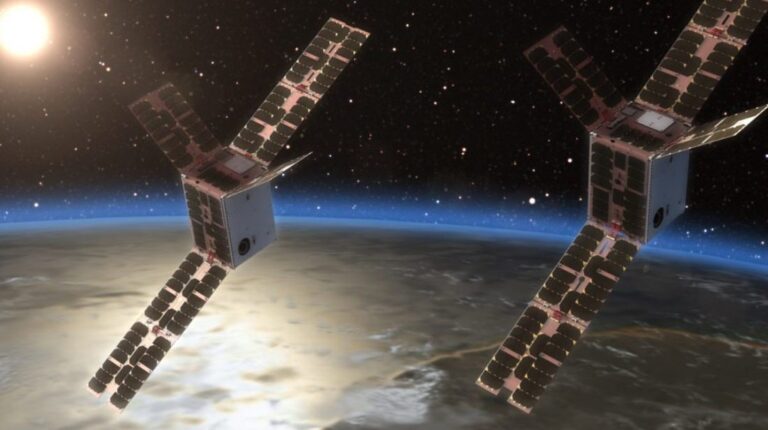
Image of two satellites in space, orbiting the earth with the sun in the background.
A space weather-sensing satellite payload developed by Bath engineers will be part of the Orpheus mission. Credit: Astroscale.
Share
LinkedIn Facebook Twitter Email

Space weather sensors developed at the University of Bath will be launched into orbit as part of the £5.15m (US$7.08m) Orpheus mission, which is set to launch in 2027.

The TOPCAT II satellite payload, created to take measurements of atmospheric conditions in space to inform improvements to technologies including GPS, were created by Dr Robert Watson and Professor Cathryn Mitchell in Bath’s Department of Electronic & Electrical Engineering.

TOPCAT (Topside ionosphere Computer Assisted Tomography) will monitor Earth’s upper atmosphere to better understand space weather and help improve GPS and communications technology.

Prof. Mitchell said, “This is an exciting opportunity for us to have our space weather instrument on a satellite and to use the data in the University of Bath MIDAS imaging data assimilation, an advanced algorithm that gives us a highly accurate three-dimensional image of the Earth’s ionosphere and its evolution in time. Orpheus will have a major impact on the UK’s capability in space weather.”

Better understanding of space weather

The Orpheus mission, which was awarded to Astroscale UK on June 16 by Defence Science and Technology Laboratory (Dstl), is a successor to the Prometheus-2 and CIRCE missions, in which the first TOPCAT satellite payload took part, that were lost onboard the Virgin Orbit launch in 2023.

The TOPCAT II payload carries an advanced multi-frequency GPS receiver to estimate the total electron content of the ionosphere. This will give scientists and engineers new data that will enable them to better understand space weather phenomena and help design resilient future satellites.

Dstl chief executive Dr Paul Hollinshead said, “Changes in space weather can have a critical impact on satellites which provide navigation aids, telecommunications and data transmission. Sustained investment in space research in collaboration with our international partners strengthens the security of UK interests in space.”

The suite of payloads carried on Orpheus will generate observations enabling a greater understanding of the driving processes of geophysical phenomena in the ionosphere-thermosphere system, distributed across a wide range of latitudes.

Understanding the characteristics of the dynamic ionosphere is vital for a range of both civil and defense applications, such as the global navigation satellite system, communications, sensing technology and space sustainability.

The fully funded project will run for three years and will conclude in 2028. It will cover the complete lifecycle of the mission, from design through to launch, operations and disposal.

In related news, EUMETSAT’s Meteosat-12 satellite, formerly Meteosat Third Generation (MTG) Imager 1, has taken over from Meteosat-10 to deliver European weather and climate monitoring data service from geostationary orbit

Previous ArticleWMO announces action plan on development and use of AI
Next Article Study shows the effect of solar flares on short-term weather patterns on distant planets

Read Similar Stories

Space Weather

Northumbria University secures £4m to study Earth’s radiation belts

April 16, 20262 Mins Read
Extreme Weather

AI model improves real-time prediction of wildfire spread

April 16, 20263 Mins Read
Satellites

AI tool uses weather satellite data to map ocean currents in near real time

April 14, 20263 Mins Read
Latest News

Northumbria University secures £4m to study Earth’s radiation belts

April 16, 2026

AI model improves real-time prediction of wildfire spread

April 16, 2026

Study identifies atmospheric trigger behind flash droughts in Puerto Rico

April 15, 2026

Receive breaking stories and features in your inbox each week, for free


Enter your email address:


Supplier Spotlights
  • EWR Radar Systems
Getting in Touch
  • Contact Us / Advertise
  • Meet the Editors
  • Media Pack
  • Free Weekly E-Newsletter
Our Social Channels
  • Facebook
  • LinkedIn
© 2026 UKi Media & Events a division of UKIP Media & Events Ltd
  • Cookie Policy
  • Privacy Policy
  • Terms and Conditions
  • Notice and Takedown Policy

Type above and press Enter to search. Press Esc to cancel.