


Close Menu
Meteorological Technology International
  • News
    • A-E
      • Agriculture
      • Automated Weather Stations
      • Aviation
      • Climate Measurement
      • Data
      • Developing Countries
      • Digital Applications
      • Early Warning Systems
      • Extreme Weather
    • G-P
      • Hydrology
      • Lidar
      • Lightning Detection
      • New Appointments
      • Nowcasting
      • Numerical Weather Prediction
      • Polar Weather
    • R-S
      • Radar
      • Rainfall
      • Remote Sensing
      • Renewable Energy
      • Satellites
      • Solar
      • Space Weather
      • Supercomputers
    • T-Z
      • Training
      • Transport
      • Weather Instruments
      • Wind
      • World Meteorological Organization
      • Meteorological Technology World Expo
  • Features
  • Online Magazines
    • January 2026
    • April 2025
    • January 2025
    • September 2024
    • April 2024
    • Archive Issues
    • Subscribe Free!
  • Opinion
  • Videos
  • Supplier Spotlight
  • Expo
LinkedIn X (Twitter) Facebook
  • Sign-up for Free Weekly E-Newsletter
  • Meet the Editors
  • Contact Us
  • Media Pack
LinkedIn Facebook
Subscribe
Meteorological Technology International
  • News
      • Agriculture
      • Automated Weather Stations
      • Aviation
      • Climate Measurement
      • Data
      • Developing Countries
      • Digital Applications
      • Early Warning Systems
      • Extreme Weather
      • Hydrology
      • Lidar
      • Lightning Detection
      • New Appointments
      • Nowcasting
      • Numerical Weather Prediction
      • Polar Weather
      • Radar
      • Rainfall
      • Remote Sensing
      • Renewable Energy
      • Satellites
      • Solar
      • Space Weather
      • Supercomputers
      • Training
      • Transport
      • Weather Instruments
      • Wind
      • World Meteorological Organization
      • Meteorological Technology World Expo
  • Features
  • Online Magazines
    1. January 2026
    2. September 2025
    3. April 2025
    4. January 2025
    5. September 2024
    6. April 2024
    7. January 2024
    8. September 2023
    9. April 2023
    10. Archive Issues
    11. Subscribe Free!
    Featured
    November 27, 2025

    In this Issue – January 2026

    By Hazel KingNovember 27, 2025
    Recent

    In this Issue – January 2026

    November 27, 2025

    In this Issue – September 2025

    August 11, 2025

    In this Issue – April 2025

    April 15, 2025
  • Opinion
  • Videos
  • Supplier Spotlight
  • Expo
Facebook LinkedIn
Subscribe
Meteorological Technology International
Space Weather

Study shows the effect of solar flares on short-term weather patterns on distant planets

Hazel KingBy Hazel KingJune 26, 20252 Mins Read
Share LinkedIn Facebook Twitter Email
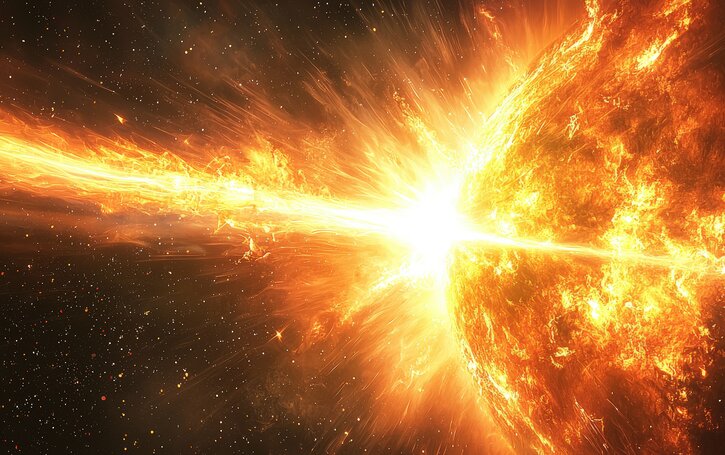
A CG image of a solar flare, large and yellow erupting from the sun.
Share
LinkedIn Facebook Twitter Email

A new study published in The Astronomical Journal has revealed a connection between solar flares and short-term weather patterns on distant Earth-like planets, which may help refine our understanding of short-term atmospheric shifts on Earth.

The Effects of transient stellar emissions on planetary climates of tidally-locked exo-earths study, which was led by scientists from the Hebrew University of Jerusalem, NASA, the Florida Institute of Technology, the Barcelona Supercomputing Center and the University of Oxford, offers the clearest evidence yet that space weather – particularly flares from a planet’s host star – can cause measurable changes in a planet’s climate within just days of an event.

“This study highlights an underexplored but important solar-climate link,” said Dr. Assaf Hochman, from the Institute of Earth Sciences at Hebrew University. “While anthropogenic greenhouse gases primarily drive long-term climate change, we now see that short-term solar variability can also play a role in modulating regional climate behavior.”

The international team used advanced 3D general circulation models to simulate how sudden flares from host stars affect the climate on tidally locked exo-Earths such as TRAPPIST-1e, a planet that always shows the same face to its sun.

The study’s results revealed a chain reaction:

  • Upper atmospheric cooling occurs quickly after a flare, driven by radiative emissions from molecules like NO and CO₂.
  • Simultaneously, lower atmospheric warming happens due to increases in greenhouse-like gases such as H₂O and N₂O.
  • Wind speeds in the middle atmosphere can intensify dramatically — surging to over 140km/h on the dark, night side of the planet.

What it means for Earth’s weather

While the focus of the study was on distant worlds, the findings open possibilities for Earth’s climate systems too, according to the researchers. The patterns observed suggest that solar activity may temporarily alter a planet’s general atmospheric circulation, resulting in short-lived regional anomalies that could be especially noticeable in already volatile weather zones.

The research emphasizes that while solar flares aren’t a major driver of Earth’s long-term climate compared to human activity, their effects are real, detectable and worth factoring into future atmospheric models, especially in regions sensitive to abrupt changes in temperature and wind.

In related news, space weather sensors developed at the University of Bath will be launched into orbit as part of the £5.15m (US$7.08m) Orpheus mission, which is set to launch in 2027

Previous ArticleUniversity of Bath to launch space weather sensors into orbit in 2027
Next Article NOAA awards US$95.4m contract to upgrade Oscar Dyson technology

Read Similar Stories

Space Weather

Northumbria University secures £4m to study Earth’s radiation belts

April 16, 20262 Mins Read
Solar

Mauna Loa Solar Observatory reopens to support Artemis II mission

April 8, 20262 Mins Read
Satellites

NCAR researchers create breakthrough tool to enhance space weather prediction

February 24, 20262 Mins Read
Latest News

Northumbria University secures £4m to study Earth’s radiation belts

April 16, 2026

AI model improves real-time prediction of wildfire spread

April 16, 2026

Study identifies atmospheric trigger behind flash droughts in Puerto Rico

April 15, 2026

Receive breaking stories and features in your inbox each week, for free


Enter your email address:


Supplier Spotlights
  • Synoptic Data PBC
Getting in Touch
  • Contact Us / Advertise
  • Meet the Editors
  • Media Pack
  • Free Weekly E-Newsletter
Our Social Channels
  • Facebook
  • LinkedIn
© 2026 UKi Media & Events a division of UKIP Media & Events Ltd
  • Cookie Policy
  • Privacy Policy
  • Terms and Conditions
  • Notice and Takedown Policy

Type above and press Enter to search. Press Esc to cancel.