


Close Menu
Meteorological Technology International
  • News
    • A-E
      • Agriculture
      • Automated Weather Stations
      • Aviation
      • Climate Measurement
      • Data
      • Developing Countries
      • Digital Applications
      • Early Warning Systems
      • Extreme Weather
    • G-P
      • Hydrology
      • Lidar
      • Lightning Detection
      • New Appointments
      • Nowcasting
      • Numerical Weather Prediction
      • Polar Weather
    • R-S
      • Radar
      • Rainfall
      • Remote Sensing
      • Renewable Energy
      • Satellites
      • Solar
      • Space Weather
      • Supercomputers
    • T-Z
      • Training
      • Transport
      • Weather Instruments
      • Wind
      • World Meteorological Organization
      • Meteorological Technology World Expo
  • Features
  • Online Magazines
    • January 2026
    • April 2025
    • January 2025
    • September 2024
    • April 2024
    • Archive Issues
    • Subscribe Free!
  • Opinion
  • Videos
  • Supplier Spotlight
  • Expo
LinkedIn X (Twitter) Facebook
  • Sign-up for Free Weekly E-Newsletter
  • Meet the Editors
  • Contact Us
  • Media Pack
LinkedIn Facebook
Subscribe
Meteorological Technology International
  • News
      • Agriculture
      • Automated Weather Stations
      • Aviation
      • Climate Measurement
      • Data
      • Developing Countries
      • Digital Applications
      • Early Warning Systems
      • Extreme Weather
      • Hydrology
      • Lidar
      • Lightning Detection
      • New Appointments
      • Nowcasting
      • Numerical Weather Prediction
      • Polar Weather
      • Radar
      • Rainfall
      • Remote Sensing
      • Renewable Energy
      • Satellites
      • Solar
      • Space Weather
      • Supercomputers
      • Training
      • Transport
      • Weather Instruments
      • Wind
      • World Meteorological Organization
      • Meteorological Technology World Expo
  • Features
  • Online Magazines
    1. January 2026
    2. September 2025
    3. April 2025
    4. January 2025
    5. September 2024
    6. April 2024
    7. January 2024
    8. September 2023
    9. April 2023
    10. Archive Issues
    11. Subscribe Free!
    Featured
    November 27, 2025

    In this Issue – January 2026

    By Hazel KingNovember 27, 2025
    Recent

    In this Issue – January 2026

    November 27, 2025

    In this Issue – September 2025

    August 11, 2025

    In this Issue – April 2025

    April 15, 2025
  • Opinion
  • Videos
  • Supplier Spotlight
  • Expo
Facebook LinkedIn
Subscribe
Meteorological Technology International
Space Weather

Lift-off for NASA and NOAA space weather mission

Alex PackBy Alex PackSeptember 25, 20253 Mins Read
Share LinkedIn Facebook Twitter Email
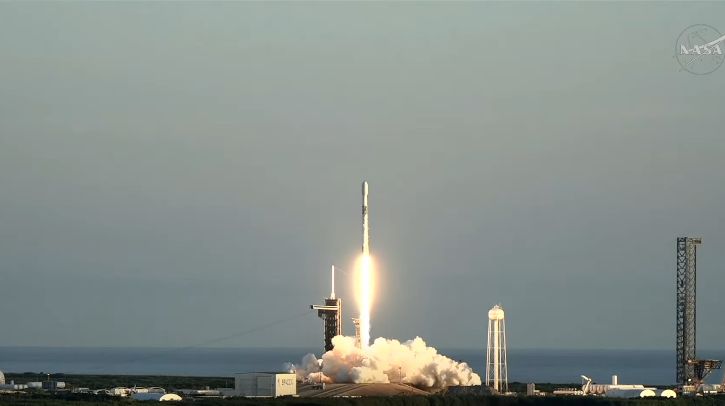
Lift off for NASA and NOAA space weather mission.
Credit: NASA
Share
LinkedIn Facebook Twitter Email

NASA and the NOAA launched three new missions on Wednesday to investigate the sun’s influence across the solar system.

A SpaceX Falcon 9 rocket lifted off from Launch Complex 39A at NASA’s Kennedy Space Center in Florida, carrying the agency’s IMAP (Interstellar Mapping and Acceleration Probe), Carruthers Geocorona Observatory and NOAA’s SWFO-L1 (Space Weather Follow On-Lagrange 1) spacecraft.

NASA says the missions will help protect its ground-based technology and human and robotic space explorers from the harsh conditions of space weather.

Each mission will investigate different effects of space weather and solar wind, examining the continuous stream of particles from their origins at the sun all the way outward to interstellar space.

“These three unique missions will help us get to know our sun and its effects on Earth better than ever before,” explained Joe Westlake, heliophysics division director at NASA Headquarters. “This knowledge is critical because the sun’s activity directly impacts our daily lives, from power grids to GPS. These missions will help us ensure the safety and resilience of our interconnected world.”

Measuring space weather to protect Earth

The IMAP mission will chart the boundary of the heliosphere – a bubble inflated by the solar wind that shields our solar system from galactic cosmic rays – which is a key protection that makes Earth habitable.

The spacecraft will also sample and measure solar wind particles streaming outward from the sun, as well as energetic particles streaming in from the boundary of the solar system and beyond.

The Carruthers Geocorona Observatory is said to be the first mission dedicated to recording changes in the outermost layer of our atmosphere, the exosphere, which plays an important role in Earth’s response to space weather.

By studying the geocorona – the ultraviolet glow given off by the exosphere when sunlight shines on it – the Carruthers mission will reveal how the exosphere responds to solar storms and how it changes with the seasons.

“The Carruthers mission will show us how the exosphere works and will help improve our ability to predict the impacts of solar activity here on Earth,” said Lara Waldrop, the mission’s principal investigator at the University of Illinois at Urbana-Champaign.

The NOAA’s SWFO-L1, which is the first of its kind, is designed to be a full-time operational space weather observatory. It will provide quicker and more accurate space weather forecasts by monitoring the sun’s activity and space conditions near Earth 24/7 without interruption or obstruction.

Next steps

In the hours after launch, it was reported that all three spacecraft successfully deployed from the rocket and sent signals to Earth to confirm they’re active and working well.

Over the next few months, the spacecraft will make their way to their destination – a location between Earth and the sun, about 1,600,000km from our planet, called Lagrange point 1 (L1).

They should arrive by January and, once their instrument checkouts and calibrations are complete, will begin their missions to better understand space weather.

In related news, the NOAA recently awarded a $24m contract to PlantiQ for satellite weather data

Previous ArticleNew satellite set to improve forecasting of severe storms
Next Article New quantum sensors developed to boost UK’s space weather resilience

Read Similar Stories

Space Weather

Northumbria University secures £4m to study Earth’s radiation belts

April 16, 20262 Mins Read
Extreme Weather

AI model improves real-time prediction of wildfire spread

April 16, 20263 Mins Read
Satellites

AI tool uses weather satellite data to map ocean currents in near real time

April 14, 20263 Mins Read
Latest News

Northumbria University secures £4m to study Earth’s radiation belts

April 16, 2026

AI model improves real-time prediction of wildfire spread

April 16, 2026

Study identifies atmospheric trigger behind flash droughts in Puerto Rico

April 15, 2026

Receive breaking stories and features in your inbox each week, for free


Enter your email address:


Supplier Spotlights
  • ELDES S.r.l.
Getting in Touch
  • Contact Us / Advertise
  • Meet the Editors
  • Media Pack
  • Free Weekly E-Newsletter
Our Social Channels
  • Facebook
  • LinkedIn
© 2026 UKi Media & Events a division of UKIP Media & Events Ltd
  • Cookie Policy
  • Privacy Policy
  • Terms and Conditions
  • Notice and Takedown Policy

Type above and press Enter to search. Press Esc to cancel.