


Close Menu
Meteorological Technology International
  • News
    • A-E
      • Agriculture
      • Automated Weather Stations
      • Aviation
      • Climate Measurement
      • Data
      • Developing Countries
      • Digital Applications
      • Early Warning Systems
      • Extreme Weather
    • G-P
      • Hydrology
      • Lidar
      • Lightning Detection
      • New Appointments
      • Nowcasting
      • Numerical Weather Prediction
      • Polar Weather
    • R-S
      • Radar
      • Rainfall
      • Remote Sensing
      • Renewable Energy
      • Satellites
      • Solar
      • Space Weather
      • Supercomputers
    • T-Z
      • Training
      • Transport
      • Weather Instruments
      • Wind
      • World Meteorological Organization
      • Meteorological Technology World Expo
  • Features
  • Online Magazines
    • January 2026
    • April 2025
    • January 2025
    • September 2024
    • April 2024
    • Archive Issues
    • Subscribe Free!
  • Opinion
  • Videos
  • Supplier Spotlight
  • Expo
LinkedIn X (Twitter) Facebook
  • Sign-up for Free Weekly E-Newsletter
  • Meet the Editors
  • Contact Us
  • Media Pack
LinkedIn Facebook
Subscribe
Meteorological Technology International
  • News
      • Agriculture
      • Automated Weather Stations
      • Aviation
      • Climate Measurement
      • Data
      • Developing Countries
      • Digital Applications
      • Early Warning Systems
      • Extreme Weather
      • Hydrology
      • Lidar
      • Lightning Detection
      • New Appointments
      • Nowcasting
      • Numerical Weather Prediction
      • Polar Weather
      • Radar
      • Rainfall
      • Remote Sensing
      • Renewable Energy
      • Satellites
      • Solar
      • Space Weather
      • Supercomputers
      • Training
      • Transport
      • Weather Instruments
      • Wind
      • World Meteorological Organization
      • Meteorological Technology World Expo
  • Features
  • Online Magazines
    1. January 2026
    2. September 2025
    3. April 2025
    4. January 2025
    5. September 2024
    6. April 2024
    7. January 2024
    8. September 2023
    9. April 2023
    10. Archive Issues
    11. Subscribe Free!
    Featured
    November 27, 2025

    In this Issue – January 2026

    By Hazel KingNovember 27, 2025
    Recent

    In this Issue – January 2026

    November 27, 2025

    In this Issue – September 2025

    August 11, 2025

    In this Issue – April 2025

    April 15, 2025
  • Opinion
  • Videos
  • Supplier Spotlight
  • Expo
Facebook LinkedIn
Subscribe
Meteorological Technology International
Solar

Solar corona polarimeter collects its first images

Elizabeth BakerBy Elizabeth BakerApril 24, 20254 Mins Read
Share LinkedIn Facebook Twitter Email
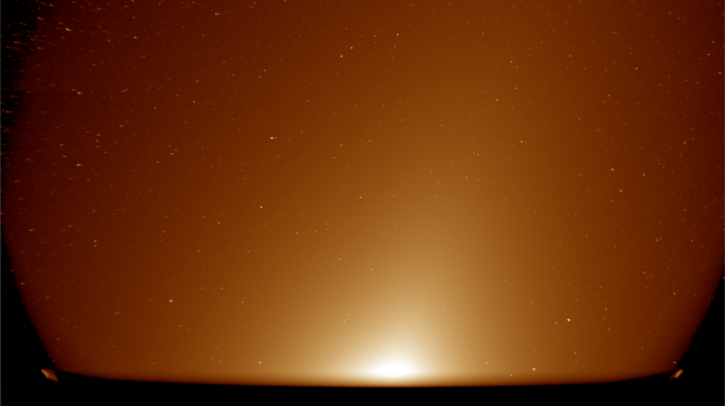
The Polarimeter to Unify the Corona and Heliosphere (PUNCH) mission, led by the Southwest Research Institute (SwRI) in Texas, has collected its first images following its launch into polar orbit around the Earth.
Credit: NASA/SwRI
Share
LinkedIn Facebook Twitter Email

The Polarimeter to Unify the Corona and Heliosphere (PUNCH) mission, led by the Southwest Research Institute (SwRI) in Texas, has collected its first images following its launch into polar orbit around the Earth. The mission’s four small spacecraft will act as a single virtual instrument 8,000 miles across to image the solar corona, the Sun’s outer atmosphere, as it transitions into the solar wind that fills and defines our solar system.

Instrumentation onboard
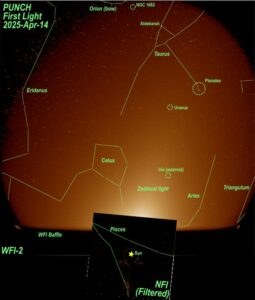
This composite of first-light images taken by PUNCH/WFI2 (top) and PUNCH/NFI (inset) shows how the fields of view fit together. When the four NASA spacecraft are fully deployed, they will work together to view a field 90° across. Constellations have been identified to show the size of the field of view. The SwRI-led PUNCH mission acquired these first images during instrument commissioning.              Credit: NASA/SwRI/NRL

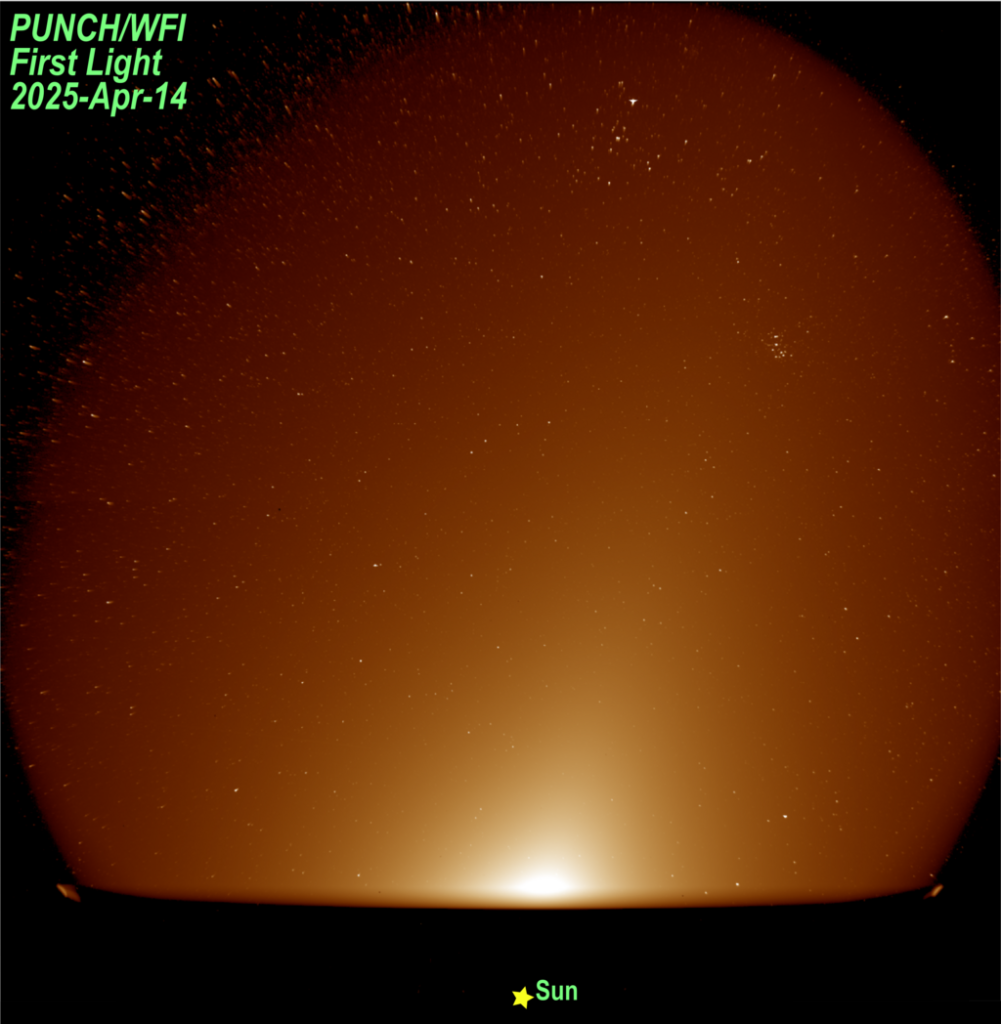
PUNCH’s constellation includes one satellite carrying a near field imager (NFI) coronagraph, developed by the US Naval Research Laboratory, that images the Sun’s corona continuously. The other three carry SwRI-developed wide field imagers (WFIs), ‘heliospheric imagers’ that are designed to view the very faint outermost portion of the solar corona and the solar wind itself. Features in the tenuous solar wind, streaming out from the Sun at over a million miles per hour, are less than 0.1% as bright as the Milky Way galaxy backdrop. PUNCH raw images contain mostly stars and ‘zodiacal light’ – a haze of dust orbiting the Sun in the inner solar system. The research team pointed out that eliminating the star field and the zodiacal light, while preserving the very faint solar wind signal, requires extraordinary care because the smallest miscalibration would swamp the solar wind signal.

During commissioning, PUNCH also demonstrated novel, water-powered, shot-glass-sized rocket engines. To run the engine, each spacecraft electrolyzes water, building up small stores of high-pressure hydrogen and oxygen that it then burns as fuel. Each cycle delivers a ‘kick’ of about one inch per second (2cm/sec), just enough to correct for small orbital shifts and keep the constellation stable.

“PUNCH is the first space mission to rely on this type of engine, which carries safe, inert, non-toxic propellant,” said PUNCH principal investigator Dr Craig DeForest of SwRI’s Solar System Science and Exploration Division, Boulder, Colorado. “That safety and stability are worth it even though the thrusters are more complex than conventional hydrazine rockets.”

According to DeForest, each satellite needs to fire its thruster hundreds of times, reliably and repeatably, over the course of the mission. On April 2, as part of its commissioning, the WFI-2 spacecraft demonstrated its first three charge-and-fire cycles, modifying its orbital velocity relative to the other PUNCH spacecraft as they drift apart to reach their final positions – a third of the way around the world from one another.
Inside each instrument, a space-rated scientific-grade camera developed by RAL Space will collect three raw images, through three different polarizing filters, every four minutes. This new perspective will enable scientists to discern the exact trajectory and speed of coronal mass ejections as they move through the inner solar system, improving on current coronagraphs that only measure the corona itself and cannot also measure motion in three dimensions.

Operation timeline

“We opened the instrument doors on the NFI and one WFI on April 14, 2025,” said DeForest. “On April 16, 2025, the other two WFIs opened their doors and collected their first-light demonstration images too. All four instruments are functioning as designed. We’re excited to finish on-orbit commissioning and get these cameras working together.”

The spacecraft is in the midst of a 90-day commissioning period, operating from SwRI’s Mission Operations Center. The science mission begins in June 2025, at which point the Science Operations Center will begin processing the data to share with NASA and the rest of the world.

“Throughout the commissioning phase, the PUNCH team is calibrating the NFI data to remove 99% of the light to show materials streaming out from the Sun’s outer atmosphere in stunning detail,” DeForest added. “The three WFI ‘first-light’ images show star fields, but the ultimate goal is to remove the star field and other background light and preserve the faint glimmer of the solar wind as it travels to Earth.”

In related news, scientists recently took near-daily measurements of the Sun’s global coronal magnetic field for the first time. The resulting observations provided insights into the processes that drive the intense solar storms that affect technologies on Earth. Click here to read the full story.

Previous ArticleNew Zealand’s weather forecasting services to merge
Next Article RM Young Company acquires specialized snow depth sensor

Read Similar Stories

Space Weather

Northumbria University secures £4m to study Earth’s radiation belts

April 16, 20262 Mins Read
Climate Measurement

China inaugurates 27th national climate observatory in Hebei

April 9, 20262 Mins Read
Solar

Mauna Loa Solar Observatory reopens to support Artemis II mission

April 8, 20262 Mins Read
Latest News

Northumbria University secures £4m to study Earth’s radiation belts

April 16, 2026

AI model improves real-time prediction of wildfire spread

April 16, 2026

Study identifies atmospheric trigger behind flash droughts in Puerto Rico

April 15, 2026

Receive breaking stories and features in your inbox each week, for free


Enter your email address:


Supplier Spotlights
  • Geolux d.o.o.
Getting in Touch
  • Contact Us / Advertise
  • Meet the Editors
  • Media Pack
  • Free Weekly E-Newsletter
Our Social Channels
  • Facebook
  • LinkedIn
© 2026 UKi Media & Events a division of UKIP Media & Events Ltd
  • Cookie Policy
  • Privacy Policy
  • Terms and Conditions
  • Notice and Takedown Policy

Type above and press Enter to search. Press Esc to cancel.