


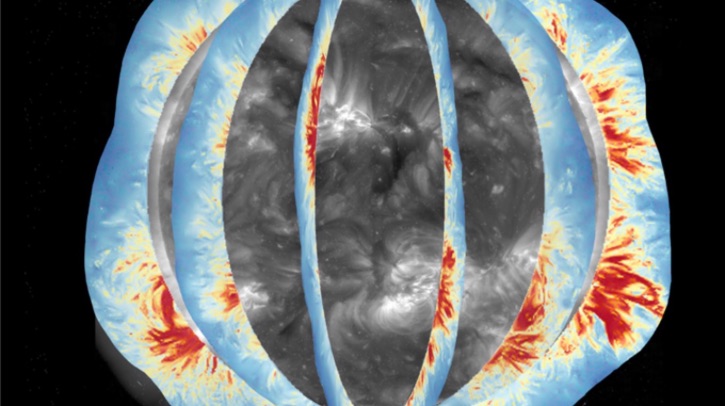
For the first time, scientists have taken near-daily measurements of the Sun’s global coronal magnetic field, a region of the Sun that has previously only been observed irregularly. The resulting observations provide insights into the processes that drive the intense solar storms that affect technologies on Earth.
An analysis of the data, collected over eight months by an instrument called the Upgraded Coronal Multi-channel Polarimeter (UCoMP), was published in Science. The international research team was made up of researchers from Northumbria University, UK; NSF NCAR; Peking University, China; and the University of Michigan.
The research was funded by a grant from the National Natural Science Foundation of China and the National Key R&D Program of China and supported by the Newkirk graduate student fellowship awarded to Yang by NSF NCAR. The UCoMP instrument was developed with support from the US National Science Foundation (NSF) and is operated by NSF NCAR at the Mauna Loa Solar Observatory.
The solar magnetic field is the primary driver of solar storms, which can pose threats to power grids, communication systems and in-space technologies like GPS. However, according to the researchers, the current ability to understand how the magnetic field builds up energy and erupts has been limited by the challenge of observing it in the solar corona, the Sun’s upper atmosphere.
Measuring the magnetism of the region through standard polarimetric methods typically requires large, expensive equipment that to date has only been able to study small segments of the corona. However, the combined use of coronal seismology and UCoMP observations makes it possible for researchers to produce consistent and comprehensive views of the magnetic field of the global corona – the whole-Sun view one sees during a solar eclipse.
“Global mapping of the coronal magnetic field has been a big missing part in the study of the Sun,” said Zihao Yang, lead author who pursued this research as a PhD graduate at Peking University, China, and is now a postdoctoral fellow at the US National Science Foundation National Center for Atmospheric Research (NSF NCAR). “This research is helping us fill a crucial gap in our understanding of coronal magnetic fields, which are the source of the energy for storms that can impact Earth.”
Upgraded instrument
As a large telescopes like NSF’s Daniel K Inouye Solar Telescope (DKIST) are not able to map the Sun all at once, the researchers found that the smaller UCoMP instrument was better suited to give scientists global pictures of the coronal magnetic field, albeit at lower resolution and in a two-dimensional projection. According to the team, the observations from both sources were thus highly complementary to a holistic view of the coronal magnetic field.
UCoMP is primarily a coronagraph, an instrument that uses a disc to block out light from the Sun, similar to an eclipse, making it easier to observe the corona. It also combines a Stokes polarimeter, which images other spectral information such as coronal line intensity and Doppler velocity. Even though UCoMP has a much smaller aperture (20cm), it is able to take a wider view which makes it possible to study the entire Sun on most days.
The researchers applied a method called coronal seismology to track magnetohydrodynamic (MHD) transverse waves in the UCoMP data. The MHD waves gave them information that made it possible to create a 2D map of the strength and direction of the coronal magnetic field.
In 2020, a previous study used UCoMP’s predecessor and the coronal seismology method to produce the first map of the global coronal magnetic field.
During the UCoMP study, the research team produced 114 magnetic field maps between February and October 2022, or one almost every other day.
“We are entering a new era of solar physics research where we can routinely measure the coronal magnetic field,” said Yang.
Completing the picture
The observations also produced the first measurements of the coronal magnetic field in the polar regions. The Sun’s poles have never been directly observed because the curve of the Sun near the poles keeps it just beyond view from Earth. Though the researchers didn’t directly view the poles, for the first time they were able to take measurements of the magnetism emitting from them. This was due in part to the improved data quality provided by UCoMP and because the Sun was near solar maximum. The typically weak emissions from the polar region have been much stronger, making it easier to obtain coronal magnetic field results in the polar regions.
As a postdoctoral fellow at NSF NCAR, Yang will continue his research of the Sun’s magnetic field. He hopes to improve existing coronal models that are based on measurements of the photosphere. Since the current method used with UCoMP is limited to two dimensions, it still doesn’t capture the full three-dimensional magnetic field. Yang and his colleagues hope to combine their research with other techniques to get a deeper understanding of the full vector of the magnetic field in the corona.
The third dimension of the magnetic field, oriented along a viewer’s line of sight, is of particular importance for understanding how the corona is energized leading up to a solar eruption. Ultimately, a combination of a large telescope and a global field of view is needed to measure all the three-dimensional twists and tangles behind phenomena like solar eruptions; this is the motivation behind the proposed Coronal Solar Magnetism Observatory (COSMO), a 1.5m diameter solar refracting telescope undergoing its final design study.
“Since coronal magnetism is the force that sends mass from the Sun flying across the solar system, we have to observe it in 3D – and everywhere all at once, throughout the global corona,” said Sarah Gibson, COSMO development lead and an NSF NCAR scientist co-author on the paper. “Yang’s work represents a huge step forward in our ability to understand how the Sun’s global coronal magnetic field changes from day to day. This is critical to our ability to better predict and prepare for solar storms, which are an ever-increasing danger to our ever-more technologically dependent lives here on Earth.”
In related news, the Laboratory for Atmospheric and Space Physics (LASP) at CU Boulder has enacted a collaborative Space Act Agreement with NASA’s Goddard Space Flight Center to advance research and modeling in the critical field of space weather.Click here to read the full story.