


Close Menu
Meteorological Technology International
  • News
    • A-E
      • Agriculture
      • Automated Weather Stations
      • Aviation
      • Climate Measurement
      • Data
      • Developing Countries
      • Digital Applications
      • Early Warning Systems
      • Extreme Weather
    • G-P
      • Hydrology
      • Lidar
      • Lightning Detection
      • New Appointments
      • Nowcasting
      • Numerical Weather Prediction
      • Polar Weather
    • R-S
      • Radar
      • Rainfall
      • Remote Sensing
      • Renewable Energy
      • Satellites
      • Solar
      • Space Weather
      • Supercomputers
    • T-Z
      • Training
      • Transport
      • Weather Instruments
      • Wind
      • World Meteorological Organization
      • Meteorological Technology World Expo
  • Features
  • Online Magazines
    • January 2026
    • April 2025
    • January 2025
    • September 2024
    • April 2024
    • Archive Issues
    • Subscribe Free!
  • Opinion
  • Videos
  • Supplier Spotlight
  • Expo
LinkedIn X (Twitter) Facebook
  • Sign-up for Free Weekly E-Newsletter
  • Meet the Editors
  • Contact Us
  • Media Pack
LinkedIn Facebook
Subscribe
Meteorological Technology International
  • News
      • Agriculture
      • Automated Weather Stations
      • Aviation
      • Climate Measurement
      • Data
      • Developing Countries
      • Digital Applications
      • Early Warning Systems
      • Extreme Weather
      • Hydrology
      • Lidar
      • Lightning Detection
      • New Appointments
      • Nowcasting
      • Numerical Weather Prediction
      • Polar Weather
      • Radar
      • Rainfall
      • Remote Sensing
      • Renewable Energy
      • Satellites
      • Solar
      • Space Weather
      • Supercomputers
      • Training
      • Transport
      • Weather Instruments
      • Wind
      • World Meteorological Organization
      • Meteorological Technology World Expo
  • Features
  • Online Magazines
    1. January 2026
    2. September 2025
    3. April 2025
    4. January 2025
    5. September 2024
    6. April 2024
    7. January 2024
    8. September 2023
    9. April 2023
    10. Archive Issues
    11. Subscribe Free!
    Featured
    November 27, 2025

    In this Issue – January 2026

    By Hazel KingNovember 27, 2025
    Recent

    In this Issue – January 2026

    November 27, 2025

    In this Issue – September 2025

    August 11, 2025

    In this Issue – April 2025

    April 15, 2025
  • Opinion
  • Videos
  • Supplier Spotlight
  • Expo
Facebook LinkedIn
Subscribe
Meteorological Technology International
Polar Weather

Florida Atlantic University Engineering designs autonomous system to monitor Arctic’s melting ice

Elizabeth BakerBy Elizabeth BakerFebruary 13, 20254 Mins Read
Share LinkedIn Facebook Twitter Email
Researchers from the College of Engineering and Computer Science at Florida Atlantic University have proposed a design of an autonomous observational method for monitoring melting Arctic sea ice, which reportedly holds promise for improving the autonomy of marine vehicles and aiding maritime missions.
Credit: Florida Atlantic University
Share
LinkedIn Facebook Twitter Email

Researchers from the College of Engineering and Computer Science at Florida Atlantic University (FAU) have proposed a design of an autonomous observational method for monitoring melting Arctic sea ice. It reportedly holds promise for improving the autonomy of marine vehicles and aiding maritime missions.

Autonomous observation vessel
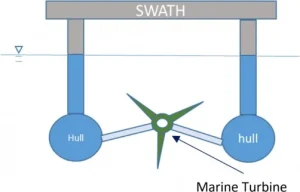
Conceptual design features a small-waterplane-area twin-hull vessel that acts as a docking and charging station for autonomous underwater vehicles and unmanned aerial vehicles, using solar and turbine energy to enable continuous monitoring. Credit: Florida Atlantic University

The conceptual design features a small-waterplane-area twin-hull (SWATH) vessel that acts as a docking and charging station for AUVs and unmanned aerial vehicles (UAVs). The SWATH ship is engineered for exceptional stability, enabling it to navigate through melting ice and operate in a wide range of sea conditions. It is designed to be self-sufficient, using automated sailing, solar panels and an underwater turbine positioned between its twin hulls to generate and store energy, ensuring continuous mission support even when sailing against ocean currents.

Unlike prior platforms, the system designed by the FAU researchers will use advanced technology to monitor the Arctic Ocean from the air, water surface and underwater. The new unmanned surface vehicle (USV) design is specifically tailored for the project to ensure stability in Arctic conditions and handle high wind speeds. The observation platform system’s main objective is to investigate the melting sea ice area. Wind energy will be harnessed to facilitate sailing in the Arctic water, while an underwater turbine will generate sufficient energy to sustain the system’s operations.

Results of the study, published in the journal Applied Ocean Research, show that using the motion of a wind-driven sailboat to generate power from the turbine beneath the SWATH is a feasible way to support long-term Arctic Ocean monitoring missions. The design integrates with the environment it monitors, offering new data on Arctic Sea ice melt beyond what satellites and manned ships can provide.

“Our proposed autonomous observation platform system offers a comprehensive approach to studying the Arctic environment and monitoring the impact of melting sea ice,” said Tsung-Chow Su, senior author and a professor in FAU’s Department of Ocean and Mechanical Engineering. “Its design and capabilities make it well suited to overcome the challenges of the Arctic’s unique conditions. By providing a self-sustaining platform for continuous data collection, this design supports scientific research, environmental protection and resource management, laying the foundation for year-round monitoring of the Arctic.”

Self-sustaining tools

The FAU-designed vessel is essential for marine data collection, integrating UAVs and AUVs for real-time monitoring, resource exploration and research. The UAVs use high-resolution cameras and sensors for mapping and navigation, while AUVs gather underwater data. The DJI Dock 2 system enables UAVs to autonomously land, recharge and redeploy, while an advanced underwater docking system ensures AUVs can refuel and transfer data, extending their range. Survey instruments in the underwater hulls collect mission-specific data, which is processed on board and transmitted via satellite, enabling long-term, unmanned ocean monitoring.
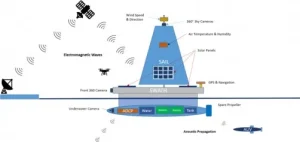
Credit: Florida Atlantic University

The self-sustaining platform will use wind energy and marine current energy to achieve long-term monitoring in the Arctic Ocean. A dimensionless formula has been developed to estimate the minimum sail area required for varying sizes of SWATH in combination with a wind-driven power system.

“Our researchers have developed an innovative observation system tailored to the Arctic environment, offering critical data on sea ice melt that satellites and manned vessels are unable to capture. Long-term monitoring is essential, as it provides deeper insights into the lasting impacts of Arctic sea ice loss, which can guide informed policy and management decisions,” said Stella Batalama, dean of the FAU College of Engineering and Computer Science. “Additionally, there remains much to uncover about Arctic phytoplankton and algae, which play a crucial role in the food web and influence ocean-atmosphere interactions. This new system could enhance our scientific understanding of their ecological significance while supporting Alaska’s indigenous communities in adapting to future changes in wildlife and food resources.”

The first author of the study is Wenqiang Xu, a doctoral degree graduate of FAU’s Department of Ocean and Mechanical Engineering.

In related news, Meteomatics recently deployed 30 of its autonomous weather drones, or ‘Meteodrones’, across Norway in collaboration with the Norwegian Research Centre (NORCE). Click here to read the full story.

Previous ArticleMIT develops spatial validation technique to increase forecast accuracy
Next Article VIDEO: Vaisala reveals radar with a solid-state power amplified transmitter

Read Similar Stories

Climate Measurement

Windracers ULTRA drones to be deployed in Greenland on glacier surveying mission

March 12, 20263 Mins Read
Climate Measurement

Unmanned Antarctica atmospheric observation experiment advances in China

February 10, 20262 Mins Read
Climate Measurement

Robotic Argo float sends back first ocean transect beneath East Antarctic ice shelf

December 11, 20252 Mins Read
Latest News

Northumbria University secures £4m to study Earth’s radiation belts

April 16, 2026

AI model improves real-time prediction of wildfire spread

April 16, 2026

Study identifies atmospheric trigger behind flash droughts in Puerto Rico

April 15, 2026

Receive breaking stories and features in your inbox each week, for free


Enter your email address:


Supplier Spotlights
  • Nel Hydrogen
Getting in Touch
  • Contact Us / Advertise
  • Meet the Editors
  • Media Pack
  • Free Weekly E-Newsletter
Our Social Channels
  • Facebook
  • LinkedIn
© 2026 UKi Media & Events a division of UKIP Media & Events Ltd
  • Cookie Policy
  • Privacy Policy
  • Terms and Conditions
  • Notice and Takedown Policy

Type above and press Enter to search. Press Esc to cancel.