


Close Menu
Meteorological Technology International
  • News
    • A-E
      • Agriculture
      • Automated Weather Stations
      • Aviation
      • Climate Measurement
      • Data
      • Developing Countries
      • Digital Applications
      • Early Warning Systems
      • Extreme Weather
    • G-P
      • Hydrology
      • Lidar
      • Lightning Detection
      • New Appointments
      • Nowcasting
      • Numerical Weather Prediction
      • Polar Weather
    • R-S
      • Radar
      • Rainfall
      • Remote Sensing
      • Renewable Energy
      • Satellites
      • Solar
      • Space Weather
      • Supercomputers
    • T-Z
      • Training
      • Transport
      • Weather Instruments
      • Wind
      • World Meteorological Organization
      • Meteorological Technology World Expo
  • Features
  • Online Magazines
    • January 2026
    • April 2025
    • January 2025
    • September 2024
    • April 2024
    • Archive Issues
    • Subscribe Free!
  • Opinion
  • Videos
  • Supplier Spotlight
  • Expo
LinkedIn X (Twitter) Facebook
  • Sign-up for Free Weekly E-Newsletter
  • Meet the Editors
  • Contact Us
  • Media Pack
LinkedIn Facebook
Subscribe
Meteorological Technology International
  • News
      • Agriculture
      • Automated Weather Stations
      • Aviation
      • Climate Measurement
      • Data
      • Developing Countries
      • Digital Applications
      • Early Warning Systems
      • Extreme Weather
      • Hydrology
      • Lidar
      • Lightning Detection
      • New Appointments
      • Nowcasting
      • Numerical Weather Prediction
      • Polar Weather
      • Radar
      • Rainfall
      • Remote Sensing
      • Renewable Energy
      • Satellites
      • Solar
      • Space Weather
      • Supercomputers
      • Training
      • Transport
      • Weather Instruments
      • Wind
      • World Meteorological Organization
      • Meteorological Technology World Expo
  • Features
  • Online Magazines
    1. January 2026
    2. September 2025
    3. April 2025
    4. January 2025
    5. September 2024
    6. April 2024
    7. January 2024
    8. September 2023
    9. April 2023
    10. Archive Issues
    11. Subscribe Free!
    Featured
    November 27, 2025

    In this Issue – January 2026

    By Hazel KingNovember 27, 2025
    Recent

    In this Issue – January 2026

    November 27, 2025

    In this Issue – September 2025

    August 11, 2025

    In this Issue – April 2025

    April 15, 2025
  • Opinion
  • Videos
  • Supplier Spotlight
  • Expo
Facebook LinkedIn
Subscribe
Meteorological Technology International
World Meteorological Organization

WMO predicts return of La Niña but temperatures likely to be above average

Hazel KingBy Hazel KingSeptember 4, 20253 Mins Read
Share LinkedIn Facebook Twitter Email
WMO predicts return of La Niña but temperatures likely to be above average.
Share
LinkedIn Facebook Twitter Email

The latest World Meteorological Organization (WMO) El Niño/La Niña update predicts that the La Niña climate pattern may return to affect weather from September onward, although temperatures are still expected to be above average for much of the world.

Neutral conditions (neither El Niño or La Niña) have persisted since March 2025, with sea surface temperature anomalies remaining near average across the equatorial Pacific. However, these conditions may gradually make way for La Niña conditions to emerge in the coming months, potentially starting in September 2025, the update reports.

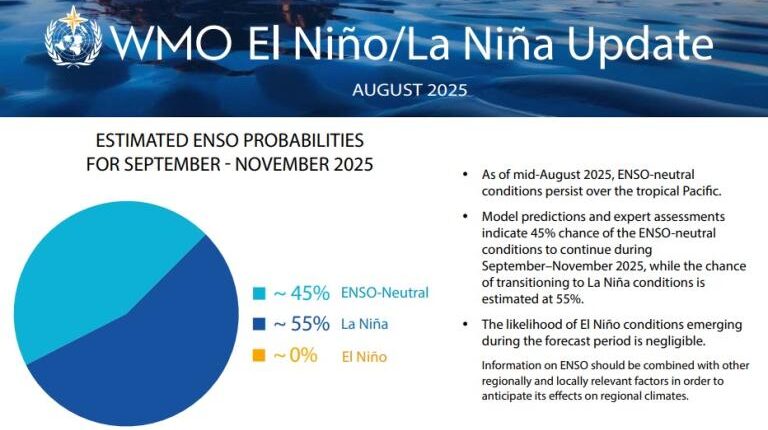
According to the latest forecasts from the WMO Global Producing Centres for Seasonal Prediction, there is a 55% chance for sea surface temperatures in the equatorial Pacific to cool to La Niña levels, and a 45% chance for them to remain at El Niño-Southern Oscillation (ENSO)-neutral levels during the upcoming September-November 2025 period.

For October-December 2025, the likelihood of La Niña conditions slightly increases to about 60%. There is little chance of El Niño developing during September-December, the report states.

“Seasonal forecasts for El Niño and La Niña and their associated impacts on our weather are an important climate intelligence tool,” said WMO secretary-general Celeste Saulo. “They translate into millions of dollars of economic savings for key sectors like agriculture, energy, health and transport, and have saved thousands of lives when used to guide preparedness and response actions.”

While the ENSO is a key driver of global climate patterns, it is not the only factor shaping the Earth’s climate, according to WMO. To provide a more comprehensive climate outlook, the organization also issues regular Global Seasonal Climate Updates (GSCU), which consider the influence of key climate variability patterns, such as the North Atlantic Oscillation, the Arctic Oscillation and the Indian Ocean Dipole.

The updates also monitor the global and regional anomalies of surface temperature and precipitation and their evolution over the upcoming season. The global updates inform more tailored and localized outlooks issued by WMO regional centers and national members.

The latest update says that for September to November, temperatures are expected to be above normal in much of the northern hemisphere and large parts of the southern hemisphere.

For more information, visit the WMO website.

In related news, the WMO has added a new chapter on image velocimetry to its Guide to Hydrological Practice, providing information to its members on the benefits of these innovative cost-effective methods for measuring rivers and streams

Previous ArticleVaisala launches new climate business after Quanterra acquisition
Next Article Summer 2025 was the UK’s hottest on record, Met Office reports

Read Similar Stories

Climate Measurement

Study identifies atmospheric trigger behind flash droughts in Puerto Rico

April 15, 20263 Mins Read
Satellites

AI tool uses weather satellite data to map ocean currents in near real time

April 14, 20263 Mins Read
Climate Measurement

New tool speeds up climate model evaluation

April 13, 20262 Mins Read
Latest News

Northumbria University secures £4m to study Earth’s radiation belts

April 16, 2026

AI model improves real-time prediction of wildfire spread

April 16, 2026

Study identifies atmospheric trigger behind flash droughts in Puerto Rico

April 15, 2026

Receive breaking stories and features in your inbox each week, for free


Enter your email address:


Supplier Spotlights
  • ZX Lidars
Getting in Touch
  • Contact Us / Advertise
  • Meet the Editors
  • Media Pack
  • Free Weekly E-Newsletter
Our Social Channels
  • Facebook
  • LinkedIn
© 2026 UKi Media & Events a division of UKIP Media & Events Ltd
  • Cookie Policy
  • Privacy Policy
  • Terms and Conditions
  • Notice and Takedown Policy

Type above and press Enter to search. Press Esc to cancel.