


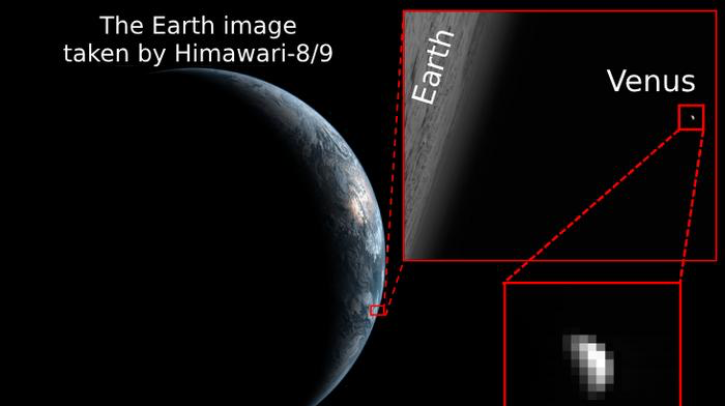
A team led by the University of Tokyo collated infrared images from Japan’s Himawari-8 and -9 meteorological satellites from 2015 to 2025 to monitor temporal changes in Venus’ cloud top temperature, revealing unseen patterns in the temperature structure of various waves.
Analyzing Venus’ atmosphere
The images have been used to estimate brightness temperatures on day to year scales. The team say that the results demonstrate that meteorological satellites can serve as additional eyes to access the Venusian atmosphere from space and complement future observations from planetary missions and ground-based telescopes.
The Himawari-8 and -9 satellites, launched in 2014 and 2016, respectively, were developed to monitor global atmospheric phenomena through use of their multispectral Advanced Himawari Imagers (AHIs). The University of Tokyo team, led by visiting researcher Gaku Nishiyama, saw the opportunity to use the sensor data for spaceborne observations of Venus, which is coincidentally captured by the AHIs near the Earth’s rim.
The team pointed out that observing temporal temperature variations in the cloud tops of Venus is essential to understand its atmospheric dynamics and related phenomena, such as thermal tides and planetary-scale waves.
Nishiyama explained, “Obtaining data for these phenomena presents multiple challenges. The atmosphere of Venus has been known to exhibit year-scale variations in reflectance and wind speed. However, no planetary mission has succeeded in continuous observation for longer than 10 years due to their mission lifetimes. Ground-based observations can also contribute to long-term monitoring, but their observations generally have limitations due to the Earth’s atmosphere and sunlight during the daytime.”
On the other hand, the the Himawari-8 and -9 satellites appeared well suited to fill this gap due to their longer mission lifetimes. They are both scheduled for operation until 2029. The AHIs enable multiband infrared coverage, which has been limited in planetary missions to date, essential for retrieving temperature information from different altitudes, along with low noise and frequent observation. The team investigated the observed temporal dynamics of the Venusian atmosphere and provided a comparative analysis with previous datasets.
“We believe this method will provide precious data for Venus science because there might not be any other spacecraft orbiting around Venus until the next planetary missions around 2030,” said Nishiyama.
The team first established a data archive by extracting all Venus images from the collected AHI datasets, identifying 437 occurrences in total. Taking into account background noise and apparent size of Venus in the captured images, they were able to track the temporal variation in cloud top temperature during the periods where the geostationary satellite, Venus and the Earth lined up in a row.
The retrieved temporal variations in brightness temperatures were then analyzed on both year and day scales and compared for all infrared bands to investigate the variability of thermal tides and planetary-scale waves. Variation in thermal tide amplitude was confirmed from the obtained dataset. The results also confirmed change in amplitude of planetary waves in the atmosphere with time, appearing to decrease with altitude. While definitive conclusions on the physics behind the detected variations were challenging due to the limited temporal resolution of the AHI data, variations in the thermal tide amplitude appeared possibly linked to decadal variation in the Venus atmosphere structure.
Improving datasets
In addition to successfully applying the Himawari data to planetary observations, the team was further able to use the data to identify calibration discrepancies in data from previous planetary missions.
Nishiyama concluded, “I think that our novel approach in this study successfully opened a new avenue for long-term and multiband monitoring of solar system bodies. This includes the moon and Mercury, which I also study at present. Their infrared spectra contain various information on physical and compositional properties of their surface, which are hints at how these rocky bodies have evolved until the present. The prospect of accessing a range of geometric conditions untethered from the limitations of ground-based observations is clearly an exciting one. We hope this study will enable us to assess physical and compositional properties, as well as atmospheric dynamics, and contribute to our further understanding of planetary evolution in general.”
For more of the top insights into the future of space-based instrumentation, read Meteorological Technology International’s exclusive feature ‘How is NASA improving the prediction of space radiation?’