


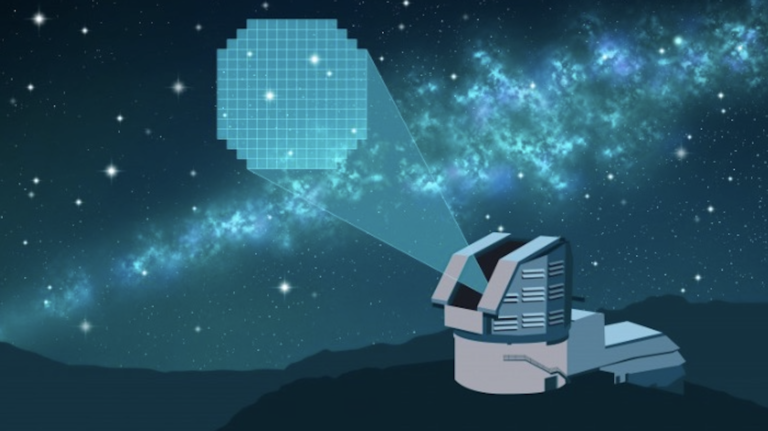
Using the largest camera ever built, the NSF–DOE Vera C. Rubin Observatory will repeatedly scan the sky for 10 years and create an ultra-wide, ultra-high-definition, time-lapse record of our universe.
The astronomy and astrophysics observatory has been jointly funded by the US National Science Foundation and the US Department of Energy’s Office of Science. Rubin is a joint program of NSF NOIRLab and DOE’s SLAC National Accelerator Laboratory, which will cooperatively operate it. NSF NOIRLab is managed by the Association of Universities for Research in Astronomy (AURA) and SLAC is operated by Stanford University for the DOE.
The observatory is under construction on Cerro Pachón in Chile and is expected to experience its first light in 2025. The facility is named after astronomer Vera Rubin, who provided the first convincing evidence for the existence of dark matter. Its primary mission is to carry out the Legacy Survey of Space and Time, providing an unprecedented dataset for scientific research supported by both agencies. France is providing key support for the construction and operations of Rubin Observatory through contributions from CNRS/IN2P3. There have been additional contributions from more than 40 international organizations and teams.
NOIRLab and SLAC said that although researchers have caught thousands of Type Ia supernovae, seeing each one once or twice is not enough. This is because by emitting a known amount of light, these explosions are integral to confident calculations of distance across the universe, as well as measurement of the universe’s expansion rate and whether it changes over time. Therefore, the NSF–DOE Vera C. Rubin Observatory is expected to provide a goldmine of information on how the fleeting light of these supernovae varies over time by scanning the southern hemisphere sky every night for 10 years, covering the entire hemisphere approximately every few nights.
Every time Rubin detects an object changing brightness or position, it will send an alert to the science community. With such rapid detection, Rubin will reportedly be the most powerful tool yet for spotting Type Ia supernovae before they fade away.
A deluge of data
Every night, Rubin Observatory will produce about 20TB of data and generate up to 10 million alerts. According to the organizations, no other telescope in history has produced “a fire hose of data quite like this”. It has reportedly required scientists to rethink the way they manage rapid alerts and to develop methods and systems to handle large incoming datasets.
Rubin’s deluge of nightly alerts will be managed and made available to scientists through seven community software systems that will ingest and process these alerts before serving them up to scientists around the world. Anais Möller, a member of the Rubin/LSST Dark Energy Science Collaboration, together with a large collaboration of scientists with a variety of expertise, is developing one of these systems, called Fink.
The software systems collect the alerts from Rubin each night, merge Rubin data with other datasets, and, using machine learning, classify them according to their type, such as kilonovae, variable stars or Type Ia supernovae. Scientists using one of Rubin’s community systems, like Fink, will be able to sort the massive dataset of alerts according to selected filters, enabling them to quickly home in on the data that is useful for their research.
“Because of the large volumes of data, we can’t do science the same way we did before,” stated Möller. “Rubin is a generational shift. And our responsibility is developing the methods that will be used by the next generation.”
Impact on the scientific community
Scientists like Möller look forward to Rubin’s decade-long Legacy Survey of Space and Time (LSST), during which it’s expected to detect millions of Type Ia supernovae. “The large volume of data from Rubin will give us a sample of all kinds of Type Ia supernovae at a range of distances and in many different types of galaxies,” said Möller.
In fact, Rubin is projected to discover many more Type Ia supernovae in the first few months of the LSST than were used in the initial discovery of dark energy – the mysterious force causing the universe to expand faster than expected based on gravitational theory. Current measurements hint that dark energy might change over time. If confirmed, this could help refine scientific understanding of the universe’s age and evolution. That in turn would affect researchers’ understanding of how the universe formed, including how quickly stars and galaxies formed in the early universe.
With a much larger set of Type Ia supernovae from across the universe, scientists will be able to refine the existing map of space and time, getting a fuller picture of dark energy’s influence.
“The universe expanding is like a rubber band being stretched. If dark energy is not constant, that would be like stretching the rubber band by different amounts at different points,” added Möller. “I think in the next decade, we will be able to constrain whether dark energy is constant or evolving with cosmic time. Rubin will allow us to do that with Type Ia supernovae.”
In related news, the twin spacecraft for NASA’s TRACERS (Tandem Reconnection and Cusp Electrodynamics Reconnaissance Satellites) mission has recently been completed, in preparation for launch in 2025. Click here to read the full story.