


Close Menu
Meteorological Technology International
  • News
    • A-E
      • Agriculture
      • Automated Weather Stations
      • Aviation
      • Climate Measurement
      • Data
      • Developing Countries
      • Digital Applications
      • Early Warning Systems
      • Extreme Weather
    • G-P
      • Hydrology
      • Lidar
      • Lightning Detection
      • New Appointments
      • Nowcasting
      • Numerical Weather Prediction
      • Polar Weather
    • R-S
      • Radar
      • Rainfall
      • Remote Sensing
      • Renewable Energy
      • Satellites
      • Solar
      • Space Weather
      • Supercomputers
    • T-Z
      • Training
      • Transport
      • Weather Instruments
      • Wind
      • World Meteorological Organization
      • Meteorological Technology World Expo
  • Features
  • Online Magazines
    • January 2026
    • April 2025
    • January 2025
    • September 2024
    • April 2024
    • Archive Issues
    • Subscribe Free!
  • Opinion
  • Videos
  • Supplier Spotlight
  • Expo
LinkedIn X (Twitter) Facebook
  • Sign-up for Free Weekly E-Newsletter
  • Meet the Editors
  • Contact Us
  • Media Pack
LinkedIn Facebook
Subscribe
Meteorological Technology International
  • News
      • Agriculture
      • Automated Weather Stations
      • Aviation
      • Climate Measurement
      • Data
      • Developing Countries
      • Digital Applications
      • Early Warning Systems
      • Extreme Weather
      • Hydrology
      • Lidar
      • Lightning Detection
      • New Appointments
      • Nowcasting
      • Numerical Weather Prediction
      • Polar Weather
      • Radar
      • Rainfall
      • Remote Sensing
      • Renewable Energy
      • Satellites
      • Solar
      • Space Weather
      • Supercomputers
      • Training
      • Transport
      • Weather Instruments
      • Wind
      • World Meteorological Organization
      • Meteorological Technology World Expo
  • Features
  • Online Magazines
    1. January 2026
    2. September 2025
    3. April 2025
    4. January 2025
    5. September 2024
    6. April 2024
    7. January 2024
    8. September 2023
    9. April 2023
    10. Archive Issues
    11. Subscribe Free!
    Featured
    November 27, 2025

    In this Issue – January 2026

    By Hazel KingNovember 27, 2025
    Recent

    In this Issue – January 2026

    November 27, 2025

    In this Issue – September 2025

    August 11, 2025

    In this Issue – April 2025

    April 15, 2025
  • Opinion
  • Videos
  • Supplier Spotlight
  • Expo
Facebook LinkedIn
Subscribe
Meteorological Technology International
Space Weather

High-speed camera used to reveal violent flaring at heart of black hole system

Helen NormanBy Helen NormanOctober 23, 20193 Mins Read
Share LinkedIn Facebook Twitter Email
Black hole
Share
LinkedIn Facebook Twitter Email

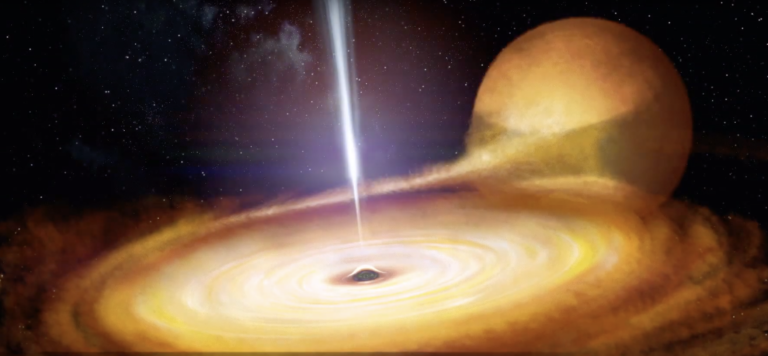
An international team of astronomers, including academics from the University of Sheffield, have used state-of-the-art cameras to create a high frame-rate movie of an accreting black hole at a level of detail never seen before.

To capture the images they used HiPERCAM, a high-speed camera that can take more than 1,000 frames every second, which was developed by the University of Sheffield. The resulting data allowed the team to study the immediate surroundings of the black hole.

Black holes can feed off a nearby star and create vast accretion discs of material. Here, the effect of the black hole’s strong gravity and the material’s own magnetic field can cause rapidly changing levels of radiation to be emitted from the system as a whole.

This radiation was detected in visible light by the HiPERCAM instrument on the Gran Telescopio Canarias (La Palma, Canary Islands) and in X-rays by NASA’s NICER observatory aboard the International Space Station.

The black hole system studied is named MAXI J1820+070, and was first discovered in early 2018. It is only about 10,000 lightyears away, in our own Milky Way. It has a mass of about seven suns, contained within a region of space smaller than the City of London.

Investigating these systems is usually very difficult, as their distances make them too faint and too small to see. The HiPERCAM and NICER instruments however, let the researchers record ‘movies’ of the changing light from the system at over 300 frames per second, capturing violent ‘flaring’ of visible and X-ray light.

Professor Vik Dhillon, from the University of Sheffield’s Department of Physics and Astronomy, said, “The challenge with these observations was that we had to use extremely short exposure times – only a few milliseconds – on an extremely faint astronomical target. The combination of the high-speed camera, HiPERCAM, mounted on the world’s largest optical telescope, the 10.4m Gran Telescopio Canarias (GTC) on La Palma, is the only facility in the world capable of providing such observations.”

Researchers found that dips in X-ray levels were accompanied by a rise in visible light and vice-versa, such patterns indirectly reveal the presence of distinct plasma, extremely hot material where electrons are stripped away from atoms, in structures deep in the embrace of the black hole’s gravity, otherwise too small to resolve.

John Paice, a graduate student at the University of Southampton and the Inter-University Centre for Astronomy and Astrophysics in India and lead author of the study, added, “The movie was made using real data, but slowed down to 1/10th of actual speed to allow the most rapid flares to be discerned by the human eye. We can see how the material around the black hole is so bright, it’s outshining the star that it is consuming, and the fastest flickers last only a few milliseconds – that’s the output of a hundred suns being emitted in the blink of an eye!

“Time-domain astrophysics is a research area rife with the potential of discovery, as this study demonstrates. New systems like MAXI J1820+070 are discovered every year. Novel cameras like HiPERCAM and NICER are helping us to better understand these enigmatic cosmic objects better than ever before,” he concluded.

To view an artist’s impression of the black hole system, based upon observed characteristics during a rapid accretion episode in March 2018, click here.

Previous ArticleLifesaving storm warnings for Africa’s Lake Victoria
Next Article High frame-rate movie of an accreting black hole at a level of detail never seen before

Read Similar Stories

Space Weather

Northumbria University secures £4m to study Earth’s radiation belts

April 16, 20262 Mins Read
Solar

Mauna Loa Solar Observatory reopens to support Artemis II mission

April 8, 20262 Mins Read
Satellites

NCAR researchers create breakthrough tool to enhance space weather prediction

February 24, 20262 Mins Read
Latest News

Northumbria University secures £4m to study Earth’s radiation belts

April 16, 2026

AI model improves real-time prediction of wildfire spread

April 16, 2026

Study identifies atmospheric trigger behind flash droughts in Puerto Rico

April 15, 2026

Receive breaking stories and features in your inbox each week, for free


Enter your email address:


Supplier Spotlights
  • Senseca
Getting in Touch
  • Contact Us / Advertise
  • Meet the Editors
  • Media Pack
  • Free Weekly E-Newsletter
Our Social Channels
  • Facebook
  • LinkedIn
© 2026 UKi Media & Events a division of UKIP Media & Events Ltd
  • Cookie Policy
  • Privacy Policy
  • Terms and Conditions
  • Notice and Takedown Policy

Type above and press Enter to search. Press Esc to cancel.