


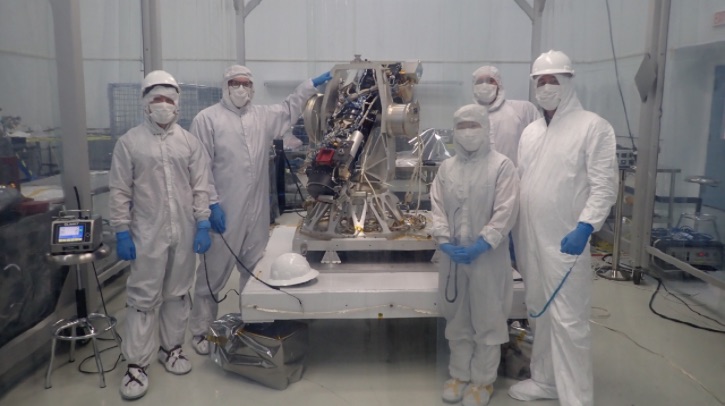
NASA’s Coronal Diagnostic Experiment (CODEX) will launch to the International Space Station in November 2024 to collect data on solar wind, including its origin and evolution.
NASA’s Coronal Diagnostic Experiment
Launching aboard SpaceX’s 31st commercial resupply services mission, CODEX will be robotically installed on the exterior of the space station. As a solar coronagraph, it will block out the bright light from the sun’s surface to better see details in the sun’s outer atmosphere, or corona.
In this animation, the CODEX instrument can be seen mounted on the exterior of the International Space Station. Credit: CODEX Team/NASA
“The CODEX instrument is a new-generation solar coronagraph,” said Jeffrey Newmark, principal investigator for the instrument, and a scientist at NASA’s Goddard Space Flight Center in Greenbelt, Maryland. “It has a dual use – it’s both a technology demonstration and will conduct science.”
This coronagraph is different from prior coronagraphs that NASA has used because it has special filters that can provide details of the temperature and speed of the solar wind. Typically, a solar coronagraph captures images of the density of the plasma flowing away from the sun. By combining the temperature and speed of the solar wind with the traditional density measurement, CODEX can reportedly give scientists a fuller picture of the wind itself.
“This isn’t just a snapshot,” said Nicholeen Viall, co-investigator of CODEX and a heliophysicist at NASA Goddard. “You’re going to get to see the evolution of structures in the solar wind, from when they form from the sun’s corona until they flow outward and become the solar wind.”
The CODEX instrument will give scientists more information to enable them to understand what heats the solar wind to around 1,000,000°C – around 175 times hotter than the sun’s surface – and sends it streaming out from the sun at more than 1,600,000km/h.
Research timeline of the instrument
This launch is the latest step in a long history for the instrument. In the early 2000s and in August 2017, NASA scientists ran ground-based experiments similar to CODEX during total solar eclipses. A coronagraph mimics what happens during a total solar eclipse, so this naturally occurring phenomenon provided a good opportunity to test instruments that measure the temperature and speed of the solar wind.
In 2019, NASA scientists launched the Balloon-borne Investigation of Temperature and Speed of Electrons in the corona (BITSE) experiment. A balloon the size of a football field carried the CODEX prototype more than 35km above Earth’s surface, where the atmosphere is much thinner and the sky is dimmer than it is from the ground, enabling better observations. However, this region of Earth’s atmosphere is still brighter than outer space itself.
“We saw enough from BITSE to see that the technique worked, but not enough to achieve the long-term science objectives,” said Newmark.
Now, by installing CODEX on the space station, scientists will be able to view the sun’s corona without fighting the brightness of Earth’s atmosphere. This is also a beneficial time for the instrument to launch because the sun has reached its solar maximum phase, a period of high activity during its 11-year cycle.
“The types of solar wind that we get during solar maximum are different from some of the types of wind we get during solar minimum,” said Viall. “There are different coronal structures during this time that lead to different types of solar wind.”
Today’s solar research goals
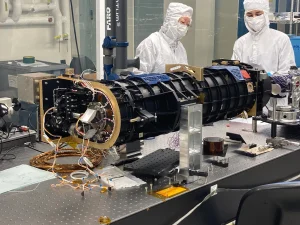
Credit: CODEX Team/NASA
This coronagraph will look at two types of solar wind. In one, the solar wind travels directly outward from our star, pulling the magnetic field from the sun into the heliosphere, the bubble that surrounds our solar system. The other type of solar wind forms from magnetic field lines that are initially closed, like a loop, but then open up.
These closed field lines contain hot, dense plasma. When the loops open, this hot plasma gets propelled into the solar wind. These ‘blobs’ of plasma are present throughout the solar cycle, but scientists expect their location to change because of the magnetic complexity of the corona during solar maximum. The CODEX instrument is designed to see for the first time how hot these blobs are.
The coronagraph will also build on research from ongoing space missions, such as the joint ESA (European Space Agency) and NASA mission Solar Orbiter, which also carries a coronagraph, and NASA’s Parker Solar Probe. For example, CODEX will look at the solar wind much closer to the solar surface, whereas the Parker Solar Probe samples it a little farther out. Launching in 2025, NASA’s Polarimeter to Unify the Corona and Heliosphere (PUNCH) mission will make 3D observations of the sun’s corona to learn how the mass and energy there become solar wind.
By comparing these findings, scientists can better understand how the solar wind is formed and how it changes as it travels farther from the sun. This research advances our understanding of space weather, the conditions in space that may interact with Earth and spacecraft.
“Just like understanding hurricanes, you want to understand the atmosphere the storm is flowing through,” said Newmark. “CODEX’s observations will contribute to our understanding of the region that space weather travels through, helping to improve predictions.”
The CODEX instrument is a collaboration between NASA’s Goddard Space Flight Center and the Korea Astronomy and Space Science Institute, with additional contribution from Italy’s National Institute for Astrophysics.
In related news, scientists recently took the first near-daily measurements of the sun’s global coronal magnetic field, a region of the sun that has previously only been observed irregularly. The resulting observations provide insights into the processes that drive the intense solar storms that affect technologies on Earth. Click here to read the full story.