


Close Menu
Meteorological Technology International
  • News
    • A-E
      • Agriculture
      • Automated Weather Stations
      • Aviation
      • Climate Measurement
      • Data
      • Developing Countries
      • Digital Applications
      • Early Warning Systems
      • Extreme Weather
    • G-P
      • Hydrology
      • Lidar
      • Lightning Detection
      • New Appointments
      • Nowcasting
      • Numerical Weather Prediction
      • Polar Weather
    • R-S
      • Radar
      • Rainfall
      • Remote Sensing
      • Renewable Energy
      • Satellites
      • Solar
      • Space Weather
      • Supercomputers
    • T-Z
      • Training
      • Transport
      • Weather Instruments
      • Wind
      • World Meteorological Organization
      • Meteorological Technology World Expo
  • Features
  • Online Magazines
    • January 2026
    • April 2025
    • January 2025
    • September 2024
    • April 2024
    • Archive Issues
    • Subscribe Free!
  • Opinion
  • Videos
  • Supplier Spotlight
  • Expo
LinkedIn X (Twitter) Facebook
  • Sign-up for Free Weekly E-Newsletter
  • Meet the Editors
  • Contact Us
  • Media Pack
LinkedIn Facebook
Subscribe
Meteorological Technology International
  • News
      • Agriculture
      • Automated Weather Stations
      • Aviation
      • Climate Measurement
      • Data
      • Developing Countries
      • Digital Applications
      • Early Warning Systems
      • Extreme Weather
      • Hydrology
      • Lidar
      • Lightning Detection
      • New Appointments
      • Nowcasting
      • Numerical Weather Prediction
      • Polar Weather
      • Radar
      • Rainfall
      • Remote Sensing
      • Renewable Energy
      • Satellites
      • Solar
      • Space Weather
      • Supercomputers
      • Training
      • Transport
      • Weather Instruments
      • Wind
      • World Meteorological Organization
      • Meteorological Technology World Expo
  • Features
  • Online Magazines
    1. January 2026
    2. September 2025
    3. April 2025
    4. January 2025
    5. September 2024
    6. April 2024
    7. January 2024
    8. September 2023
    9. April 2023
    10. Archive Issues
    11. Subscribe Free!
    Featured
    November 27, 2025

    In this Issue – January 2026

    By Hazel KingNovember 27, 2025
    Recent

    In this Issue – January 2026

    November 27, 2025

    In this Issue – September 2025

    August 11, 2025

    In this Issue – April 2025

    April 15, 2025
  • Opinion
  • Videos
  • Supplier Spotlight
  • Expo
Facebook LinkedIn
Subscribe
Meteorological Technology International
Early Warning Systems

Satellites can provide warnings for volcanic eruption and tsunamis, Penn State discovers

Elizabeth BakerBy Elizabeth BakerFebruary 18, 20254 Mins Read
Share LinkedIn Facebook Twitter Email
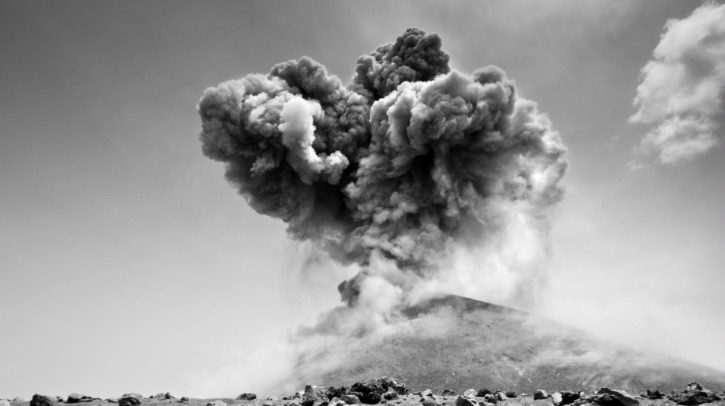
Through a new analysis of satellite data, researchers at Penn State, recently discovered that the side of the Anak Krakatau volcano was slipping for years and accelerated before the eruption and deadly ensuing tsunami in 2018.
Share
LinkedIn Facebook Twitter Email

Through a new analysis of satellite data, researchers at Penn State have discovered that the side of the Anak Krakatau volcano was slipping for years and accelerated before the eruption and deadly ensuing tsunami in 2018.

Satellite warning system

The team published their findings in the journal Geophysical Research Letters, which highlighted the information that could have potentially offered a warning of the collapse.

“Ocean volcanoes, when they are unstable, can collapse catastrophically and generate a tsunami,” said Christelle Wauthier, associate professor of geosciences at Penn State and co-author of the study. “And when that happened in 2018, more than 400 people died because nobody had instruments on the ground to know potentially if there was acceleration or change in the deformation behavior. Nobody knew the collapse was imminent. This study shows, unfortunately retrospectively, that we could forecast it if we had this remote sensing data set to get the surface deformation.”

The scientists tracked ground movements – or surface deformation – using radar satellites sensitive enough to spot changes of just a few inches. In this work, the team used a remote sensing technique called Interferometric Synthetic Aperture Radar (InSAR), to create accurate maps of those changes over time. The researchers analyzed more than a decade of data from three satellites – ALOS-1, COSMO-SkyMED and Sentinel 1 – and used InSAR techniques to map deformation in the lead up to the 2018 Anak Krakatau eruption.

“Overall, the detachment fault experienced approximately 15m – roughly 50ft – of slip from 2006 to 2018 with acceleration and deceleration periods, and a notable acceleration prior to the 2018 collapse,” said Young Cheol Kim, a doctoral candidate at Penn State and lead author of the study.

Increasing the dataset

The team also underlines that while the InSAR technique is not novel, it is rare to analyze such a large amount of data. The work required access to the high-performance Roar computer cluster managed by the Penn State Institute for Computational and Data Sciences.

“Integrating hundreds of radar images requires a great deal of computational power,” Wauthier said. “It’s a lot of data storage and data processing and it takes some time and resources.”

Still, in the report, the scientists asserted that the technique may show promise for near-real-time monitoring of active ocean volcanoes, especially in locations where other monitoring is not available, the scientists said.

“Slip occurs when there is a weakness – or fault – under a volcano. The volcano grows larger as it erupts over time, and eventually it reaches a threshold where there is too much weight for the fault to support, leading to a collapse. This process may start like a ‘slow landslide’ over years, but when it begins to accelerate it can be a sign that collapse is imminent. The whole chunk of the volcano that collapsed was already moving – like a slow landslide,” said Wauthier, who is Kim’s adviser.

“And, so, it’s very important to be able to look at the temporal evolution of that deformation, because if you have an acceleration, it can lead to a collapse. Our data shows that, basically, there was a precursor to the collapse.”

The researchers concluded that other ways to track deformation, like ground-based GPS instruments, are often lacking in locations like Anak Krakatau. This is because it is an active volcano and there are safety and permitting issues. Ground-based equipment was also found to be costly to deploy and maintain and funding is not always available.

“If you have a sudden acceleration of slip, it might be the sign that you will have a collapse happening,” Wauthier said. “Whether it’s this volcano or others susceptible to collapse worldwide, if you don’t have ground-based data in real time, maybe having near-real-time InSAR processing can help researchers be on the lookout for any significant acceleration in slip.”

In related news, UNESCO recently presented a dedicated roadmap to ensure that 100% of coastal communities worldwide are tsunami-ready by 2030. Click here to read the full story.

Previous ArticleAI could replace numerical weather models, say CMA and Nanjing University researchers
Next Article NASA joins sunshade to Roman Observatory’s ‘exoskeleton’

Read Similar Stories

Space Weather

Northumbria University secures £4m to study Earth’s radiation belts

April 16, 20262 Mins Read
Extreme Weather

AI model improves real-time prediction of wildfire spread

April 16, 20263 Mins Read
Climate Measurement

Study identifies atmospheric trigger behind flash droughts in Puerto Rico

April 15, 20263 Mins Read
Latest News

Northumbria University secures £4m to study Earth’s radiation belts

April 16, 2026

AI model improves real-time prediction of wildfire spread

April 16, 2026

Study identifies atmospheric trigger behind flash droughts in Puerto Rico

April 15, 2026

Receive breaking stories and features in your inbox each week, for free


Enter your email address:


Supplier Spotlights
  • Nel Hydrogen
Getting in Touch
  • Contact Us / Advertise
  • Meet the Editors
  • Media Pack
  • Free Weekly E-Newsletter
Our Social Channels
  • Facebook
  • LinkedIn
© 2026 UKi Media & Events a division of UKIP Media & Events Ltd
  • Cookie Policy
  • Privacy Policy
  • Terms and Conditions
  • Notice and Takedown Policy

Type above and press Enter to search. Press Esc to cancel.