



Close Menu
Meteorological Technology International
  • News
    • A-E
      • Agriculture
      • Automated Weather Stations
      • Aviation
      • Climate Measurement
      • Data
      • Developing Countries
      • Digital Applications
      • Early Warning Systems
      • Extreme Weather
    • G-P
      • Hydrology
      • Lidar
      • Lightning Detection
      • New Appointments
      • Nowcasting
      • Numerical Weather Prediction
      • Polar Weather
    • R-S
      • Radar
      • Rainfall
      • Remote Sensing
      • Renewable Energy
      • Satellites
      • Solar
      • Space Weather
      • Supercomputers
    • T-Z
      • Training
      • Transport
      • Weather Instruments
      • Wind
      • World Meteorological Organization
      • Meteorological Technology World Expo
  • Features
  • Online Magazines
    • January 2026
    • April 2025
    • January 2025
    • September 2024
    • April 2024
    • Archive Issues
    • Subscribe Free!
  • Opinion
  • Videos
  • Supplier Spotlight
  • Expo
LinkedIn X (Twitter) Facebook
  • Sign-up for Free Weekly E-Newsletter
  • Meet the Editors
  • Contact Us
  • Media Pack
LinkedIn Facebook
Subscribe
Meteorological Technology International
  • News
      • Agriculture
      • Automated Weather Stations
      • Aviation
      • Climate Measurement
      • Data
      • Developing Countries
      • Digital Applications
      • Early Warning Systems
      • Extreme Weather
      • Hydrology
      • Lidar
      • Lightning Detection
      • New Appointments
      • Nowcasting
      • Numerical Weather Prediction
      • Polar Weather
      • Radar
      • Rainfall
      • Remote Sensing
      • Renewable Energy
      • Satellites
      • Solar
      • Space Weather
      • Supercomputers
      • Training
      • Transport
      • Weather Instruments
      • Wind
      • World Meteorological Organization
      • Meteorological Technology World Expo
  • Features
  • Online Magazines
    1. January 2026
    2. September 2025
    3. April 2025
    4. January 2025
    5. September 2024
    6. April 2024
    7. January 2024
    8. September 2023
    9. April 2023
    10. Archive Issues
    11. Subscribe Free!
    Featured
    November 27, 2025

    In this Issue – January 2026

    By Hazel KingNovember 27, 2025
    Recent

    In this Issue – January 2026

    November 27, 2025

    In this Issue – September 2025

    August 11, 2025

    In this Issue – April 2025

    April 15, 2025
  • Opinion
  • Videos
  • Supplier Spotlight
  • Expo
Facebook LinkedIn
Subscribe
Meteorological Technology International
Numerical Weather Prediction

AI could replace numerical weather models, say CMA and Nanjing University researchers

Elizabeth BakerBy Elizabeth BakerFebruary 17, 20252 Mins Read
Share LinkedIn Facebook Twitter Email
The School of Atmospheric Sciences at Nanjing University, China and the Earth System Numerical Prediction Center of the China Meteorological Administration have published a paper, entitled "Impacts of lateral boundary conditions from numerical models and data-driven networks on convective-scale ensemble forecasts", in Atmospheric and Oceanic Science Letters.
Share
LinkedIn Facebook Twitter Email

The School of Atmospheric Sciences at Nanjing University, China, and the Earth System Numerical Prediction Center of the China Meteorological Administration have published a paper, Impacts of lateral boundary conditions from numerical models and data-driven networks on convective-scale ensemble forecasts, in Atmospheric and Oceanic Science Letters, which outlines the impacts of the lateral boundary conditions provided by the AI models ‘Pangu-weather’ and ‘Fuxi-weather’ on convective-scale ensemble prediction systems.

The future of convective-scale ensemble forecasts
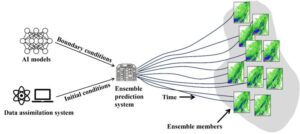
How AI models drive convective-scale ensemble forecasts. Credit: Junjie Deng

Overall, this work shows that AI weather models have the ability to replace traditional global numerical weather models in providing lateral boundary conditions for convective-scale ensemble prediction systems. Moreover, as the vertical resolution of AI weather models improves, it is expected that further positive impacts on convective-scale ensemble forecasts will materialize.

Evaluating the effectiveness of AI

The research set out to investigate the performance of using the predictions from the AI weather models as lateral boundary conditions to drive convective-scale ensemble prediction systems. This is because AI weather models can produce forecasts for the next seven to 10 days in just a few minutes, which is around 10,000 times faster than numerical weather models.

The team found that the results of the ensemble prediction system using lateral boundary conditions from Pangu-weather forecasts were found to be comparable to those using the conditions from National Centers for Environmental Prediction Global Forecast System forecasts.

Meanwhile, the results using lateral boundary conditions from Fuxi-weather forecasts showed slightly inferior performance compared to the others. When the number of vertical levels of the Global Forecast System forecasts was reduced from 33 to 13 (the same as Pangu-weather and Fuxi-weather), the results were the worst among all ensemble prediction systems. This indicates that the vertical resolution of the lateral boundary conditions could significantly affect the convective-scale ensemble prediction systems.

In related news, researchers from the Institute of Oceanology of the Chinese Academy of Sciences (IOCAS) have developed a new model for forecasting rapid intensification (RI) of a tropical cyclone (TC) based on ‘contrastive learning’. This study was published in the Proceedings of the National Academy of Sciences (PNAS). Click here to read the full story.

Previous ArticleMore than half of early warning system funding is in five countries, reports Global Observatory for Early Warning System Investments
Next Article Satellites can provide warnings for volcanic eruption and tsunamis, Penn State discovers

Read Similar Stories

Climate Measurement

China inaugurates 27th national climate observatory in Hebei

April 9, 20262 Mins Read
Data

Met Office rolls out major forecasting system upgrade

February 9, 20263 Mins Read
Solar

India partners on hybrid solar forecasting project for large solar parks

February 5, 20262 Mins Read
Latest News

Northumbria University secures £4m to study Earth’s radiation belts

April 16, 2026

AI model improves real-time prediction of wildfire spread

April 16, 2026

Study identifies atmospheric trigger behind flash droughts in Puerto Rico

April 15, 2026

Receive breaking stories and features in your inbox each week, for free


Enter your email address:


Supplier Spotlights
  • REMTECH
Getting in Touch
  • Contact Us / Advertise
  • Meet the Editors
  • Media Pack
  • Free Weekly E-Newsletter
Our Social Channels
  • Facebook
  • LinkedIn
© 2026 UKi Media & Events a division of UKIP Media & Events Ltd
  • Cookie Policy
  • Privacy Policy
  • Terms and Conditions
  • Notice and Takedown Policy

Type above and press Enter to search. Press Esc to cancel.