

Close Menu
Meteorological Technology International
  • News
    • A-E
      • Agriculture
      • Automated Weather Stations
      • Aviation
      • Climate Measurement
      • Data
      • Developing Countries
      • Digital Applications
      • Early Warning Systems
      • Extreme Weather
    • G-P
      • Hydrology
      • Lidar
      • Lightning Detection
      • New Appointments
      • Nowcasting
      • Numerical Weather Prediction
      • Polar Weather
    • R-S
      • Radar
      • Rainfall
      • Remote Sensing
      • Renewable Energy
      • Satellites
      • Solar
      • Space Weather
      • Supercomputers
    • T-Z
      • Training
      • Transport
      • Weather Instruments
      • Wind
      • World Meteorological Organization
      • Meteorological Technology World Expo
  • Features
  • Online Magazines
    • January 2026
    • April 2025
    • January 2025
    • September 2024
    • April 2024
    • Archive Issues
    • Subscribe Free!
  • Opinion
  • Videos
  • Supplier Spotlight
  • Expo
LinkedIn X (Twitter) Facebook
  • Sign-up for Free Weekly E-Newsletter
  • Meet the Editors
  • Contact Us
  • Media Pack
LinkedIn Facebook
Subscribe
Meteorological Technology International
  • News
      • Agriculture
      • Automated Weather Stations
      • Aviation
      • Climate Measurement
      • Data
      • Developing Countries
      • Digital Applications
      • Early Warning Systems
      • Extreme Weather
      • Hydrology
      • Lidar
      • Lightning Detection
      • New Appointments
      • Nowcasting
      • Numerical Weather Prediction
      • Polar Weather
      • Radar
      • Rainfall
      • Remote Sensing
      • Renewable Energy
      • Satellites
      • Solar
      • Space Weather
      • Supercomputers
      • Training
      • Transport
      • Weather Instruments
      • Wind
      • World Meteorological Organization
      • Meteorological Technology World Expo
  • Features
  • Online Magazines
    1. January 2026
    2. September 2025
    3. April 2025
    4. January 2025
    5. September 2024
    6. April 2024
    7. January 2024
    8. September 2023
    9. April 2023
    10. Archive Issues
    11. Subscribe Free!
    Featured
    November 27, 2025

    In this Issue – January 2026

    By Hazel KingNovember 27, 2025
    Recent

    In this Issue – January 2026

    November 27, 2025

    In this Issue – September 2025

    August 11, 2025

    In this Issue – April 2025

    April 15, 2025
  • Opinion
  • Videos
  • Supplier Spotlight
  • Expo
Facebook LinkedIn
Subscribe
Meteorological Technology International
Satellites

NOAA decommissions long-running POES constellation of weather data satellites

Alasdair MortonBy Alasdair MortonAugust 21, 20253 Mins Read
Share LinkedIn Facebook Twitter Email
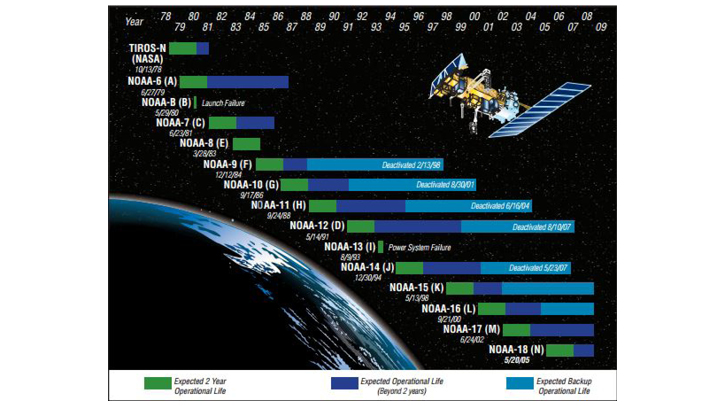
A graphic showing the time line of the launch and operations of the satellites of the 47-year-running POES contellation
Credit: NOAA
Share
LinkedIn Facebook Twitter Email

The National Oceanic and Atmospheric Administration has retired the last two operational satellites in its long-serving POES (Polar-orbiting Operational Environmental Satellites) constellation, which has been gathering weather and climate data from around the world for more than 40 years.

NOAA-15 was decommissioned on August 19 and NOAA-19 on August 13, 2025, following the emergency passivation of NOAA-18 on June 6, 2025, after the satellite lost functionality of its transmitter in late May. This brought to an end an environmental satellite mission that had run for 47 years.

The first POES satellite was launched in 1978 to monitor Earth’s weather and environment. Each POES satellite was originally designed to last for five years but many have far outlived those expectations. Flying about 520 miles above Earth and orbiting pole-to-pole 14 times a day, they provided critical observations of Earth’s atmosphere, surface and oceans that improved forecasts for hurricanes, wildfires, floods and other hazards that gave communities more time to prepare. The POES satellites also carried instruments that supported the international Search and Rescue Satellite-Aided Tracking (SARSAT) system since 1982. By relaying distress beacon signals, they have helped to save more than 24,400 lives around the world, NOAA says.

“POES wasn’t just a weather satellite system, it was a global asset,” said Greg Marlow, NOAA director of satellite and product operations. “From search and rescue to climate monitoring, these satellites supported NOAA’s mission and helped build international partnerships that endure to this day.”

POES satellites also benefited global commerce, agriculture, shipping, aviation and energy production by providing timely reliable weather data, especially in remote parts of the world where they were often the only near real-time source available. For decades, their data fed into  NOAA’s numerical weather prediction models, improving three- to five-day weather forecasts and directly assisting the federal, state and local governments in protecting life and property, especially during extreme weather events.

Furthermore, as the POES mission operated for more than four decades, it also contributed to the development of long-term environmental records that have supported research into the changing of global weather patterns. It consistently calibrated observations that enabled scientists to track patterns such as ocean heat waves and ozone depletion. This long-term data continues to support the baseline inputs used in NOAA’s weather models and forecasting systems.

Today, NOAA continues the critical mission of collecting weather observations from low-Earth orbit (LEO) through its next-generation satellite system, the Joint Polar Satellite System (JPSS). Building on the legacy of POES and working in coordination with other NOAA and partner LEO satellites, JPSS features more advanced instruments, delivers data more quickly and improves the accuracy of weather forecasts.

In related news, the Metop Second Generation A1 (Metop-SGA1) satellite, carrying the European Union’s Copernicus Sentinel-5 mission, was successfully launched from Europe’s Spaceport in Kourou, French Guiana, on August 13. Read the full story here

Previous ArticleWMO adds image velocimetry to Guide to Hydrological Practices
Next Article “Still raining?”: Met Office reveals UK public’s interest in the weather

Read Similar Stories

Space Weather

Northumbria University secures £4m to study Earth’s radiation belts

April 16, 20262 Mins Read
Extreme Weather

AI model improves real-time prediction of wildfire spread

April 16, 20263 Mins Read
Satellites

AI tool uses weather satellite data to map ocean currents in near real time

April 14, 20263 Mins Read
Latest News

Northumbria University secures £4m to study Earth’s radiation belts

April 16, 2026

AI model improves real-time prediction of wildfire spread

April 16, 2026

Study identifies atmospheric trigger behind flash droughts in Puerto Rico

April 15, 2026

Receive breaking stories and features in your inbox each week, for free


Enter your email address:


Supplier Spotlights
  • Meteorage
Getting in Touch
  • Contact Us / Advertise
  • Meet the Editors
  • Media Pack
  • Free Weekly E-Newsletter
Our Social Channels
  • Facebook
  • LinkedIn
© 2026 UKi Media & Events a division of UKIP Media & Events Ltd
  • Cookie Policy
  • Privacy Policy
  • Terms and Conditions
  • Notice and Takedown Policy

Type above and press Enter to search. Press Esc to cancel.