


Close Menu
Meteorological Technology International
  • News
    • A-E
      • Agriculture
      • Automated Weather Stations
      • Aviation
      • Climate Measurement
      • Data
      • Developing Countries
      • Digital Applications
      • Early Warning Systems
      • Extreme Weather
    • G-P
      • Hydrology
      • Lidar
      • Lightning Detection
      • New Appointments
      • Nowcasting
      • Numerical Weather Prediction
      • Polar Weather
    • R-S
      • Radar
      • Rainfall
      • Remote Sensing
      • Renewable Energy
      • Satellites
      • Solar
      • Space Weather
      • Supercomputers
    • T-Z
      • Training
      • Transport
      • Weather Instruments
      • Wind
      • World Meteorological Organization
      • Meteorological Technology World Expo
  • Features
  • Online Magazines
    • January 2026
    • April 2025
    • January 2025
    • September 2024
    • April 2024
    • Archive Issues
    • Subscribe Free!
  • Opinion
  • Videos
  • Supplier Spotlight
  • Expo
LinkedIn X (Twitter) Facebook
  • Sign-up for Free Weekly E-Newsletter
  • Meet the Editors
  • Contact Us
  • Media Pack
LinkedIn Facebook
Subscribe
Meteorological Technology International
  • News
      • Agriculture
      • Automated Weather Stations
      • Aviation
      • Climate Measurement
      • Data
      • Developing Countries
      • Digital Applications
      • Early Warning Systems
      • Extreme Weather
      • Hydrology
      • Lidar
      • Lightning Detection
      • New Appointments
      • Nowcasting
      • Numerical Weather Prediction
      • Polar Weather
      • Radar
      • Rainfall
      • Remote Sensing
      • Renewable Energy
      • Satellites
      • Solar
      • Space Weather
      • Supercomputers
      • Training
      • Transport
      • Weather Instruments
      • Wind
      • World Meteorological Organization
      • Meteorological Technology World Expo
  • Features
  • Online Magazines
    1. January 2026
    2. September 2025
    3. April 2025
    4. January 2025
    5. September 2024
    6. April 2024
    7. January 2024
    8. September 2023
    9. April 2023
    10. Archive Issues
    11. Subscribe Free!
    Featured
    November 27, 2025

    In this Issue – January 2026

    By Hazel KingNovember 27, 2025
    Recent

    In this Issue – January 2026

    November 27, 2025

    In this Issue – September 2025

    August 11, 2025

    In this Issue – April 2025

    April 15, 2025
  • Opinion
  • Videos
  • Supplier Spotlight
  • Expo
Facebook LinkedIn
Subscribe
Meteorological Technology International
Remote Sensing

The Chinese Academy of Sciences introduces a hyperspectral remote sensing technique for trace gases

Elizabeth BakerBy Elizabeth BakerJanuary 17, 20242 Mins Read
Share LinkedIn Facebook Twitter Email
Share
LinkedIn Facebook Twitter Email

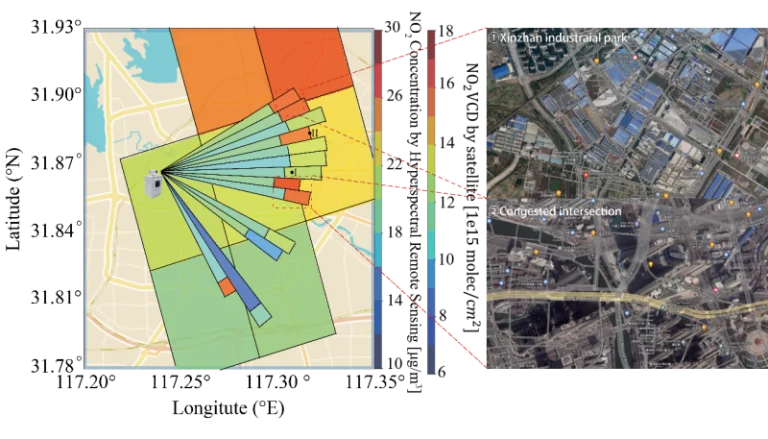
The Chinese Academy of Sciences has published a study in the Journal of Remote Sensing that introduces a hyperspectral remote sensing technique capable of hour-hectometer-level horizontal distribution of trace gases, offering an advanced tool to accurately identify emission sources.

This technique uses effective optical paths (EOPs) within the ultraviolet (UV) and visible (VIS) spectral bands to measure average trace gas concentrations across various distances. A novel aspect of the study is the application of the onion-peeling method, which refines the data to reveal concentrations at specific distances, offering heightened detail and accuracy.

The method represents a significant improvement over traditional satellite and in-situ monitoring techniques, which are often constrained by spatial and temporal resolution. In practical applications, this technique successfully pinpointed small, high-value emission areas in Hefei, China, demonstrating its potential for detailed environmental monitoring and urban planning. It also highlighted the limitations in the ability of satellite data to represent daily average concentrations, indicating the need for a reevaluation of current emission inventories. This research not only improves understanding of atmospheric pollutants and their distribution but also reportedly provides a powerful tool for more targeted pollution control strategies and environmental policymaking.

Chinese Academy of Sciences researcher Chuan Lu said, “This new method significantly outperforms existing ones in terms of spatial and temporal resolution, offering a detailed insight into the horizontal distribution of trace gases and enabling more accurate identification of high-value emission areas.”

This technique offers insights into urban pollution hot spots and helps identify high-value emission areas, which are crucial for urban planning and public health. It enhances the reliability of bottom-up emission calculations and informs strategies for pollution control and mitigation. The method’s capacity to provide higher resolution in emission source detection paves the way for more targeted and effective environmental policies and interventions. According to the researchers, its application has the potential to revolutionize the understanding of emission sources and make a significant contribution to global efforts in pollution control and environmental protection.

For more key remote sensing updates from the meteorological technology industry, click here.

Previous ArticleVaisala launches weather confidence platform for short-term forecast accuracy
Next Article WMO confirms that 2023 smashed global temperature record

Read Similar Stories

Climate Measurement

KBR secures US$350m US Geological Survey contract to support next-generation Earth observation

January 6, 20262 Mins Read
Climate Measurement

WMO Endorses next phase of Global Greenhouse Gas Watch

October 30, 20251 Min Read
Climate Measurement

Jauen International to distribute Vaisala weather solutions in South Korea

October 22, 20252 Mins Read
Latest News

Northumbria University secures £4m to study Earth’s radiation belts

April 16, 2026

AI model improves real-time prediction of wildfire spread

April 16, 2026

Study identifies atmospheric trigger behind flash droughts in Puerto Rico

April 15, 2026

Receive breaking stories and features in your inbox each week, for free


Enter your email address:


Supplier Spotlights
  • ZOGLAB Microsystem Co., Ltd
Getting in Touch
  • Contact Us / Advertise
  • Meet the Editors
  • Media Pack
  • Free Weekly E-Newsletter
Our Social Channels
  • Facebook
  • LinkedIn
© 2026 UKi Media & Events a division of UKIP Media & Events Ltd
  • Cookie Policy
  • Privacy Policy
  • Terms and Conditions
  • Notice and Takedown Policy

Type above and press Enter to search. Press Esc to cancel.