

Close Menu
Meteorological Technology International
  • News
    • A-E
      • Agriculture
      • Automated Weather Stations
      • Aviation
      • Climate Measurement
      • Data
      • Developing Countries
      • Digital Applications
      • Early Warning Systems
      • Extreme Weather
    • G-P
      • Hydrology
      • Lidar
      • Lightning Detection
      • New Appointments
      • Nowcasting
      • Numerical Weather Prediction
      • Polar Weather
    • R-S
      • Radar
      • Rainfall
      • Remote Sensing
      • Renewable Energy
      • Satellites
      • Solar
      • Space Weather
      • Supercomputers
    • T-Z
      • Training
      • Transport
      • Weather Instruments
      • Wind
      • World Meteorological Organization
      • Meteorological Technology World Expo
  • Features
  • Online Magazines
    • January 2026
    • April 2025
    • January 2025
    • September 2024
    • April 2024
    • Archive Issues
    • Subscribe Free!
  • Opinion
  • Videos
  • Supplier Spotlight
  • Expo
LinkedIn X (Twitter) Facebook
  • Sign-up for Free Weekly E-Newsletter
  • Meet the Editors
  • Contact Us
  • Media Pack
LinkedIn Facebook
Subscribe
Meteorological Technology International
  • News
      • Agriculture
      • Automated Weather Stations
      • Aviation
      • Climate Measurement
      • Data
      • Developing Countries
      • Digital Applications
      • Early Warning Systems
      • Extreme Weather
      • Hydrology
      • Lidar
      • Lightning Detection
      • New Appointments
      • Nowcasting
      • Numerical Weather Prediction
      • Polar Weather
      • Radar
      • Rainfall
      • Remote Sensing
      • Renewable Energy
      • Satellites
      • Solar
      • Space Weather
      • Supercomputers
      • Training
      • Transport
      • Weather Instruments
      • Wind
      • World Meteorological Organization
      • Meteorological Technology World Expo
  • Features
  • Online Magazines
    1. January 2026
    2. September 2025
    3. April 2025
    4. January 2025
    5. September 2024
    6. April 2024
    7. January 2024
    8. September 2023
    9. April 2023
    10. Archive Issues
    11. Subscribe Free!
    Featured
    November 27, 2025

    In this Issue – January 2026

    By Hazel KingNovember 27, 2025
    Recent

    In this Issue – January 2026

    November 27, 2025

    In this Issue – September 2025

    August 11, 2025

    In this Issue – April 2025

    April 15, 2025
  • Opinion
  • Videos
  • Supplier Spotlight
  • Expo
Facebook LinkedIn
Subscribe
Meteorological Technology International
Polar Weather

NASA visual shows what polar ice loss would look like in New York City

Paul WillisBy Paul WillisMarch 11, 20202 Mins Read
Share LinkedIn Facebook Twitter Email
Share
LinkedIn Facebook Twitter Email

It has long been known that Greenland and Antarctica have lost and are continuing to lose ice at a catastrophic rate.

But the ice losses are so big and the terms so unfamiliar that it can be hard to visualize what this looks like. In an effort to help translate the metrics NASA has created a series of animations.

According to the US space agency, satellite data shows that Greenland and Antarctica are losing mass at a rate of 283 gigatons and 145 gigatons per year, respectively.

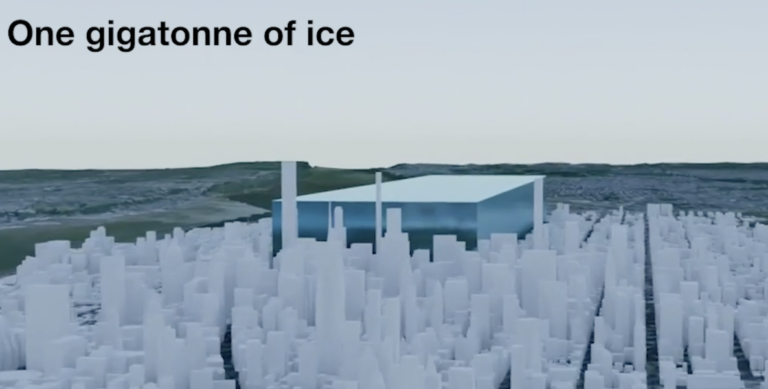
But most of us have little idea what a gigaton is, let alone what it looks like. It is one billion metric tons, or equivalent to 10,000 fully loaded US aircraft carriers, says the agency.

Another way to see visualize it is as a block of ice stretching the length and breadth of New York’s Central Park (which is 4km long and 0.8km wide) and rising up 341m.

Another of the animations visualizes ice loss at the two poles over a 15-year period as documented by NASA. According to the agency, between 2002 and 2017, 5,641 gigatons of ice of were lost in Greenland and Antarctica. This is enough to cover Texas in a sheet of ice 8m thick.

Meanwhile since the start of the 20th century an estimated 49,000 gigatons of ice have disappeared from both poles. This is enough ice to cover the entire the land mass of the US in an ice sheet 7m thick, or to coat the whole of the Moon in a 1.5m-thick ice sheet.

To see all the animations, click here.

Previous ArticleForecasters struggling to predict flash droughts, say researchers
Next Article ClimaCell weather app launched on Android

Read Similar Stories

Climate Measurement

Windracers ULTRA drones to be deployed in Greenland on glacier surveying mission

March 12, 20263 Mins Read
Climate Measurement

Unmanned Antarctica atmospheric observation experiment advances in China

February 10, 20262 Mins Read
Climate Measurement

Robotic Argo float sends back first ocean transect beneath East Antarctic ice shelf

December 11, 20252 Mins Read
Latest News

Northumbria University secures £4m to study Earth’s radiation belts

April 16, 2026

AI model improves real-time prediction of wildfire spread

April 16, 2026

Study identifies atmospheric trigger behind flash droughts in Puerto Rico

April 15, 2026

Receive breaking stories and features in your inbox each week, for free


Enter your email address:


Supplier Spotlights
  • Reuniwatt
Getting in Touch
  • Contact Us / Advertise
  • Meet the Editors
  • Media Pack
  • Free Weekly E-Newsletter
Our Social Channels
  • Facebook
  • LinkedIn
© 2026 UKi Media & Events a division of UKIP Media & Events Ltd
  • Cookie Policy
  • Privacy Policy
  • Terms and Conditions
  • Notice and Takedown Policy

Type above and press Enter to search. Press Esc to cancel.