


Close Menu
Meteorological Technology International
  • News
    • A-E
      • Agriculture
      • Automated Weather Stations
      • Aviation
      • Climate Measurement
      • Data
      • Developing Countries
      • Digital Applications
      • Early Warning Systems
      • Extreme Weather
    • G-P
      • Hydrology
      • Lidar
      • Lightning Detection
      • New Appointments
      • Nowcasting
      • Numerical Weather Prediction
      • Polar Weather
    • R-S
      • Radar
      • Rainfall
      • Remote Sensing
      • Renewable Energy
      • Satellites
      • Solar
      • Space Weather
      • Supercomputers
    • T-Z
      • Training
      • Transport
      • Weather Instruments
      • Wind
      • World Meteorological Organization
      • Meteorological Technology World Expo
  • Features
  • Online Magazines
    • January 2026
    • April 2025
    • January 2025
    • September 2024
    • April 2024
    • Archive Issues
    • Subscribe Free!
  • Opinion
  • Videos
  • Supplier Spotlight
  • Expo
LinkedIn X (Twitter) Facebook
  • Sign-up for Free Weekly E-Newsletter
  • Meet the Editors
  • Contact Us
  • Media Pack
LinkedIn Facebook
Subscribe
Meteorological Technology International
  • News
      • Agriculture
      • Automated Weather Stations
      • Aviation
      • Climate Measurement
      • Data
      • Developing Countries
      • Digital Applications
      • Early Warning Systems
      • Extreme Weather
      • Hydrology
      • Lidar
      • Lightning Detection
      • New Appointments
      • Nowcasting
      • Numerical Weather Prediction
      • Polar Weather
      • Radar
      • Rainfall
      • Remote Sensing
      • Renewable Energy
      • Satellites
      • Solar
      • Space Weather
      • Supercomputers
      • Training
      • Transport
      • Weather Instruments
      • Wind
      • World Meteorological Organization
      • Meteorological Technology World Expo
  • Features
  • Online Magazines
    1. January 2026
    2. September 2025
    3. April 2025
    4. January 2025
    5. September 2024
    6. April 2024
    7. January 2024
    8. September 2023
    9. April 2023
    10. Archive Issues
    11. Subscribe Free!
    Featured
    November 27, 2025

    In this Issue – January 2026

    By Hazel KingNovember 27, 2025
    Recent

    In this Issue – January 2026

    November 27, 2025

    In this Issue – September 2025

    August 11, 2025

    In this Issue – April 2025

    April 15, 2025
  • Opinion
  • Videos
  • Supplier Spotlight
  • Expo
Facebook LinkedIn
Subscribe
Meteorological Technology International
Data

Woods Hole Oceanographic Institution finds that Atlantic overturning has not yet declined

Elizabeth BakerBy Elizabeth BakerFebruary 4, 20254 Mins Read
Share LinkedIn Facebook Twitter Email
A team of scientists from Woods Hole Oceanographic Institution (WHOI) have reviewed air-sea heat fluxes and 24 different Coupled Model Intercomparison Project (CMIP) models to understand how the Atlantic Meridional Overturning Circulation (AMOC) has changed, and how its distribution of the ocean’s heat, moisture and nutrients will continue to regulate the Earth’s climate and weather in the future.
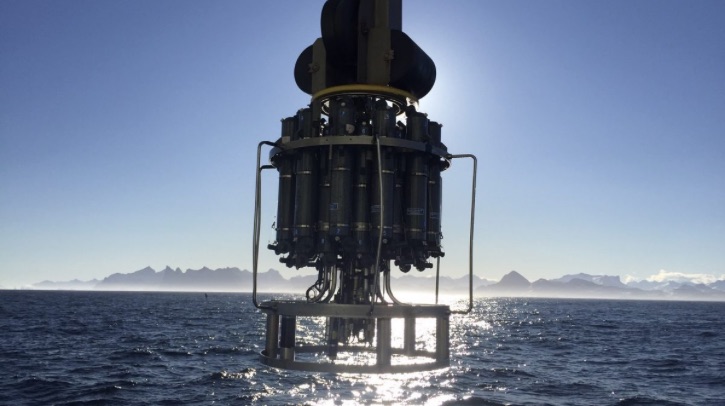
Previous AMOC studies relied on sea surface temperature data. A CTD rosette device measures the ocean’s conductivity, temperature, and depth by collecting water samples at varying depths, making models more accurate than ever. Credit: Woods Hole Oceanographic Institution)
Share
LinkedIn Facebook Twitter Email

A team of scientists from Woods Hole Oceanographic Institution (WHOI) have reviewed air-sea heat fluxes and 24 Coupled Model Intercomparison Project (CMIP) models to understand how the Atlantic Meridional Overturning Circulation (AMOC) has changed, and how its distribution of the ocean’s heat, moisture and nutrients will continue to regulate the Earth’s climate and weather in the future.

In a new paper, published in Nature Communications, scientists found that the AMOC has not declined in the last 60 years. Authors Nicholas P Foukal, adjunct scientist in Physical Oceanography at WHOI and assistant professor at the University of Georgia; Jens Terhaar, affiliated scientist at WHOI and senior scientist at the University of Bern; and Linus Vogt, a visiting student at WHOI when he started to work on this study and now a scientist at LOCEAN, Sorbonne Université, said that their results mean that the AMOC is currently more stable than expected.

“Our paper says that the Atlantic overturning has not declined yet,” said Foukal, who conducted the research while at WHOI. “That doesn’t say anything about its future, but it doesn’t appear the anticipated changes have occurred yet.”

Overturning old findings

These findings contrast with previous work, notably a paper from 2018 cited in this study, which reported that the AMOC has declined over the last 70 years. This past work relied on sea surface temperature measurements to understand how the AMOC has changed, but the team “learned that sea surface temperature doesn’t work as well as initially thought,” said Terhaar, who began leading this study at WHOI as a postdoctoral scientist and completed the work in Bern.

To address the uncertainty, Terhaar and the team relied on new data from the CMIP, and climate-earth models produced by the World Climate Research Program. They used 24 CMIP models and found that the most recently available surface temperature data did not accurately reconstruct the AMOC. To go a step further, the researchers looked at a different measure: air-sea heat fluxes, which is the exchange of heat from the ocean to the atmosphere. When the AMOC is stronger, more heat is released from the ocean to the atmosphere over the North Atlantic.

The authors derived this AMOC proxy with the CMIP models, then applied it to observational data. The study authors focused on two reanalysis datasets that extend back to the late 1950s to reconstruct the AMOC.
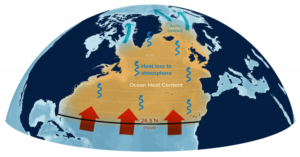
To reconstruct the AMOC, researchers looked at air-sea heat fluxes, which is the exchange of heat from the ocean to the atmosphere. When the AMOC is stronger, more heat is released from the ocean to the atmosphere over the North Atlantic. Credit: Woods Hole Oceanographic Institution Creative

Surprisingly stable results

“Based on the results, the AMOC is more stable than we thought,” Vogt said. “This might mean that the AMOC isn’t as close to a tipping point as previously suggested.”

The paper states that air-sea heat flux anomalies in the North Atlantic are tightly linked to the AMOC and that “the decadal averaged AMOC has not weakened from 1963 to 2017”. Since there are many processes that lead to large year-to-year variability in the AMOC, the air-sea heat flux and the AMOC are correlated most strongly at those timescales, as opposed to annual averages.

“It’s almost unanimous at this point that the Atlantic overturning will slow in the future, but whether or not it will collapse is still up for debate,” Foukal said. “This work indicates that there is still time to act before we reach this potential tipping point.”

As with all proxy-based reconstructions, there are limitations and caveats. The authors point out that direct measurements of air-sea heat flux going back in time are sparse, and thus the reanalysis products contain significant uncertainty. However, Terhaair said that despite these limitations, “a decline in AMOC over the last 60 years seems very unlikely”.

In related news, NOAA’s National Ocean Service (NOS) recently released the first modeled, historical water level and wave dataset for the Atlantic, Caribbean and Gulf coasts. This new comprehensive dataset – known as Coastal Ocean Reanalysis (CORA) – is expected to help improve flood mitigation tools and flood-risk assessment. Click here to read the full story.

Previous ArticleNSF–DOE Vera C. Rubin Observatory to detect millions of exploding stars
Next Article UCL, NOC and ENS to deploy machine learning and lidar to study breaking waves

Read Similar Stories

Satellites

AI tool uses weather satellite data to map ocean currents in near real time

April 14, 20263 Mins Read
Climate Measurement

New tool speeds up climate model evaluation

April 13, 20262 Mins Read
Climate Measurement

China inaugurates 27th national climate observatory in Hebei

April 9, 20262 Mins Read
Latest News

Northumbria University secures £4m to study Earth’s radiation belts

April 16, 2026

AI model improves real-time prediction of wildfire spread

April 16, 2026

Study identifies atmospheric trigger behind flash droughts in Puerto Rico

April 15, 2026

Receive breaking stories and features in your inbox each week, for free


Enter your email address:


Supplier Spotlights
  • Nel Hydrogen
Getting in Touch
  • Contact Us / Advertise
  • Meet the Editors
  • Media Pack
  • Free Weekly E-Newsletter
Our Social Channels
  • Facebook
  • LinkedIn
© 2026 UKi Media & Events a division of UKIP Media & Events Ltd
  • Cookie Policy
  • Privacy Policy
  • Terms and Conditions
  • Notice and Takedown Policy

Type above and press Enter to search. Press Esc to cancel.