


Close Menu
Meteorological Technology International
  • News
    • A-E
      • Agriculture
      • Automated Weather Stations
      • Aviation
      • Climate Measurement
      • Data
      • Developing Countries
      • Digital Applications
      • Early Warning Systems
      • Extreme Weather
    • G-P
      • Hydrology
      • Lidar
      • Lightning Detection
      • New Appointments
      • Nowcasting
      • Numerical Weather Prediction
      • Polar Weather
    • R-S
      • Radar
      • Rainfall
      • Remote Sensing
      • Renewable Energy
      • Satellites
      • Solar
      • Space Weather
      • Supercomputers
    • T-Z
      • Training
      • Transport
      • Weather Instruments
      • Wind
      • World Meteorological Organization
      • Meteorological Technology World Expo
  • Features
  • Online Magazines
    • January 2026
    • April 2025
    • January 2025
    • September 2024
    • April 2024
    • Archive Issues
    • Subscribe Free!
  • Opinion
  • Videos
  • Supplier Spotlight
  • Expo
LinkedIn X (Twitter) Facebook
  • Sign-up for Free Weekly E-Newsletter
  • Meet the Editors
  • Contact Us
  • Media Pack
LinkedIn Facebook
Subscribe
Meteorological Technology International
  • News
      • Agriculture
      • Automated Weather Stations
      • Aviation
      • Climate Measurement
      • Data
      • Developing Countries
      • Digital Applications
      • Early Warning Systems
      • Extreme Weather
      • Hydrology
      • Lidar
      • Lightning Detection
      • New Appointments
      • Nowcasting
      • Numerical Weather Prediction
      • Polar Weather
      • Radar
      • Rainfall
      • Remote Sensing
      • Renewable Energy
      • Satellites
      • Solar
      • Space Weather
      • Supercomputers
      • Training
      • Transport
      • Weather Instruments
      • Wind
      • World Meteorological Organization
      • Meteorological Technology World Expo
  • Features
  • Online Magazines
    1. January 2026
    2. September 2025
    3. April 2025
    4. January 2025
    5. September 2024
    6. April 2024
    7. January 2024
    8. September 2023
    9. April 2023
    10. Archive Issues
    11. Subscribe Free!
    Featured
    November 27, 2025

    In this Issue – January 2026

    By Hazel KingNovember 27, 2025
    Recent

    In this Issue – January 2026

    November 27, 2025

    In this Issue – September 2025

    August 11, 2025

    In this Issue – April 2025

    April 15, 2025
  • Opinion
  • Videos
  • Supplier Spotlight
  • Expo
Facebook LinkedIn
Subscribe
Meteorological Technology International
Climate Measurement

AI-powered wind speed model improves ocean weather forecasting

Elizabeth BakerBy Elizabeth BakerJuly 1, 20253 Mins Read
Share LinkedIn Facebook Twitter Email
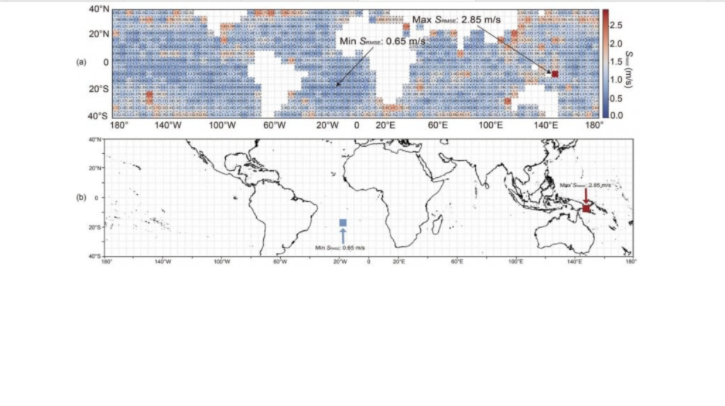
Two maps of the world are overlaid with squares, and the top one is colour coded to depict the wind's root mean square error.
Spatial performance of the CNN-SENet model. The subfigure a depicts RMSE of grid cells in the research area and subfigure b depicts land distribution within the research area. Credit: Satellite Navigation
Share
LinkedIn Facebook Twitter Email

Researchers from Nanjing Tech University and the Chinese Academy of Sciences have introduced a model called CNN-SENet, designed to deliver more accurate and computationally efficient wind speed retrievals across global oceans. The study has been published in Satellite Navigation.

Developing CNN-SENet

Trained on more than one million data points from NASA’s CYGNSS satellite and ERA5 reanalysis datasets, the CNN-SENet model blends convolutional neural networks (CNNs) with the squeeze-and-excitation network (SENet) attention mechanism to enhance feature extraction from GNSS-R Delay Doppler Maps.

CNN-SENet elevates traditional CNN architecture by embedding SENet modules between convolutional layers. These attention modules dynamically emphasize the most informative parts of the input, enabling the model to learn more effectively while cutting training iterations. The model was tested across a broad dataset compiled from CYGNSS satellite observations and ERA5 reanalysis wind speeds, spanning wind conditions from calm seas to 40m/s gales.

Research results

CNN-SENet achieved a root mean square error (RMSE) of 1.29 m/s and an R² of 62.4%, outperforming the standard CNN (RMSE: 1.43 m/s) and the widely used geophysical model function (GMF) method (RMSE: 1.91 m/s). Even under high wind conditions, where retrieval is most difficult, CNN-SENet maintained superior performance, with an RMSE of just 3.01 m/s – substantially lower than its counterparts.

The model also showed faster training efficiency, completing its learning in half the time of standard CNNs across various hardware configurations. Spatially, it performed best over open ocean regions, with 82% of analyzed areas achieving RMSE below 1.5m/s. Temporal tests across different months confirmed the model’s consistency, indicating robust generalization over time. Together, these results highlight CNN-SENet as a promising tool for global, high-resolution ocean wind monitoring.

Real-world applications

“Our aim was to create a smarter, faster model that can adapt to real-world variability in ocean environments,” said Dr Dongliang Guan, co-author of the study.

“By integrating SENet into the CNN framework, we’ve empowered the system to focus on what matters most – improving both efficiency and accuracy. This is especially critical for monitoring extreme weather systems like typhoons, where every minute counts.”

The researchers believe this advancement will contribute significantly to building more agile, data-driven marine forecasting networks.

The team also states that the practical implications of CNN-SENet extend far beyond academic performance. The researchers assert that its lightweight design and computational efficiency make it ideal for deployment on microsatellite constellations, offering the potential for near real-time global wind field monitoring.

In related news, the UK’s National Oceanography Centre (NOC) recently delivered a roadmap to guide how scientists observe the ocean to increase their understanding of the potential impacts of expanding offshore wind developments on the marine environment. Read the full story here

Previous ArticleVIDEO: Meteosat Third Generation Sounder satellite launches into geostationary orbit
Next Article Air quality monitoring market to reach US$9.5bn by 2033

Read Similar Stories

Climate Measurement

Study identifies atmospheric trigger behind flash droughts in Puerto Rico

April 15, 20263 Mins Read
Satellites

AI tool uses weather satellite data to map ocean currents in near real time

April 14, 20263 Mins Read
Climate Measurement

New tool speeds up climate model evaluation

April 13, 20262 Mins Read
Latest News

Northumbria University secures £4m to study Earth’s radiation belts

April 16, 2026

AI model improves real-time prediction of wildfire spread

April 16, 2026

Study identifies atmospheric trigger behind flash droughts in Puerto Rico

April 15, 2026

Receive breaking stories and features in your inbox each week, for free


Enter your email address:


Supplier Spotlights
  • Reuniwatt
Getting in Touch
  • Contact Us / Advertise
  • Meet the Editors
  • Media Pack
  • Free Weekly E-Newsletter
Our Social Channels
  • Facebook
  • LinkedIn
© 2026 UKi Media & Events a division of UKIP Media & Events Ltd
  • Cookie Policy
  • Privacy Policy
  • Terms and Conditions
  • Notice and Takedown Policy

Type above and press Enter to search. Press Esc to cancel.