

Close Menu
Meteorological Technology International
  • News
    • A-E
      • Agriculture
      • Automated Weather Stations
      • Aviation
      • Climate Measurement
      • Data
      • Developing Countries
      • Digital Applications
      • Early Warning Systems
      • Extreme Weather
    • G-P
      • Hydrology
      • Lidar
      • Lightning Detection
      • New Appointments
      • Nowcasting
      • Numerical Weather Prediction
      • Polar Weather
    • R-S
      • Radar
      • Rainfall
      • Remote Sensing
      • Renewable Energy
      • Satellites
      • Solar
      • Space Weather
      • Supercomputers
    • T-Z
      • Training
      • Transport
      • Weather Instruments
      • Wind
      • World Meteorological Organization
      • Meteorological Technology World Expo
  • Features
  • Online Magazines
    • January 2026
    • April 2025
    • January 2025
    • September 2024
    • April 2024
    • Archive Issues
    • Subscribe Free!
  • Opinion
  • Videos
  • Supplier Spotlight
  • Expo
LinkedIn X (Twitter) Facebook
  • Sign-up for Free Weekly E-Newsletter
  • Meet the Editors
  • Contact Us
  • Media Pack
LinkedIn Facebook
Subscribe
Meteorological Technology International
  • News
      • Agriculture
      • Automated Weather Stations
      • Aviation
      • Climate Measurement
      • Data
      • Developing Countries
      • Digital Applications
      • Early Warning Systems
      • Extreme Weather
      • Hydrology
      • Lidar
      • Lightning Detection
      • New Appointments
      • Nowcasting
      • Numerical Weather Prediction
      • Polar Weather
      • Radar
      • Rainfall
      • Remote Sensing
      • Renewable Energy
      • Satellites
      • Solar
      • Space Weather
      • Supercomputers
      • Training
      • Transport
      • Weather Instruments
      • Wind
      • World Meteorological Organization
      • Meteorological Technology World Expo
  • Features
  • Online Magazines
    1. January 2026
    2. September 2025
    3. April 2025
    4. January 2025
    5. September 2024
    6. April 2024
    7. January 2024
    8. September 2023
    9. April 2023
    10. Archive Issues
    11. Subscribe Free!
    Featured
    November 27, 2025

    In this Issue – January 2026

    By Hazel KingNovember 27, 2025
    Recent

    In this Issue – January 2026

    November 27, 2025

    In this Issue – September 2025

    August 11, 2025

    In this Issue – April 2025

    April 15, 2025
  • Opinion
  • Videos
  • Supplier Spotlight
  • Expo
Facebook LinkedIn
Subscribe
Meteorological Technology International
Extreme Weather

Natural disasters costing US$1bn each, says NOAA

Paul WillisBy Paul WillisOctober 15, 20192 Mins Read
Share LinkedIn Facebook Twitter Email
Climate disasters
Share
LinkedIn Facebook Twitter Email

Extreme weather has resulted in at least US$10bn-worth of damage to the US in 2019 so far, according to US government statistics. The economic toll of natural disasters in the country was laid out in a report published by NOAA.

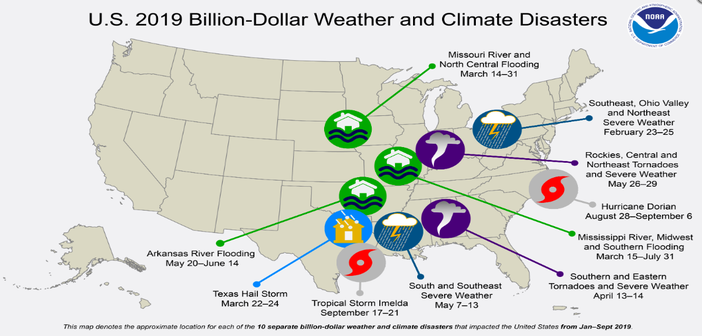
According to the report “there have been 10 weather and climate disaster events with losses exceeding US$1bn each across the United States” since the start of the year.

These events included three major floods, five severe storm events and two tropical cyclones – Hurricane Dorian and Tropical Storm Imelda. As well as their economic impact, these natural disasters accounted for the deaths of 39 people, according to NOAA.

Although the impact of Dorian was most destructive in the Bahamas, storm surge damage on the South Carolina coast resulting from the hurricane, coupled with damage caused by high winds, pushed the cost of the weather event to over the US$1bn mark.

Most of the economic losses resulting from Imelda, which struck Texas in late September, were due to flooding.

Three other major flooding events also made the list. Respectively, they were a record-breaking deluge that struck the Missouri Valley in March, and flooding along the Mississippi and Arkansas rivers from Spring through Summer.

The NOAA report also noted that record rainfall in 2019 had resulted in the wettest January through September period ever recorded in the US.

The report said that since 1980 the US has suffered 254 weather and climate disasters where the economic losses reached in excess of US$1bn.

Out of those 254 events, 65 have occurred in the past five years, meaning that the rate of such disasters has more than doubled per year in this time span. The increase cannot be explained by inflation because the economic losses were adjusted to take account of inflation, according to NOAA.

The NOAA also reported that unusually high temperatures in September made it the joint second highest September ever recorded in the country.

Previous ArticleAntarctic warm front reveals influence of stratosphere in shaping weather
Next Article Oceans absorbing CO2 at much higher rates than previously thought

Read Similar Stories

Extreme Weather

AI model improves real-time prediction of wildfire spread

April 16, 20263 Mins Read
Climate Measurement

Study identifies atmospheric trigger behind flash droughts in Puerto Rico

April 15, 20263 Mins Read
Climate Measurement

Regional training aims to improve flood forecasting in Central Africa

April 1, 20263 Mins Read
Latest News

Northumbria University secures £4m to study Earth’s radiation belts

April 16, 2026

AI model improves real-time prediction of wildfire spread

April 16, 2026

Study identifies atmospheric trigger behind flash droughts in Puerto Rico

April 15, 2026

Receive breaking stories and features in your inbox each week, for free


Enter your email address:


Supplier Spotlights
  • Adolf Thies GmbH & Co. KG
Getting in Touch
  • Contact Us / Advertise
  • Meet the Editors
  • Media Pack
  • Free Weekly E-Newsletter
Our Social Channels
  • Facebook
  • LinkedIn
© 2026 UKi Media & Events a division of UKIP Media & Events Ltd
  • Cookie Policy
  • Privacy Policy
  • Terms and Conditions
  • Notice and Takedown Policy

Type above and press Enter to search. Press Esc to cancel.