


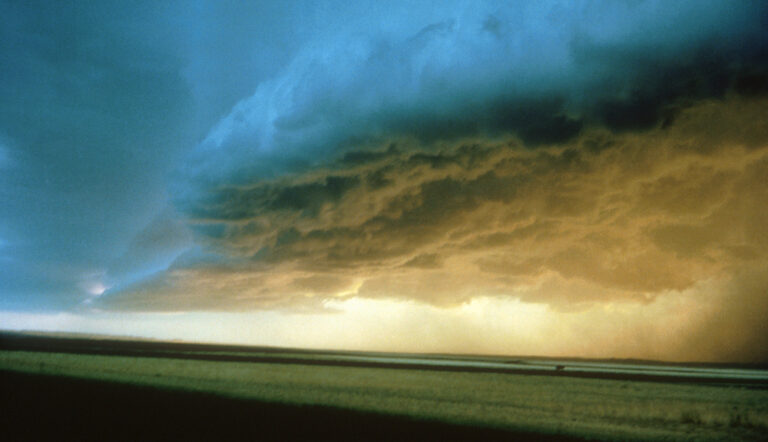
According to research by the US National Science Foundation (NSF) National Center for Atmospheric Research (NCAR), destructive winds that flow out of thunderstorms in the central USA are becoming more widespread with warming temperatures.
The study, published in Nature Climate Change, shows that the central USA experienced a fivefold increase in the geographic area affected by damaging thunderstorm straight-line winds in the past 40 years. The research uses a combination of meteorological observations, high-resolution computer modeling, and analyses of fundamental physical laws to estimate the changes in the winds, which are so short-lived and localized that they often are not picked up by weather stations. The work was funded by NSF, which is NCAR’s sponsor, and by the MIT Climate Grand Challenge on Weather and Climate Extremes.
“Thunderstorms are causing more and more of these extreme wind events,” said NCAR scientist Andreas Prein, the author of the study. “These gusts that suddenly go from no wind at all to gusts of 60 to 80mph can have very damaging impacts on buildings, power grids and even human safety.”
Capturing small-scale events
Straight-line winds are caused by powerful downdrafts that flow from the base of thunderstorms. The National Weather Service (NWS) classifies such winds as damaging if they exceed 50kts, or about 57mph. The winds likely cause about US$2.5bn in damage annually in the USA, based on insurance industry estimates. In 2020, a particularly powerful derecho – a widespread, straight-line windstorm associated with fast-moving thunderstorms – caused an estimated US$11bn in damage in the Midwest.
Scientists have long been interested in the impact of climate change on straight-line winds. Until now, however, simulations of climate conditions run on computer models have been too coarse to capture such brief and small-scale events. Further clouding the picture, weather observations appear to show that there are more periods of little to no wind worldwide (a phenomenon known as global stilling), even though, paradoxically, maximum wind speeds can rise simultaneously.
To determine if damaging straight-line winds are becoming more widespread, Prein turned to a high-resolution, computer model simulation that NCAR scientists recently produced in collaboration with the US Geological Survey. The advanced simulation is named CONUS404 because it simulates climate and hydrological conditions at a resolution of 4km (2.5 miles) across the continental USA, or CONUS, over the past 40-plus years.
Prein focused on summertime conditions in the central USA, a global hotspot for straight-line winds. The high-resolution modeling enabled him to get a much more fine-grained picture of winds than relying on sparse atmospheric observations, and to expand his analysis from 95 weather stations to 109,387 points in the simulation. The simulation showed that the area affected by straight-line winds has increased in the last 40 years by about 4.8 times.
Prein verified the accuracy of the simulation by comparing it with measurements of selected winds in the past, such as the 2020 derecho. His analysis showed that the CONUS404 simulations were reliably capturing straight-line winds, as opposed to previous, coarser simulations that failed to capture many such events.
This left the question of whether climate change could be responsible for the increase in winds. Prein approached this question by analyzing the thermodynamics of straight-line winds and how actual wind events such as the 2020 derecho would have been affected by different atmospheric conditions based on first-order physical principles.
Straight-line winds result when rain and hail at high altitudes evaporate and cool the ambient air, which then plummets and, at the surface, spawns intense winds that rush outward. In studying this process, Prein’s calculations showed that climate change is likely altering the picture by increasing the temperature difference between the cool air in downdrafts and the warm surrounding air. This larger temperature difference lets the cold air descend even faster, making it more likely for a thunderstorm to generate damaging winds.
“As these findings show, it is crucial to incorporate the increasing risk of straight-line winds when planning for the impacts of climate change so we can ensure the future resiliency of infrastructure to this frequently neglected peril,” Prein said.
Read more of the latest wind updates from the meteorological technology industry, here.